
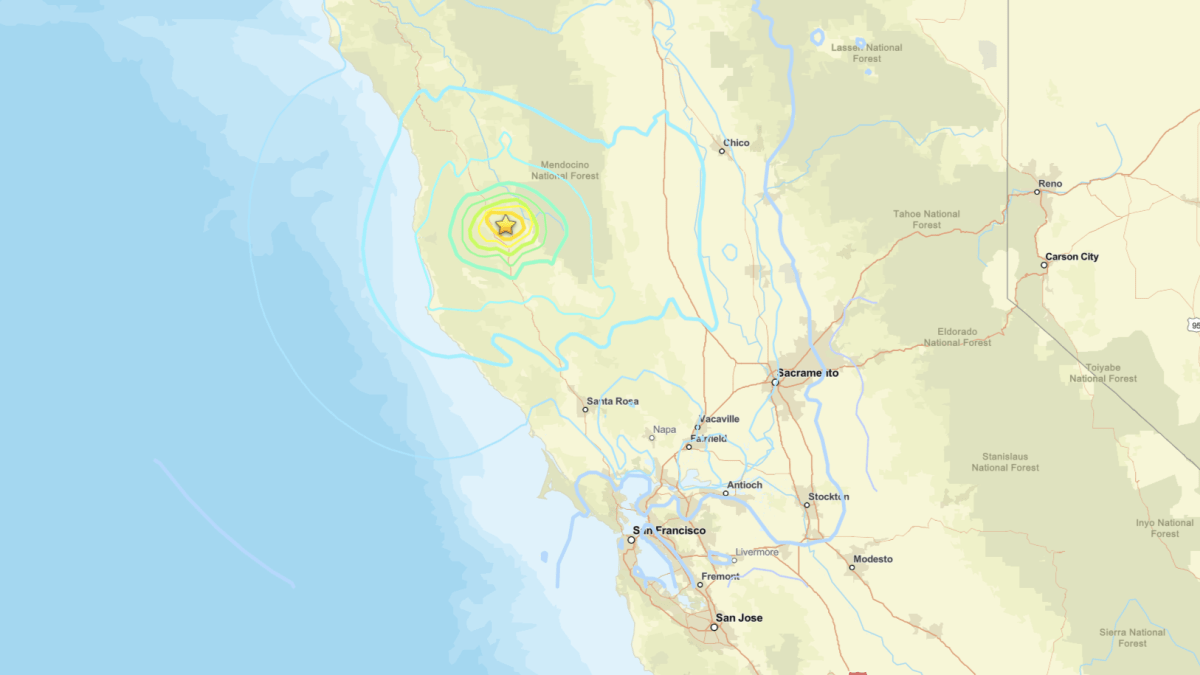
A magnitude-5.6 earthquake was reported Wednesday morning in Northern California’s Mendocino County.
The 8:10 a.m. earthquake was followed by six aftershocks of magnitude-2.5 or greater.
The quakes were centered north of the community of Redwood Valley, about 120 miles north of San Francisco. Shaking was reported in Mendocino, Rohnert Park, Sacramento and other areas.
In a statement, officials with Mendocino County said some injuries were reported, but details about the severity of the injuries were not provided.
There were no reports of major damage.
Power outages affected about 6,000 residents in the communities of Willits, Laytonville, Leggett, Round Valley/Covelo.
Drivers were advised to stay off major roads as Caltrans, PG&E and county worker finish inspections.
There were some injuries and power outages from the quake. Kathy Vara reports for the NBC4 News at 3 p.m. on Wednesday, June 24, 2026.
Brie Leon, who works at Club Calpella Restaurant in Ukiah, told the Associated Press that she was just starting a shift when the building started shaking, rattling plates and bottles. The quake knocked frames off walls and bottles off shelves, she said.
“I had just turned the open sign on and went back into the kitchen, and that’s when it happened,” she said. “It almost felt like something hit the building.”
The governor’s office said nearly 657,000 earthquake early warning alerts were sent by the MyShake App.
Have you ever wondered how our phones can alert us that an earthquake is here seconds before we start feeling the shaking? The U.S. Geological Survey has complex infrastructure dedicated to this warning system.
Did you feel it?
Whether you feel shaking from an earthquake largely depends on three major factors — magnitude, distance and local soil conditions. Magnitude refers to the strength of the quake. The closer your location to the epicenter, the more likely you’ll feel the effects of seismic waves that become less intense as they move out from the fault. Generally, the looser the soil under your location, the greater the amplification.
Aftershocks
Some earthquakes are followed by a larger earthquake, in which case the first quake would then be called a foreshock. For example, the magnitude-9.1 Japan earthquake and tsunami in 2011 was preceded by a magnitude-7.3 foreshock two days earlier.
Aftershocks decrease over time, but can continue for days, weeks, months and years.
Photos: What to Keep in Your Disaster Emergency Kit