
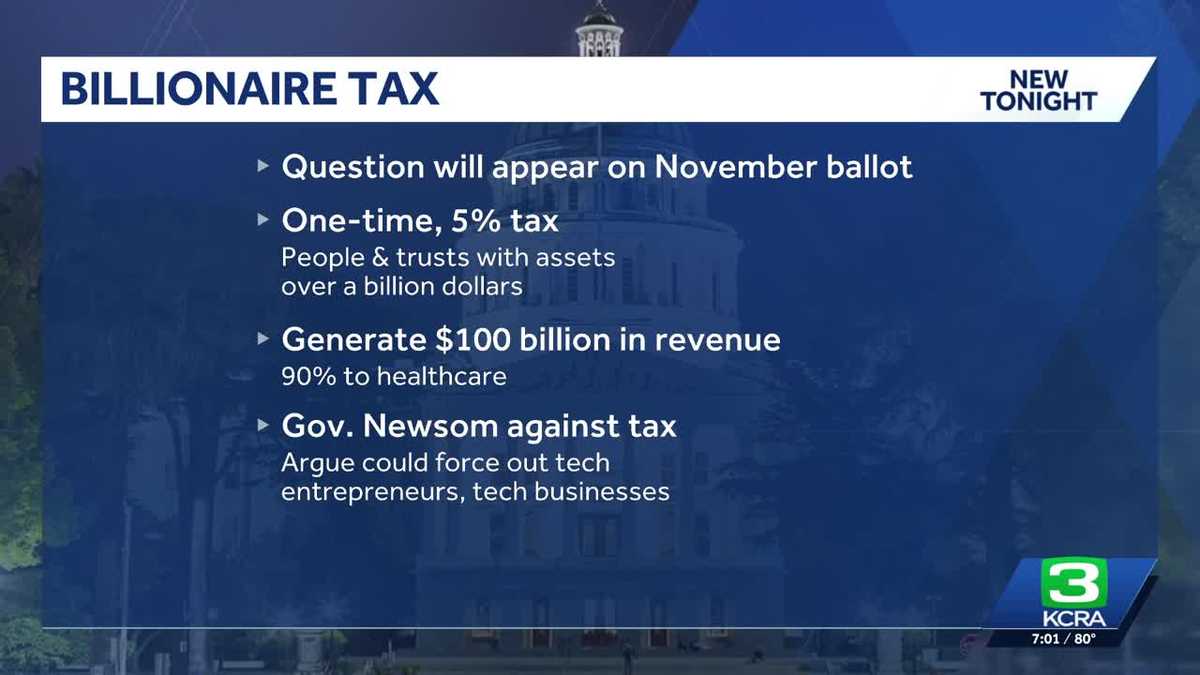
ARGUES HE ACTED IN SELF-DEFENSE. WE START TONIGHT WITH A QUESTION CALIFORNIA VOTERS WILL NOW DECIDE IN NOVEMBER. SHOULD THE STATE IMPOSE A TAX ON BILLIONAIRES. IT’S BEING CALLED THE BILLIONAIRE TAX AND IT WILL BE ON THE BALLOT. IT’S SET TO BE ONE OF THE STATE’S MOST CONTENTIOUS INITIATIVES. SECRETARY OF STATE SHIRLEY WEBER SAYS THE MEASURE HAS ENOUGH SIGNATURES NOW TO MAKE IT ON THE NOVEMBER NOVEMBER BALLOT. IT WOULD IMPOSE A ONE TIME 5% TAX ON PEOPLE AND TRUSTS, WITH ASSETS OF MORE THAN $1 BILLION. BACKERS SAY THE MEASURE WOULD GENERATE $100 BILLION IN REVENUE. 90% OF THAT MONEY WOULD GO TOWARD HEALTH CARE. BUT GOVERNOR GAVIN NEWSOM AND OTHER CRITICS ARE AGAINST IT. THEY ARGUE THIS COULD FORCE OUT TECH ENTREPRENEURS, THEIR BUSINESSES A
California billionaire’s tax measure officially on November ballot

Updated: 7:32 PM PDT Jun 25, 2026
A billionaire tax measure is officially on the ballot for the 2026 General Election in NovemberIf approved, the tax would impose a one-time 5% charge on taxpayers and trusts with covered assets valued over $1 billion, including businesses, securities, art, collectibles and intellectual property, while excluding real property and certain pensions and retirement accounts, according to the California Secretary of State.,The measure would allocate 90% of the tax revenues to healthcare and 10% for food assistance or education-related programs. It would prohibit using revenues to replace existing funding for such purposes and exempt them from constitutional requirements for school funding, budget reserves and state spending limits. Secretary of State Shirley Weber said the measure gathered enough signatures to qualify for the ballot. Thursday was the deadline for measures to be certify for the ballot in November.KCRA 3 Political Director Ashley Zavala reported that state leaders had about a week to try to negotiate a deal to keep the measure off the ballot. A summary by the legislative analyst and director of finance said that the initiative would result in a temporary increase in state revenues from a new tax on billionaires. A potential tax could add up to tens of billions of dollars spread over several years. The summary also notes a likely decrease in state income tax revenues of hundreds of millions of dollars or more per year. The billionaire tax is opposed by the California Business Roundtable, Gov. Gavin Newsom, both of California’s governor candidates, Xavier Becerra and Steve Hilton, and Silicon Valley tech leaders. It’s backed by healthcare workers with the SEIU-UHW and Vermont Sen. Bernie Sanders. A Public Policy Institute of California poll in May found that a majority of respondents would support the initiative. The proponents of the billionaire tax previously said they’d be okay to lower the 5% one-time tax to 2% if Newsom agrees to put it into state law. If Newsom would agree, the initiative would come off the ballot. “All of the serious issues voters care about – healthcare, school funding, the cost of living – would get worse by this so-called “wealth tax”. Trading away the state’s sustainable tax base for a one-time cash grab doesn’t just target 200 people – it would harm 40 million Californians who would be left holding the bag,” “Stop the Squeeze” spokesman Dan Newsom said in a statement. “It makes no sense to do this on one state out of fifty, which is why the opposition spans such a broad and unlikely coalition of healthcare professionals, teachers, small businesses, and community groups, and why Californians will reject it in November.” See more coverage of top California stories here | Download our app | Subscribe to our morning newsletter | Find us on YouTube here and subscribe to our channel
A billionaire tax measure is officially on the ballot for the 2026 General Election in November
If approved, the tax would impose a one-time 5% charge on taxpayers and trusts with covered assets valued over $1 billion, including businesses, securities, art, collectibles and intellectual property, while excluding real property and certain pensions and retirement accounts, according to the California Secretary of State.,
The measure would allocate 90% of the tax revenues to healthcare and 10% for food assistance or education-related programs. It would prohibit using revenues to replace existing funding for such purposes and exempt them from constitutional requirements for school funding, budget reserves and state spending limits.
Secretary of State Shirley Weber said the measure gathered enough signatures to qualify for the ballot. Thursday was the deadline for measures to be certify for the ballot in November.
KCRA 3 Political Director Ashley Zavala reported that state leaders had about a week to try to negotiate a deal to keep the measure off the ballot.
A summary by the legislative analyst and director of finance said that the initiative would result in a temporary increase in state revenues from a new tax on billionaires. A potential tax could add up to tens of billions of dollars spread over several years.
The summary also notes a likely decrease in state income tax revenues of hundreds of millions of dollars or more per year.
The billionaire tax is opposed by the California Business Roundtable, Gov. Gavin Newsom, both of California’s governor candidates, Xavier Becerra and Steve Hilton, and Silicon Valley tech leaders.
It’s backed by healthcare workers with the SEIU-UHW and Vermont Sen. Bernie Sanders.
A Public Policy Institute of California poll in May found that a majority of respondents would support the initiative.
The proponents of the billionaire tax previously said they’d be okay to lower the 5% one-time tax to 2% if Newsom agrees to put it into state law. If Newsom would agree, the initiative would come off the ballot.
“All of the serious issues voters care about – healthcare, school funding, the cost of living – would get worse by this so-called “wealth tax”. Trading away the state’s sustainable tax base for a one-time cash grab doesn’t just target 200 people – it would harm 40 million Californians who would be left holding the bag,” “Stop the Squeeze” spokesman Dan Newsom said in a statement. “It makes no sense to do this on one state out of fifty, which is why the opposition spans such a broad and unlikely coalition of healthcare professionals, teachers, small businesses, and community groups, and why Californians will reject it in November.”
See more coverage of top California stories here | Download our app | Subscribe to our morning newsletter | Find us on YouTube here and subscribe to our channel