
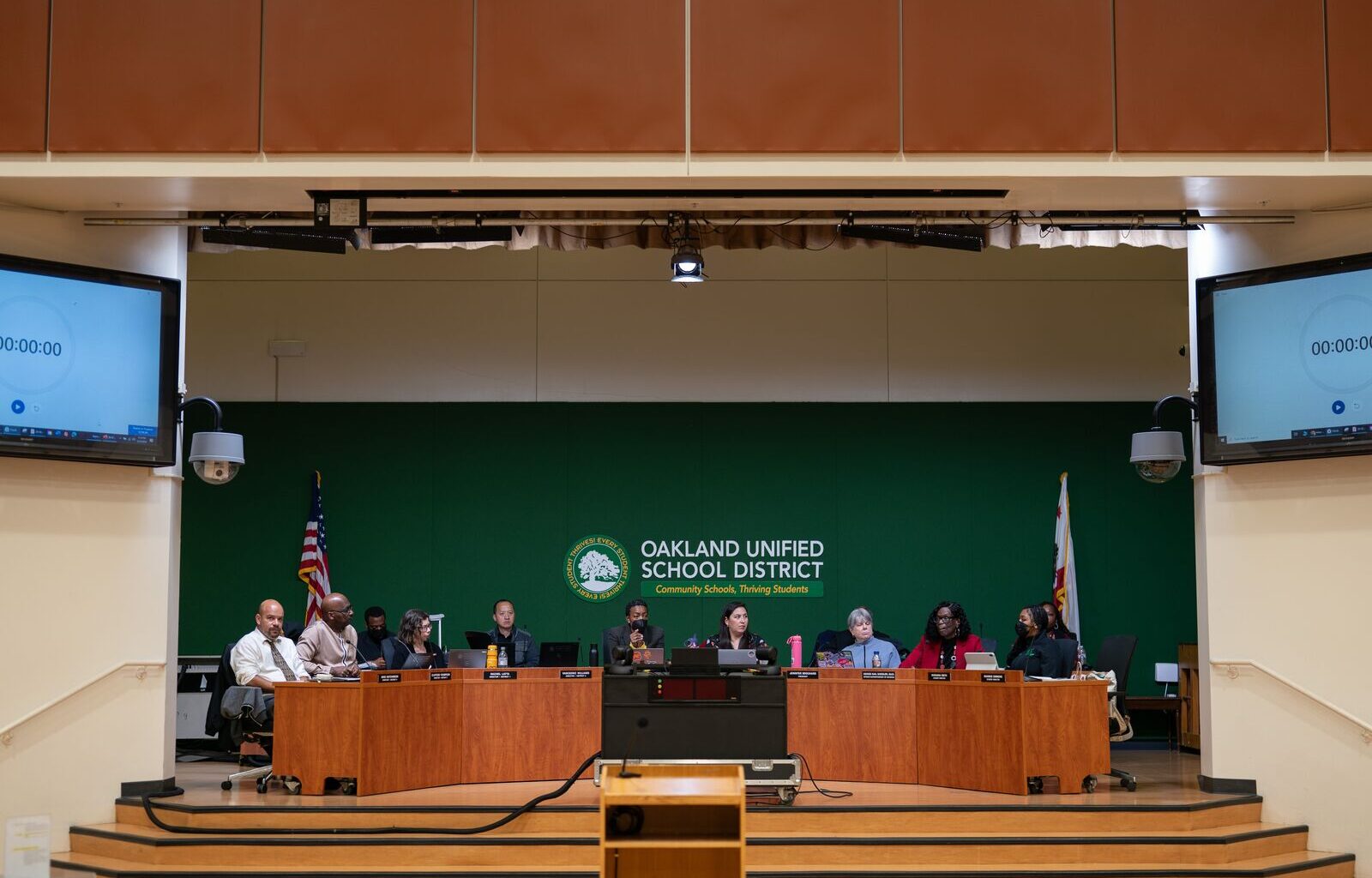
The Oakland school board tenuously approved its budget for next school year, with a vague intent to slash an extra $30 million in the fall, following months of austerity measures designed to plug a structural deficit.
The Oakland Unified School District board held its final meeting before the summer recess on Wednesday, bringing to a close a year that saw repeated split votes by the fractured board, turnover among OUSD’s most senior staff, a suspended search for a permanent superintendent, and a narrowly averted teacher strike, all while the district was struggling to close a $100 million deficit for the coming year.
That tension was on display Wednesday evening, when district staff presented a budget containing seemingly incompatible forecasts of a deficit, a surplus, and a balanced budget for the coming school year. Their projections forecast a $22 million deficit for the next school year, but it also effectively included plans for the board to identify $30 million more in reductions when it reconvenes in the fall. Once those cuts were made, district staff said, the district would have $8 million left over, which was variously described as both a “surplus” and an “increase.”
“There are some challenges to the budget, and thus the need for those $30 million and other measures to continue to address the structural deficit,” said Ruben Frutos, a fiscal advisor the district pays from the firm Hazard, Young, Attea and Associates. “This $8 million that has been discussed ad nauseum is not a surplus, it’s an increase. It’s an increase of our revenue based solely on the fact that there are $30 million in reductions” — cuts that have yet to be identified.
“We can’t have a surplus and a balanced budget at the same time as we have a deficit,” Director Mike Hutchinson, who represents District 4, said. “If we have a deficit, it’s not a balanced budget.”
The board is expected to vote on the specifics of those $30 million in cuts in the fall. Frutos described the budget as conservative, saying it does not account for potential additional revenue from the state budget. OUSD used a lower cost-of-living adjustment in projecting per-pupil state revenue than what the state legislature could end up adopting, and the district could receive roughly $12 million more in special education funding as a result of Gov. Gavin Newsom’s revised budget proposal that increased special education allocations. Newsom has until July 1 to sign the state budget. That means by the time the board reconvenes in the fall, that estimated $30 million deficit may have shrunk.
Hutchinson cast a vote against the budget. Directors Rachel Latta, Jennifer Brouhard, VanCedric Williams, and Valarie Bachelor all voted to approve it. Director Patrice Berry, who represents District 5, was briefly absent and missed the vote, and Director Clifford Thompson, who represents District 7, was absent for the entire meeting.
“I have serious concern for all the reasons named about the $30 million,” Berry said. “But I have confidence, given all of my conversations with staff and others and people across the state, that that $30 million is manageable. What I think is a more serious concern is how we manage the deficit and contain it so it doesn’t grow year after year.”
A new teacher contract could ‘endanger’ fiscal stability
The 2026-2027 budget incorporates about $32 million in additional costs from a recent agreement with the Oakland Education Association, the teachers union — a number that will rise to $60 million for 2027-2028. The district settled negotiations with the teachers union in February, agreeing to raises of 11 to 13% for all teachers, depending on seniority, plus additional raises for special education teachers, early education teachers, nurses and social workers.
The board tentatively approved that contract on Wednesday night, pending any additional requests from the Alameda County Office of Education. Hutchinson abstained from the vote and Thompson was absent.
 Alameda County Superintendent Alysse Castro addresses the OUSD school board on Feb. 12, 2025. Credit: Florence Middleton for The Oaklandside
In an June 18 evaluation of the contract and OUSD’s strategy to pay for it, Alameda County Superintendent Alysse Castro expressed concern about OUSD’s ability to cover its costs, saying the agreement “endangers” the district’s fiscal stability. The district’s plan to afford the raises appears to require $30 million in budget cuts during each of the next two school years, without any specifics about where those reductions will come from. The contract also retroactively added about $13 million in costs for the 2025-2026 school year.
Castro’s letter echoes what she’s said all year: that the district’s financial plans just aren’t specific enough.
“The concern is not the compensation increases themselves, rather, it is the continued reliance on future solutions that have not yet been fully developed, publicly discussed, or approved,” Castro wrote. The Alameda County Office of Education, she wrote, “recommends that, at the time of considering the collective bargaining agreement, the board publicly acknowledges the assumptions supporting its affordability, approve any needed budget revisions to cover the settlement costs, direct staff to implement the fiscal stabilization plan, and require regular public updates on progress.”
She emphasized that when the board considers the teacher contract, as it did on Wednesday night, it needs to provide a list of tradeoffs that will allow the district to afford the costs of the agreement.
Castro said in her notice that her office won’t be able to approve OUSD’s 2026-2027 budget unless the district has fully incorporated cuts corresponding to the costs of the teachers’ contract and has shown that the district can clearly afford it.
Castro told The Oaklandside on Thursday that the board’s actions trigger her analysis, and that her office looks forward to receiving the budget and conducting its examination, which it will do for every Alameda County district over the summer.
“Their actions appear to move in the right direction,” she said.
A call for transparency
Ahead of Wednesday’s meeting, the Oakland NAACP chapter released a statement calling on district leaders to hold a public forum to discuss the district’s financial position and to host regular town halls to update the public about the district’s finances.
“Although OUSD leadership has repeatedly communicated messages of fiscal stability, [the county’s] findings raise immediate questions about the district’s plans to uphold its financial commitments without making additional cuts that would affect students, staff, and school communities,” the statement said. “Oakland families deserve honest answers, responsible management of public funds, and clear explanations of how today’s decisions will impact students in the future.”
Latta, the director for District 1, said during the meeting that the process could have been more transparent.
“There have been decisions that have been implemented very quickly,” she said. “I accept the criticism that we could have engaged more people, that it should have been done slower, that it should have been done over a longer timeline.”
“We had a responsibility to make sure that our district remains stable,” she added, “and so that has happened.”
On Wednesday the board also voted to continue its budget stabilization plan into the 2026-2027 school year, the implementation of which has been ongoing since January. That plan includes strategies such as significantly shrinking the district’s central office, shifting costs from the unrestricted general fund to more restricted dollars, increasing student attendance to boost per-pupil state revenue, and expanding transitional kindergarten hubs to increase enrollment. The plan has resulted in around $43 million in savings from the general fund for the 2026-2027 school year so far, Frutos and the district staff said.
OUSD’s general counsel Jenine Lindsey said that the district had met the county’s requirement to show how it will afford the OEA contract, by referring to the ongoing budget stabilization strategies. She did not explicitly address the $30 million elephant in the room.
“*” indicates required fields