
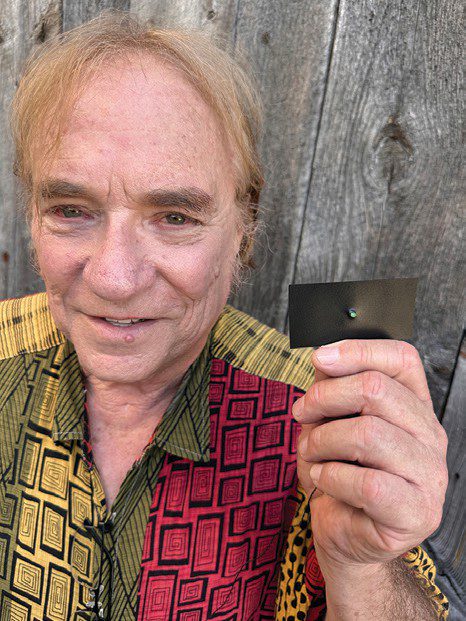
MAGIC—A black “sail,” a tiny light and a hidden power source put the flight in Tim Carter’s “fireflies.” SCOTT STEEPLETON/Acorn Newspapers
If you’ve ever settled into a drifting boat at Disneyland’s Pirates of the Caribbean, passing under the eternal twilight of the Blue Bayou, you have likely found yourself hypnotized by the tiny, dancing points of light flickering along the riverbanks. They are fireflies—seemingly alive, pulsing with an erratic, intelligent glow.
For decades, millions of theme park guests have marveled at that quiet bit of Southern magic. But the story behind how those lightning bugs learned to fly farther and look more lifelike isn’t just the product of a corporate think tank. It started in an ordinary backyard in the San Fernando Valley, born from a son’s desire to make his mother smile—and eventually resulted in a registered U.S. Patent.
Masterpiece in mom’s backyard
Meet Tim Carter. He is a man who has spent his life subtly shadowed by the mouse. As a seven-year-old visiting Disneyland, a chance encounter with Walt Disney himself resulted in Walt asking Carter’s father if the boy could be tested for film.
“My dad didn’t think it was a good idea,” Carter chuckles. “I mean, I could have been living in Bel Air. I always say that because I about it!”
While he didn’t become a child star, Carter carried a lifelong fascination with the artistry of Disney’s Imagineers. In 1985, he decided to bring a piece of that magic home to his mother’s house.
His mother had an old, run-down 1950s dollhouse in her backyard—weathered, unpainted, and destined for the landfill. Where others saw trash, Carter saw a movie set. He transformed the structure into a rugged “miner’s shack,” cutting chinks into the boards, installing a flickering yellow light, and placing a conical smokestack on top. He scattered rocks, arranged old cooking pans, and built a scene straight out of the deep bayou.
But the set was missing its soul.
“I’m out there at night and I’m thinking, ‘Wow, it looks just like a miner could show up with his rifle…what’s this place need?’” Carter recalls. “I go: fireflies.”
Using his Disneyland pass, Carter went on a scouting mission. He rode Pirates of the Caribbean, sneaking up the exit to get as close to the banks as possible. The original fireflies, designed by legendary Imagineer Yale Gracie in the mid-1960s, used walnut-shell-sized domes hanging from springs, intermittently lifted by an air vent to reveal a constant light.
Carter respected Gracie’s genius, but he thought he could improve the physics. He went to RadioShack, bought tiny lightbulbs, used the plastic backing they were packaged in as a “sail” to catch the wind, and suspended them from incredibly thin 30-gauge wire. When he turned an ordinary household fan on them, the results were instantaneous. Because the lightweight rectangles spun randomly in the breeze, the light blinked on and off naturally.
“It looked better than Disneyland,” Carter says. “It’s random. It looks like it has intelligence, which is the best part. It makes it so interesting to look at at night. It’s very relaxing.”
His very first audience was his mother. “She loved it,” he says softly.
From the Valley to Imagineering
At the time, Carter ran a window cleaning business in the San Fernando Valley, boasting about 150 clients. One of those clients happened to have deep family roots in Disney animation and Imagineering. After Carter told her about his backyard project, she asked for a nighttime demonstration.
“She was absolutely floored,” Carter says. “The next day, she called up Disney and, because of her family influence, she got me right down there to Imagineering in Glendale.”
Carter suddenly found himself escorted past security, signing non-disclosure agreements, and walking past black curtains shielding top-secret projects. When he set up his prototype, the building emptied.
“I thought that some Imagineers would come out to look, but they all dropped what they were doing and came to see,” Carter remembers. “There was a whole room full of people, and they pulled some blackout curtains, and hit the lights… and they were very, very interested.”
Disney’s special effects team recognized the elegance of Carter’s design. Because his fireflies relied on aerodynamic sails rather than heavy mechanical springs, they could “fly” much farther, bob and weave quietly, and be placed deep into the background of a set. Ultimately, Disney adopted the principle for the ride. When Pirates of the Caribbean emerged from a major refurbishment in 1987, Carter’s updated firefly effect was officially part of the show.
Parkgoers took notice. In the comments section of an online post about the fireflies, one reader said, “Thank you for your contribution to one of the greatest effects at Disneyland. It’s the pluses like yours that are so important to the park. As a kid, I always looked forward to the fireflies—nearly more than anything else in the show.”
Sadly, Carter’s milestone coincided with a profound personal loss.
“It became my mother’s backyard as well,” Carter says. “Because she died from cancer shortly after that. So it’s a great memorial to me.”
Protecting the magic and making the movies
While the theme park application cemented his relationship with Imagineering, Carter knew his mechanical breakthrough was unique. He ultimately sought protection from the United States Patent and Trademark Office, securing a patent for his simulated, moving artificial fireflies. His design solved a massive industry problem: creating an ultra-silent, self-contained system that realistically mimicked the erratic flight patterns of a real lightning bug without massive machinery.
That patented innovation eventually caught the eye of Hollywood. Decades after his technology debuted in the park, Disney came calling again—this time for the silver screen. Carter’s artificial fireflies were utilized by film crew decorators to bring an authentic, eerie Southern atmosphere to life in the background scenes of the blockbuster hit movie “Pirates of the Caribbean: Dead Man’s Chest” (2006).
Later, around 2009, Carter’s motion technology merged with another breakthrough. He teamed up with inventor Stephen Taylor, who held separate patents for microprocessing LEDs that perfectly recreated the biological flicker and fade of real fireflies.
By pairing Carter’s aerodynamic movement with Taylor’s lighting precision, they commercialized the technology under the brand Firefly Magic, lighting up theme parks, zoos, and prestigious public gardens across the globe.
One of ‘the boys’
Carter never made a massive corporate fortune from the corporate handoff. He signed a proprietary agreement, and Disney ran with the technology. But to hear him tell it, he was compensated in a currency far more valuable than residuals: respect and lifelong friendship from his heroes.
Because of his contribution, Carter became a welcome peer among the original creators of Disneyland. He spent weekends trading stories with Disney Legend Ward Kimball, and sat in the home of famed designer Bob Gurr, talking about the monorail while Gurr treated him to a private marionette show.
He even installed his fireflies in the front yard pond of legendary Disney rock-work designer Fred Joerger. Years later, when Joerger passed away, Carter was incredibly touched to see his own name mentioned in the Los Angeles Times obituary alongside the master Imagineer.
“The other Imagineers are ‘the boys,’” Carter says proudly. “And they just all contribute and nobody gets their name on it. And so I was one of the boys. So that’s quite an honor.”
By his own estimation, more than 600 million people have enjoyed his version of the fireflies over the last four decades. “Imagine all those people. And they went home happy because of me. That is exactly what Disney is all about: leaving happier than when you arrived.”
Bringing the magic home
Today, Carter is still spinning magic out of thin air. Using a hand drill attached to a doorknob, he custom-twists 1,000-foot spools of ultra-thin wire to handcraft firefly kits for backyard dreamers across the country. He has personally driven from Long Beach to Seattle, stopping in backyard after backyard to professionally install the effects for dedicated fans.
For local homeowners looking to turn an ordinary lawn into an enchanted forest, Carter sells his handmade fireflies in sets of two for $25.
The setup is remarkably simple—requiring only a standard AA battery pack (which Carter recommends slipping into a sandwich bag to protect it from the elements) and a gentle evening breeze or a small fan.
“People ask me, ‘How many do I need? Should I get a dozen?’ And I will tell them, ‘No, you only need two,’” Carter says. “I’m not just trying to make money. I’m trying to make beauty and fun.”
Just be careful where you hang them. “I tell people not to put them in the front yard. It might cause a traffic accident,” he warns with a wink. “They’re so distracting. When people see them, they just want to stare.”
Moved by his creation, Carter is wistful for what could be.
“Ever since I was a boy, my greatest dream was to go on the other sider of the barbed-wire fence on Tom Sawyer, to be where the greatest essence of dream existed– Indian village, burning cabin–and breathe in some of that rarified air. Now, when I’m making fireflies, I’m on the other side of that barbed-wire fence, living in my greatest dream.”
To bring a sense of the wonder of Disneyland’s Pirates of the Caribbean to your own home, you can reach out to Carter directly at myfireflies@yahoo.com.