
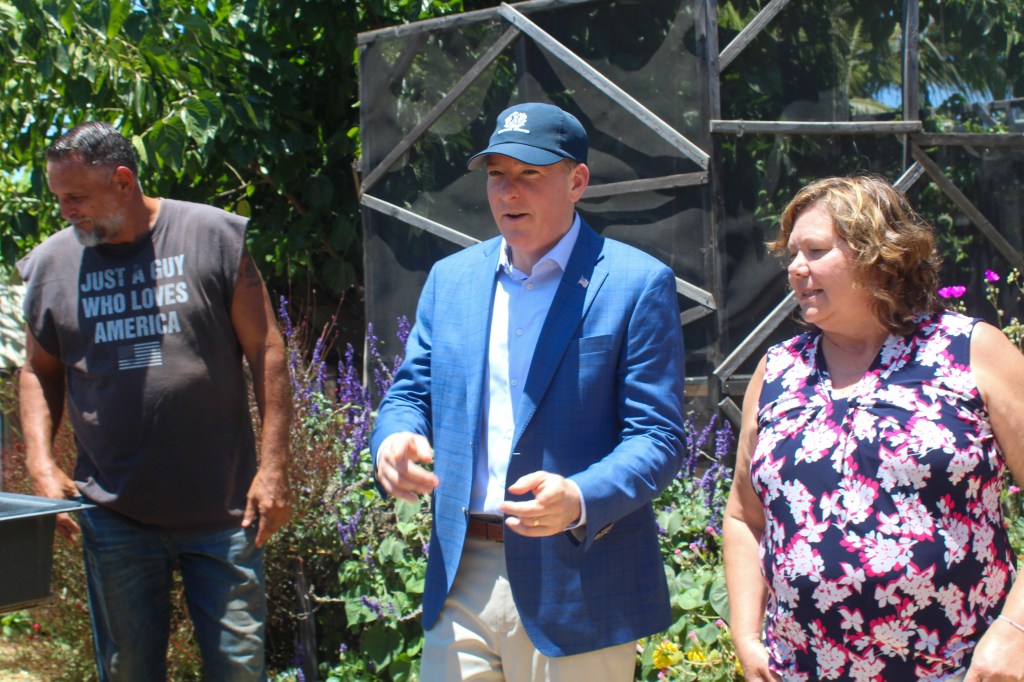
In a quarter-acre lot on the corner of Santa Fe Avenue and Columbia Street, in West Long Beach, sits Grow2Zero Farms, an urban farm whose mission is to provide resources and education to communities that are striving to achieve food security and minimize the environmental impacts of waste.
Grow2Zero Farms was founded in 2020 by two veterans who are focused on bringing healthy, accessible food to underserved communities, according to the nonprofit’s website. It has continued that work by hosting weekly food distributions, growing produce locally, providing community education, preventing food waste and collaborating with community partners.
And this week, the farm had a special visitor.
U.S. Environmental Protection Agency Administrator Lee Zeldin visited the farm on Wednesday, June 24, and recognized the organization for its efforts in regenerative urban farming and food waste reduction in Long Beach. Grow2Zero’s efforts aligned with the federal department’s initiative to reduce food waste and strengthen food security across the nation, called “Feed It Onward,” Zeldin said.
In the United States, more than one-third of food goes uneaten and gets thrown away, according to the EPA. Food waste has become the largest component of materials reaching landfills — more than any other type of trash.
At the same time, millions of families across the country don’t have enough food to eat. Data from EPA’s 2025 report, “Estimating the Cost of Food Waste to Consumers,” shows that individual consumers lose $728 annually to food waste – equivalent to $14 thrown away every week.
Judi Gregory, co-founder and executive director of Grow2Zero, said she was shocked, stunned and excited about the administrator’s visit to the farm. She was anticipating a representative from the EPA’s local office to visit — but not the head of the whole agency.
“When you are doing this kind of work, you just kind of do it behind the curtain,” Gregory said in an interview after the visit. “You do it for the reason to help the community, not for publicity, and we’re kind of quiet people. So to have him show up here at our little farm and our little organization, it meant a lot.”

Judi Gregory and Leif Kemp, co-founders of Grow2Zero Farms in Long Beach, with U.S. Environmental Protection Agency Administrator Lee Zeldin (center) on Wednesday, June 24, 2026. (Photo by Christina Merino, Press-Telegram/SCNG)

Grow2Zero Farms, 2851 Sante Fe Ave., is an urban farm in Westside Long Beach whose mission is to provide resources and education to communities striving to achieve food security and minimize the environmental impacts of waste. (Photo by Christina Merino, Press-Telegram/SCNG)

Grow2Zero Farms, 2851 Sante Fe Ave., is an urban farm in Westside Long Beach whose mission is to provide resources and education to communities striving to achieve food security and minimize the environmental impacts of waste. (Photo by Christina Merino, Press-Telegram/SCNG)

Grow2Zero Farms, 2851 Sante Fe Ave., hosts a weekly food distribution at the urban farm on Wednesdays from 4 to 4:30 p.m. Staff and volunteers were packing up bags with fresh produce on Wednesday, June 24, 2026, for the weekly distribution. (Photo by Christina Merino, Press-Telegram/SCNG)

Grow2Zero Farms, 2851 Sante Fe Ave., hosts a weekly food distribution at the urban farm on Wednesdays from 4 to 4:30 p.m. Staff and volunteers were packing up bags with fresh produce on Wednesday, June 24, 2026, for the weekly distribution. (Photo by Christina Merino, Press-Telegram/SCNG)

Judi Gregory and Leif Kemp, co-founders of Grow2Zero Farms in Long Beach, with U.S. Environmental Protection Agency Administrator Lee Zeldin (center) on Wednesday, June 24, 2026. (Photo by Christina Merino, Press-Telegram/SCNG)

(L-R) Judi Gregory and Leif Kemp, co-founders of Grow2Zero Farms in Long Beach, with U.S. Environmental Protection Agency Administrator Lee Zeldin on Wednesday, June 24, 2026. (Photo by Christina Merino, Press-Telegram/SCNG)
Show Caption
1 of 7
Judi Gregory and Leif Kemp, co-founders of Grow2Zero Farms in Long Beach, with U.S. Environmental Protection Agency Administrator Lee Zeldin (center) on Wednesday, June 24, 2026. (Photo by Christina Merino, Press-Telegram/SCNG)
The roots of Grow2Zero took hold when former high school classmates Gregory and Leif Kemp reconnected over a shared vision of community resilience.
After serving in the U.S. Marine Corps and working in the commercial sector, Kemp had founded Semper Fi Growers, a nonprofit aiming to help fellow veterans establish their own independent vertical farms, according to the Grow2Zero website. In a parallel experience, Gregory served in the U.S. Army and then founded her own company, Go2Zero Strategies, LLC, which consults on zero-waste and sustainable projects throughout Southern California. She has now been working in the recycling and solid waste management field for more than 30 years.
Gregory and Kemp decided to start an urban farm as a practical means of making healthy food accessible and affordable in underserved communities while also diverting organic material away from landfills and promoting carbon sequestration, according to the nonprofit’s website.
After finding a corner lot at 2851 Santa Fe Ave., Grow2Zero officially made its home in West Long Beach. Funding from logistics real estate firm Prologis as part of the Santa Fe Corridor Business Grant enabled them to begin the process of beautifying and building out the neighborhood farm amid the COVID-19 pandemic.
“This did not happen overnight,” Gregory said as she pointed around the farm. “It was literally one raised bed, one row at a time, and a lot of long weekends. I’m not here working all the time; Leif is really the one that’s here. But it’s a lot of work.”
Grow2Zero Farms’ vision is to empower local communities to improve human and environmental health by building access to local and healthy food, teaching regenerative farming and gardening practices, and installing principles of waste reduction and pollution prevention. Last year, for example, Grow2Zero trained 140 new urban farmers, distributed 7,000 bags of groceries and built a farm team with graduates from their farming academy, according to its 2025 annual report.
The nonprofit has been able to accomplish this through its different programs.
One of those is the Future Urban Farmer Academy. The no-cost, 16-week training program is for aspiring urban agriculture professionals in Long Beach and the greater Los Angeles County area. The academy offers practical agricultural education and training, with an emphasis on drought-friendly practices and addressing the needs of food insecurity in an urban environment, according to the nonprofit’s website.
Long Beach Food Fairs, meanwhile, is a program through which Grow2Zero partners with chefs at Feel Good Salsa Kitchen and with Sowing Seeds of Change Urban Farm to provide healthy, prepared food to the local community. The partnership has increased the likelihood of rescued food being consumed and the prepared food is shared with the community at weekly “food fairs.”
Grow2Zero started its weekly food distribution during the COVID-19 pandemic and it has continued uninterrupted ever since, Gregory said. From 4 to 4:30 p.m. every Wednesday, the farm gives away bags full of fresh produce from the farm and community partners, as well as a bag of shelf-stable pantry items, to more than 140 local Long Beach families. This includes delivering to housebound families at the Century Villages at Cabrillo and other veteran housing locations in the city.
On Wednesday, the cofounders met with Zeldin at the farm to share their story and give the administrator a tour.
Grow2Zero Farms staffers and volunteers, meanwhile, were preparing the produce bags for the food distribution later that day.
After the tour, Zeldin held a press conference and spoke about the EPA’s efforts to support regenerative and new farming techniques across the country — especially in urban environments.
“In my first nine and a half months as EPA administrator, I traveled to all 50 states and I visited a lot of farms,” said Zeldin, who was sworn into the role in January 2025, “but I tell you, I don’t think I’ve visited an operation like Grow2Zero.”
Last year, the EPA announced the “Feed It Onward” initiative, which serves as a national platform to spotlight the farmers, businesses, nonprofits, military partners and communities working to ensure food is being used instead of turning into waste. Feed It Onward also connects food donors and organizations leading on food waste reduction with communities in need.
“Grow2Zero’s work is really something that I think should be a story told all across this country,” Zeldin said. “It should inspire others and I’m very grateful for both Leif and Judi, for them to be able to dedicate so much of their passions, time and lives – (and) for all the other veterans, community members who serve as staff members and volunteers, and what they’re doing to feed the local community, including today.”
Other communities with blighted locations can think about creating urban farms in their areas, Zeldin added. He encouraged local government and private partnerships to help make these farms possible, which will provide support to communities in various ways.
“I got involved with growing food to address some of the issues that I was dealing with internally due to my time in combat,” Kemp said during the press conference. “So I noticed really quickly the benefits of having my hands in the soil and I wanted to figure out a way to use veterans to heal communities, and we have seemed to have found a way to do that.”
Grow2Zero Farms not only helps support veterans, but also at-risk youth and formerly incarcerated people, Gregory said. And volunteers of all backgrounds are always welcome and needed.
The programs the urban farm is able to provide are because of grants, Gregory said, which, like many nonprofits at this time, has become a bigger struggle because of federal funding cuts.
Last year, amid the Trump administration’s broader pullback of hundreds of environmental justice grants, money initially aimed at efforts to improve minority communities impacted by pollution, climate change, and air and water quality issues was canceled. Among those denied grants was a proposed $250,000 for Grow2Zero Farms.
While the Long Beach urban farm currently has grant funding for its programs through Los Angeles County and the EPA, Gregory said, community support has become more important than ever to continue providing food and teaching others about growing healthy produce in their communities.
“If you can teach one person to put this in their backyard, this bed, and it can grow all year-round, different crops, then you can feed your family and you can in some way become independent of the lack of food in your neighborhood,” Gregory said. “But then, if your neighbor does it, and if 10 neighbors do it, now you guys are growing and you’re sharing food and you’re creating community. That’s something that’s very powerful.”