
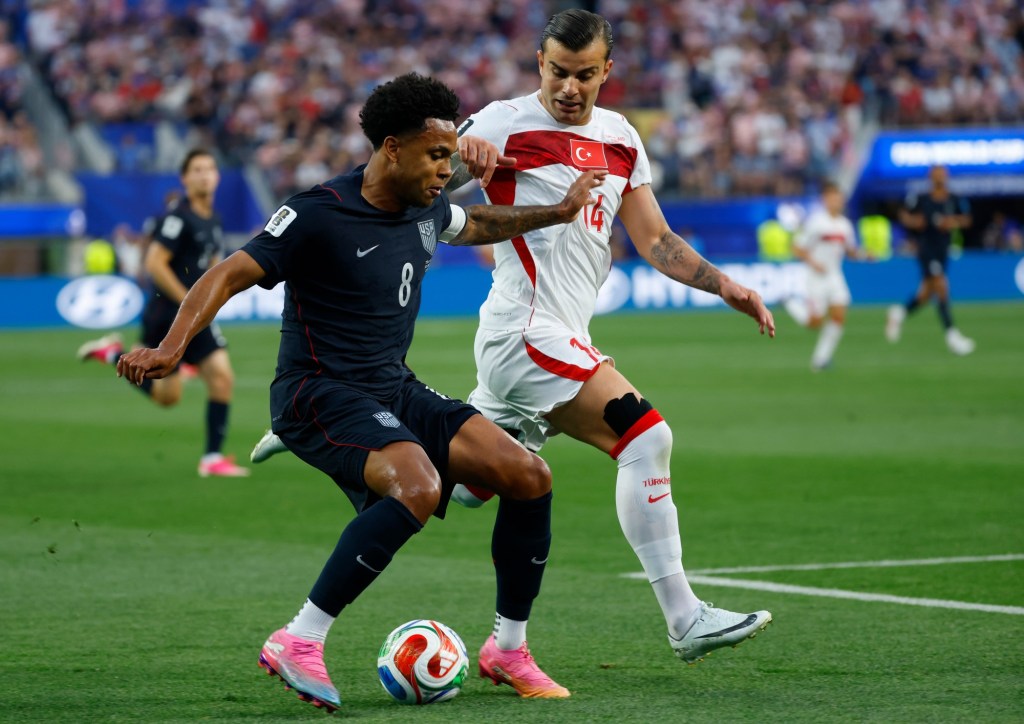
INGLEWOOD — Three thoughts on U.S. national team’s 3-2 loss to Turkey in the World Cup at SoFi Stadium on Thursday night:
1. Culture clash
Mauricio Pochettino was born and raised in Argentina. His family is of Italian descent. He played or coached in Spain, France and England. He speaks broken English.
Pochettino has tirelessly tried to learn American culture in his 21 months as U.S. national coach, watching the “Yellowstone” TV series, listening to country artists like Lainey Wilson and Ella Langley and asking his players about basketball during the NBA Finals.
On Thursday, he experienced another American quirk: Our obsession with momentum.
“Will you explain what is momentum?” he said during his post-match news conference when asked whether his team lost it by virtue of a meaningless loss. “It is a topic I don’t understand. What is momentum?”
Its existence, real or perceived, has long been debated in American sports circles, whether a quantifiable psychological phenomenon or merely a coincidental cluttering of statistical events. Most fans, however, subscribe to the former.
Global soccer has a more nuanced view, a sport where ties are common and often pursued. In the two-leg series used in tournaments like the UEFA Champions League, where aggregate score decides who advances, it’s perfectly acceptable to lose the second leg 1-0 if you won the first 2-0, momentum be damned.
For the usually jovial Pochettino, it grew into an increasingly irritable interaction with journalists from a series of seemingly innocuous questions about the match’s larger implications.
“I think we need to remember we won first place in our group,” said Pochettino, whose team had already clinched the top spot before kickoff and whose opponent had already been eliminated. “The objective was to finish first and we finished first. It’s all positive. I’m so happy, maybe not showing it because your question is a bit weird.
“I am confused. The mood or the vibe is like we go home tonight and Turkey stays, no?”
He was asked how the 3-2 loss on a last-second Turkish goal from multiple defensive blunders might impact Tuesday’s win-or-go-home encounter in Santa Clara against Bosnia and Herzegovina.
“If we win the next match, it won’t have weighed on us at all whatsoever,” Pochettino said, this time in Spanish. “And if we don’t win, then you can say whatever, if it weighed on us or not … What would you like me to tell you? And whatever I tell you, I’m not going to convince you. Some may think one thing, others may think another thing, and then I think what I think.
“A newspaper is going to write whatever they think and whatever they want.”
Photos: USA Fans at the World Cup
Pochettino was asked about his roster depth after rotating nine of 11 starters from the 2-0 win against Australia, saving legs and shielding four key players from a second yellow card that would have meant automatic suspension against Bosnia.
He started to answer, then quickly swerved back to the notion that his team might have lost momentum, whatever that is.
“I’m sorry, guys,” he said. “Can it be possible that Turkey celebrates three points (from the win), Australia celebrates their qualification (to the next round), Paraguay celebrates their qualification, and for you not to say congratulations that we won the group? That is a little bit sad.
“I need to (remind) you and everyone that we won the group. Sorry, guys, we won.”
The moderator abruptly ended the press conference there, which was probably a good thing, given its lack of positive momentum.
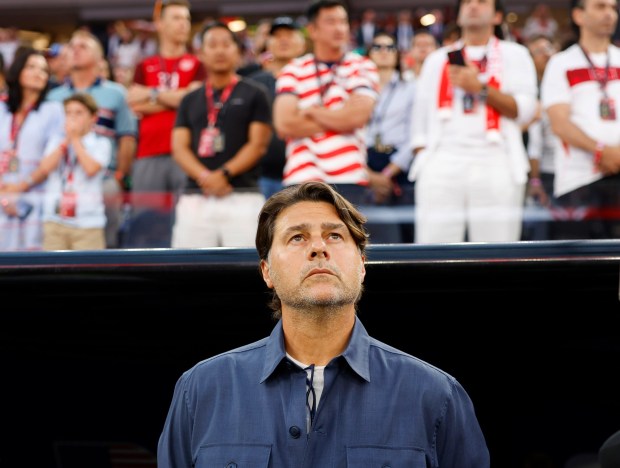 U.S. coach Mauricio Pochettino listens to the national anthem before his team played Turkey in the World Cup at SoFi Stadium in Inglewood. (K.C. Alfred / The San Diego Union-Tribune)
2. History, repeating
Reports emerged Friday that U.S. Soccer has offered Pochettino a four-year contract extension through the 2030 World Cup.
What’s that quote about if you don’t learn from history, you’re doomed to repeat it?
Is U.S. Soccer really going to try this again?
Internationally, the second-cycle World Cup coach has a worse result in an overwhelming majority of cases, although, admittedly, it is a flawed statistic (the coaches who bombed rarely get a chance to jump over a low bar) and five of the eight quarterfinalists in 2022 were guided by retained coaches from 2018.
But the numbers are indisputable when it comes to the U.S. men’s team: It doesn’t work.
Tried it four times, failed miserably four times. Only one of the four even made it to the next World Cup. Two were gone the following year.
Bruce Arena: got a new contract after reaching the 2002 quarterfinals, then went winless and got grouped in 2006.
Bob Bradley: retained after reaching the second round in 2010, fired a year later after a string of poor results.
Jurgen Klinsmann: extended through 2018 six months before the 2014 World Cup, fired in 2016 amid a disastrous qualifying campaign that ended without making the World Cup from soccer’s weakest region.
Gregg Berhalter: re-hired after reaching the 2022 knockout stage, fired the following summer after crashing out of the group stage in the Copa America on home soil.
In all four cases, the team predictably went stale. Two things happen: The second-cycle coach relies on aging players on whose backs he got the extension, and veterans increasingly tune him out after one too many jet-lagged trips across the Atlantic.
The good news is U.S. Soccer and Pochettino seem to be postponing further discussions until after the World Cup, when a more pragmatic decision might prevail.
Another factor: Sporting director Matt Crocker, who hired Pochettino and U.S. women’s coach Emma Hayes, left just weeks before the World Cup for a similar position in Saudi Arabia. A replacement hasn’t been hired and, you’d think, would want a say in the national coach who reports to him or her.
“We told the federation we are open,” Pochettino said in a roundtable with journalists earlier this week, “but we don’t want to distract when all the energy needs to be with my players.”
 Trionda, a giant replica of the official ball for the FIFA Wold Cup 2026 is displayed in Zurich, Switzerland, Thursday, Nov. 20, 2025. (Claudio Thoma/Keystone via AP)
3. Drag crisis
Auston Trusty’s third-minute goal was the 173rd of the tournament, surpassing the previous World Cup record of 172 set across 64 games in 2022 in Qatar. By the end of the night, four more had been scored.
On Friday, the first two matches produced another 10.
The obvious culprit is an expanded World Cup that dumped an additional 16 minnows into the fish tank. And there seems to be a greater commitment to attacking, especially with the safety net of third-place teams able to advance from groups to the knockout stage.
The Adidas Trionda ball may also be at work.
Past World Cup balls like 2010’s Jabulani have been criticized for their unpredictable flight, knuckling and changing direction as it approaches the goal with spin. The issue with the Trionda is less about trajectory than velocity.
Researchers in Japan and South Korea put the four-panel ball through wind tunnel tests at two different altitudes while striking it at six different places “to obtain drag, lift, and side-force coefficients.”
https://wpdash.medianewsgroup.com/2026/06/25/photos-united-states-vs-turkiye-world-cup-match/
Their conclusion: The ball experienced a “drag crisis” that allowed it to speed up and fly faster in certain conditions, which might explain why some goalkeepers have suggested it reaches them faster than expected. And indeed, there have been instances in this World Cup where a powerful shot zoomed past them before they could react.
U.S. goalies Matt Freese, the starter in the first two matches, and Thursday night starter Matt Turner declined to take the excuse bait.
“I haven’t noticed it,” Freese said of increased ball speeds. “The guys at this level shoot hard, regardless of the ball. I know the ball is flying no matter what.”
“I didn’t notice that,” Turner said after Turkey dropped three on him. “It’s interesting, but honestly guys, but this is soccer. Sometimes the ball hits you, sometimes it doesn’t. Look at the quality of chances we conceded tonight. Against a quality opponent, we’re going to have to limit the chance creation if we want to advance far in the tournament.
“It’s not just about the ball.”