
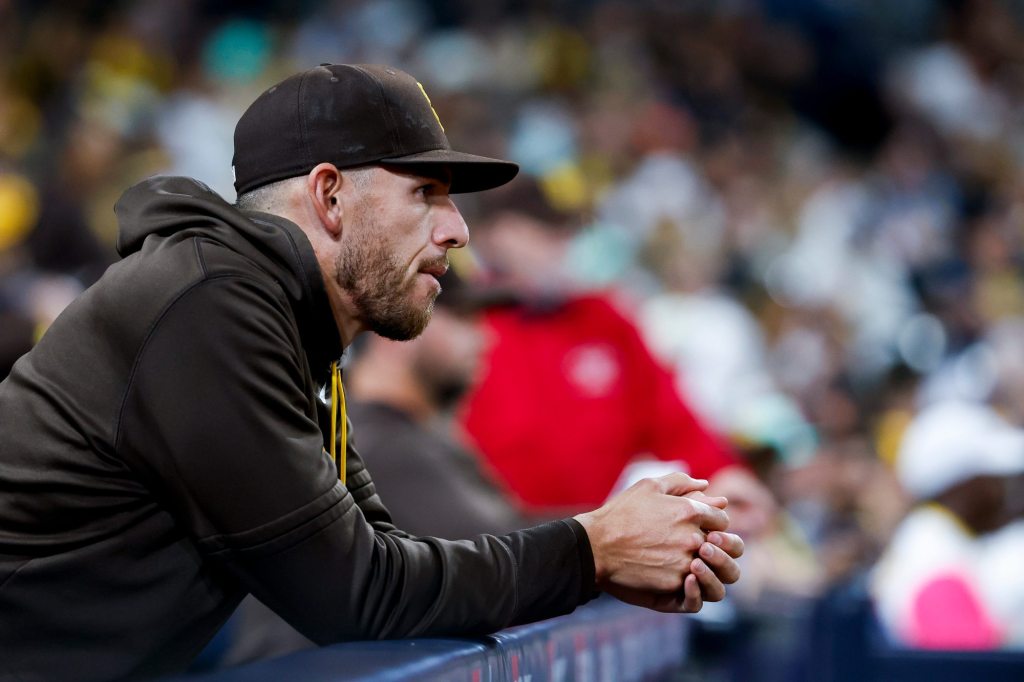
Walker Buehler is, by many measures, a Tommy John success story.
He returned from his first elbow reconstruction to become a two-time All-Star for the Dodgers. He came back from his second surgery to get the final three outs of the 2024 World Series. He has since settled into a steady role in the Padres’ starting rotation.
Yet on the mound and off, Buehler is still trying to marry his body with his mind.
“Obviously, this analogy is a stretch,” he said, “but it feels like PTSD in my elbow.”
Tommy John surgery has become a routine endeavor in baseball. What was once experimental now hardly raises an eyebrow. Go under the knife, get a new tendon in your elbow to act as a fresh ulnar collateral ligament, disappear for 12 to 18 months and return with new life in your career.
The truth is, it’s not always that simple.
“I think the perception of how easy that surgery has become to come back from is really kind of disingenuous a little bit,” Buehler said. “I don’t think people really understand.”
Nearly 700 pitchers in Major League Baseball have undergone Tommy John surgery, based on a list compiled by baseball analyst Jon Roegele.
Have the surgeries been successful? It depends on your definition of the term.
According to a report by Mass General Brigham, 80% to 95% of athletes resume game action following the procedure.
But that statistic does not factor in the reality players describe. It doesn’t account for lost velocity, command, or feel. It ignores durability or how long rehab takes or the setbacks encountered along the way or what the arm does to compensate after undergoing ligamentization — the process by which the tendon graft gradually transforms into a functioning ligament.
It does not measure the altered mechanics, lingering pain, or the psychological toll of continuing your career when your body no longer works the way it once did.
For many pitchers, Tommy John surgery isn’t about getting back to who you once were. It’s about figuring out who you now need to become.
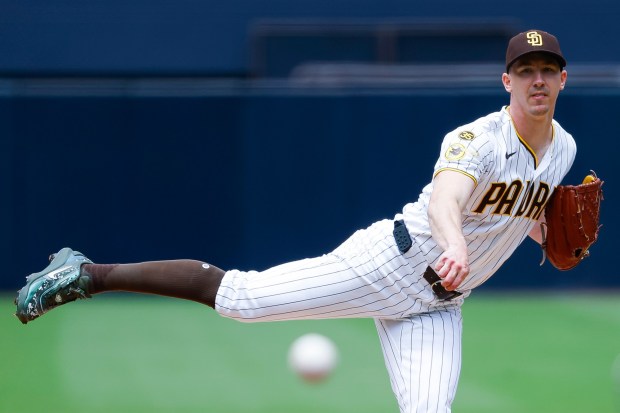 Padres starter Walker Buehler pitches against the Phillies on Wednesday. (Meg McLaughlin / The San Diego Union-Tribune)
Same surgeries, different experiences
Buehler’s first Tommy John surgery in 2015 could not have gone better. He returned throwing harder than before and reached the major leagues the following season.
“The first one, I think honestly, I was just the perfect age,” Buehler said.
Buehler’s second Tommy John surgery — in 2022, seven years after his first one — was anything but easy.
Same doctor, same organization, similar rehab.
But different frustrations. And more complications.
Buehler tried to get back to who he was — the player who pitched seven scoreless innings in the 2018 World Series and still threw 98 mph toward the end of that appearance.
That velocity is still in there somewhere, Buehler says. But several years of inconsistent performance and pitching through pain has led Buehler to reinvent himself rather than trying to chase his flamethrowing ghost.
“You’re always hunting these certain feels — ‘This is the way my body feels when I’m good,’ or ‘This is what it looks like when I’m good,’” Buehler said. “And you have a surgery and they change the composition of your elbow. Like, I have the equivalent of three ligaments in there now, so I just don’t have room in the elbow to do some of the things I used to do, or I need to do it a different way. All these litany of reasons.”
Padres pitcher Joe Musgrove underwent his first Tommy John surgery in October 2024 and has yet to return. His recovery has been a series of starts and stops marked by frustration and slow progress.
“The ligament is almost guaranteed to be good. It’s going to be strong,” Musgrove said. “But there’s a lot of other structures in the elbow that need to work properly to throw a baseball, not just the ligament. … The success rate is there, but the success rate doesn’t say if it’s in 12 months or 24 months or 16 months.”
Musgrove’s surgery involved more than ligament reconstruction; doctors also cleaned up bone spurs and repaired his flexor tendon.
“I was rehabbing essentially three surgeries, or three injuries, at once,” he said.
Changes in mechanics are virtually inevitable. Early in his recovery, Musgrove lost range of motion in his arm and had to relearn movements he had performed his entire life.
“Throwing a certain way for 25-plus years of my life and then all of a sudden, at 33, having to switch it and learn how to throw differently, was a big challenge for me,” he said.
Musgrove has since regained most of his extension and now has “great” range of motion, he said. But a new problem emerged: pain at the end of his throwing motion, which he believes is tied to a bone issue and lost cartilage in the elbow.
“If we were gonna bounce a ball, that bouncing of the elbow is where I get a lot of pain,” Musgrove explained. “And to be able to throw a ball with good intensity and be able to spin the ball and put the ball where I want location-wise, I need to be able to bounce the elbow and lock it out hard. That’s been the biggest struggle for me over the last couple months.
“I’ve been in this position without a lot of cartilage in there for years, so I know I can pitch with it how it is. I just got to get everything calmed down and get the bone healed up before we start banging on it again.”
Musgrove’s setback illustrates the unpredictability of recovery.
Initially, Musgrove hoped to return within a year and potentially help the Padres during their 2025 playoff push. When that timeline evaporated, he targeted 2026 spring training. He reached that milestone only to be shut down again with discomfort after his first spring appearance.
“In spring training, coming back under the assumption and the feeling of, ‘I’m going to be able to make the opening day roster and be back pitching’ and then to have a different elbow issue pop up — one that’s arguably been harder to figure out and harder to resolve than the Tommy John itself — has been extremely frustrating,” he said.
“The excitement and the joy of everybody talking about how great it is (for you) to be back, and (asking) how are you feeling, and inside not feeling very good but trying to tell people, ‘Yeah, I’m excited about it,’ when really, I don’t know if I’m gonna make it to the starting gate.”
Musgrove expected that if he attacked rehab diligently, the process would follow a predictable timeline.
“And it just doesn’t always work out like that,” he said.
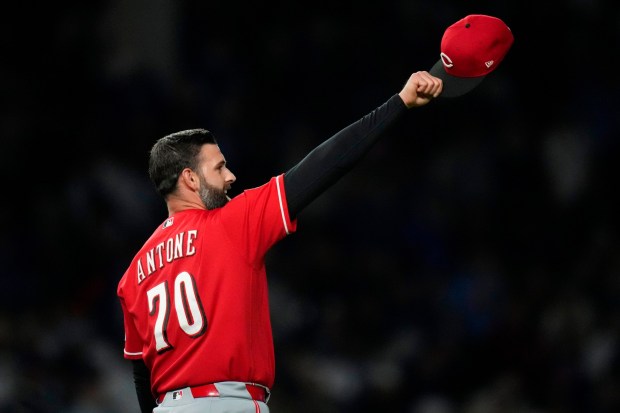 Cincinnati Reds’ pitcher Tejay Antone signals to the outfield during the eighth inning of a baseball game against the Chicago Cubs, Wednesday, May 6, 2026, in Chicago. (AP Photo/Erin Hooley)
‘My way’ not always the right way
The success rate after a second Tommy John surgery is considerably lower, with 65% of players returning to pitch at the MLB level, according to a study published in 2015 by Henry Ford Hospital.
Performance can take a drastic hit, too.
“Although a second surgery may not be career-ending, it appears to be career-limiting by virtue of a decreased workload and pitching productivity,” Vasilios Moutzouros, a Henry Ford orthopedic surgeon and the study’s senior author, said at the time of publication.
Buehler admits he was “pretty stubborn” in how he attacked his recovery following his second surgery and developed what he called “some really, really bad habits.”
If you haven’t proven yourself in the big leagues, it can be easier to do the rehab work.
But if you’ve tasted success …
“I think the people that were in L.A. will tell you that I was a lot easier to deal with in my first rehab than my second one. And I’m kind of paying the price for that stubbornness, or have the past two years,” Buehler said.
“When the (trainer) goes, ‘Hey, you need to go run,’ you can say, ‘No, I just won us a World Series three years ago. (Eff) you.’ Like, I’m not doing that, right?” he said.
“I think it gets really hard and it takes a special relationship between a trainer or a couple trainers or a strength coach and a player to be stuck in Arizona for a year watching their team play, and for me not to be able to just say, ‘(Eff) you.’ I think 100% that was a big issue for me and something that I really struggled with. The ‘My way is the right way.’ Like, I’ve proven that, I’ve shown you that. The inability to get off of that (mentality) was difficult for me for a long time.”
When it comes to thriving after a second Tommy John surgery, outliers exist.
Jameson Taillon has notched several impressive seasons since his second surgery, as has Nathan Eovaldi. Shohei Ohtani is once again dominant after utilizing an internal brace in his second procedure, something many pitchers now elect to do. Two-time Tommy John recipient Dustin May pitched a complete game one-hitter against the Padres recently, throwing in the high-90s in the ninth inning.
And Buehler, in a recent outing against the Phillies, hit 97 mph on two pitches as he completed a quality start for the second time in a month.
Perhaps no current player better embodies the improbable more than Reds reliever Tejay Antone. Antone, a 32-year-old who pitched against the Padres twice this month at Petco Park, has undergone three Tommy John surgeries since 2017. Incredibly, he returned to a big-league mound in May.
Antone received the news that he would need a third operation on the same day he and his wife experienced what he described as a personal matter. Both developments left him in tears. The prospect of another lengthy rehabilitation was almost too much to comprehend.
“Having that happen and getting injured on the same day, I was like — excuse my French, but (eff) this,” he said. “Like, I’m ready to just check out on all this. I’m done grinding. I’m not doing this. I just needed to go do my own thing and disappear. I think a lot of people in that situation would have.”
Antone’s wife encouraged him to see his doctor. His doctor encouraged him to at least undergo the surgery. And Antone ultimately convinced himself to keep going.
“I think a lot of it is just mental perseverance,” he said. “I think that (you need) that attitude of, ‘I don’t care, I’m gonna show up every day and just do the thing to the best of my abilities.’ If you can’t do that, it’ll eat you alive. …. I think (success) really depends on the mental fortitude of the human (and) how hungry that athlete is to get back and how much work they’re able to put in.”
Antone regularly receives messages on social media from young athletes and parents asking for “tips and tricks” for navigating Tommy John surgery.
“It’s not routine,” he said. “I’m like, ‘Dude, it’s so much more than just some tips and tricks.’”
Antone recently wrote a book, “The Tommy John Protocol.” He will self-publish it on Amazon this month. Former big-league pitcher Tommy John, the namesake of the surgery, wrote the foreword.
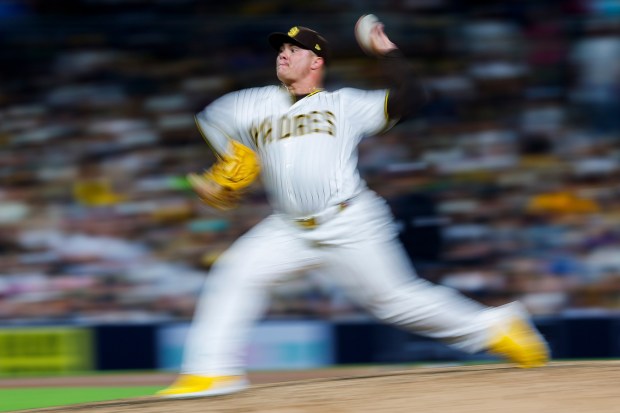 Adrian Morejon #50 of the San Diego Padres pitches against the Athletics during the seventh inning at Petco Park on Saturday, May 23, 2026 in San Diego, California. (Meg McLaughlin / The San Diego Union-Tribune)
Pushing through
There is a misconception that Tommy John surgery restores pitchers to their old selves. The reality is that the revolutionary procedure gives them another opportunity to pitch, but promises nothing more.
Adrián Morejón, now a dominating reliever for the Padres, had Tommy John surgery in April 2021, at 22 years old. He pitched 34 innings in 2022 but only nine innings the year after due to fatigue and other injuries.
“My arm was more tired than normal,” he said.
Teammate Germán Márquez approached Tommy John surgery positively in 2023, but his optimism faded quickly.
“I felt it was gonna be easy, but it wasn’t easy,” Márquez said. “Too much up and down. … I don’t feel like you come back the same. If you do the right things, you’re gonna come back stronger. But I feel like (there’s) always gonna be something (you’re dealing with).”
Márquez initially tried to be the pitcher he used to be, but that version of himself no longer existed.
“Last year I changed too many things in my delivery because I was coming back and I was trying to be the same, but I couldn’t,” Márquez said.
Mentally, the process can take a toll. Rehabbing pitchers are often removed from the team, watching walk-off celebrations or deep playoff runs at a distance.
Some see their teams flailing and feel guilty.
“The biggest part to me is the feeling of (letting) down my teammates,” Musgrove said. “I know it’s out of my control. I’m doing everything I can right, which gives me a little bit of peace of mind. But there’s a lot of guys here that haven’t seen me play and don’t really know me as a person, and it’s hard to not feel like they have this assumption that I’m just kind of sitting by and letting time pass. Especially over the stretches of time where I wasn’t having any changes; no progress is the most frustrating thing.”
Motivation can be hard to find amid the monotony of rehab.
“For me, that was the tough part,” Morejón said. “You do the same thing every day, every week, every month. Like for five months, no throwing. Just only exercise, running, exercise, running. That’s the tough part, mentally, I think, for everybody.”
Said Márquez: “You spend too much time outside of the thing that you love. It’s kind of horrible. You have to be strong mentally and keep going with your routine, and you’ll be fine.”
“It’s the hardest thing I’ve had to go through in the big leagues, for sure,” Musgrove said. “I’ve tried not to show it. I’ve done a pretty good job of compartmentalizing all the different thoughts that come through my head and really just focusing on what’s important. But the more time that passes — obviously, you can ignore things for so long, but you hear everything, you see things that get out there. I’ve tried to ignore it as much as possible and not think about it, but it’s been difficult.”
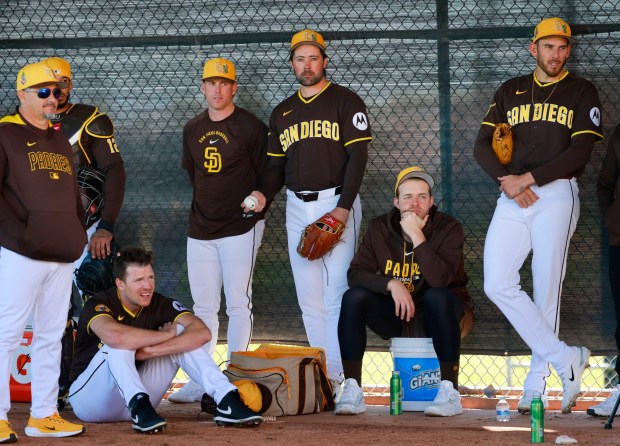 Padres pitching coach Ruben Niebla, left, and pitchers Nick Pivetta (sitting), JP Sears, Matt Waldron, Michael King, and Joe Musgrove watch a bullpen session during a spring training practice on February 19, 2026 in Peoria, AZ. (K.C. Alfred / The San Diego Union-Tribune)
‘How do you feel?’
The prevalence of Tommy John surgery has created a bit of a fraternity among players who have undergone the procedure.
Morejón said Padres veteran Yu Darvish helped him through the process. Darvish underwent Tommy John surgery in 2015; he’s currently working his way back from UCL repair surgery and an internal brace procedure.
“He told me a lot of things to do,” Morejón said. “He helped me a lot. And the other guy here that helped me (stay) positive is (former Padre) Blake Snell. He called me every week. ‘How do you feel?’ I think that did help me a lot.”
While in San Diego with the Reds for a recent series against the Padres, Antone found himself watching Buehler’s bullpen.
“I was like, ‘Man, he doesn’t even look like he’s had two (surgeries),’” Antone said. “He was throwing the ball really well.”
Buehler will never stop searching for the skills that once made him elite. But in San Diego, four years removed from his second Tommy John surgery, he’s gotten closer. He’s had to develop patience along the way.
The lack of guarantees gives way to gratitude. That’s its own version of success.
“Right now, I’m just happy to feel healthy and feel like I have a chance to go and pitch good every fifth day,” Buehler said. “ That’s really encouraging for me. It’s something I haven’t felt in a long time.”