
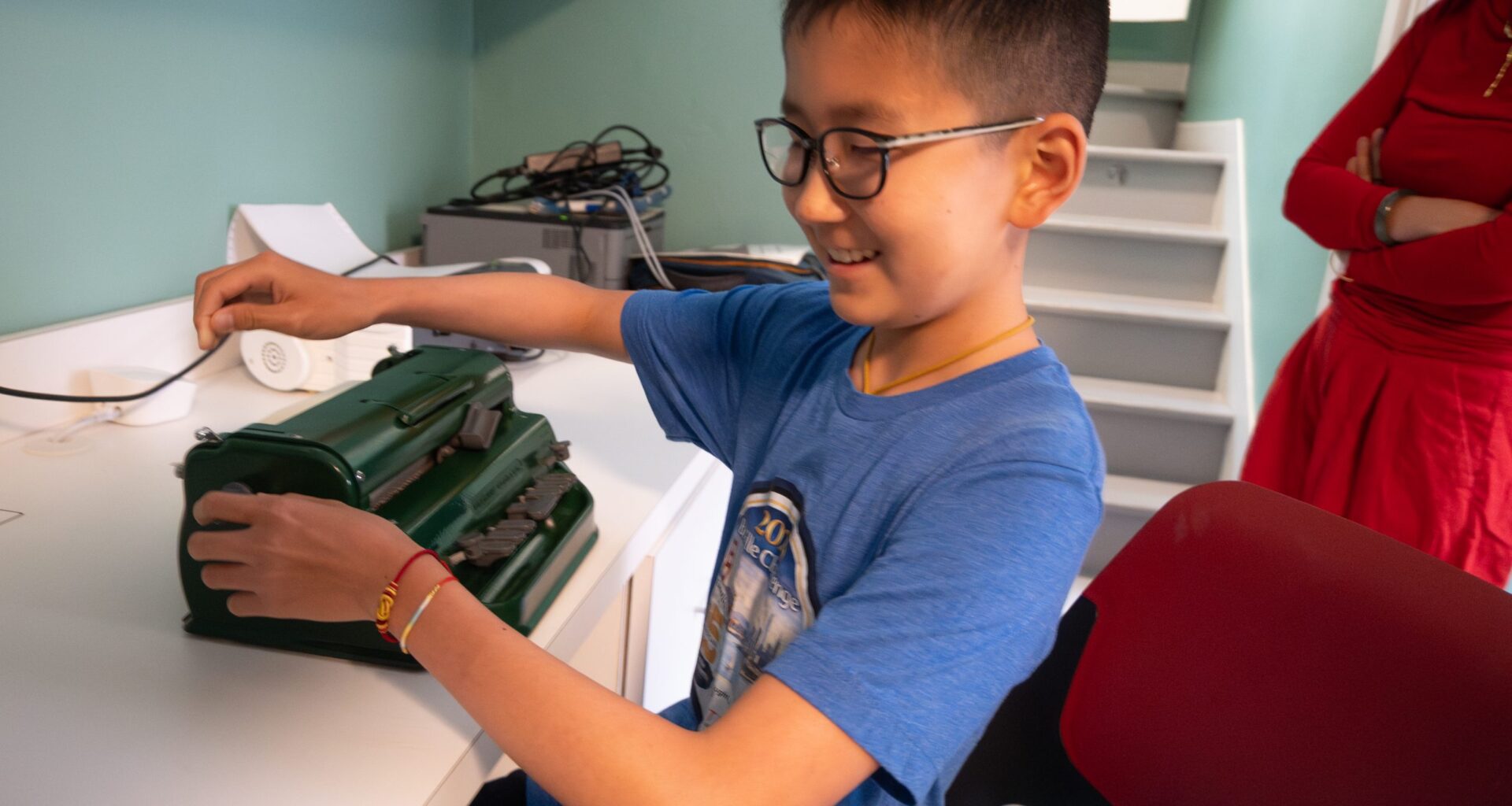
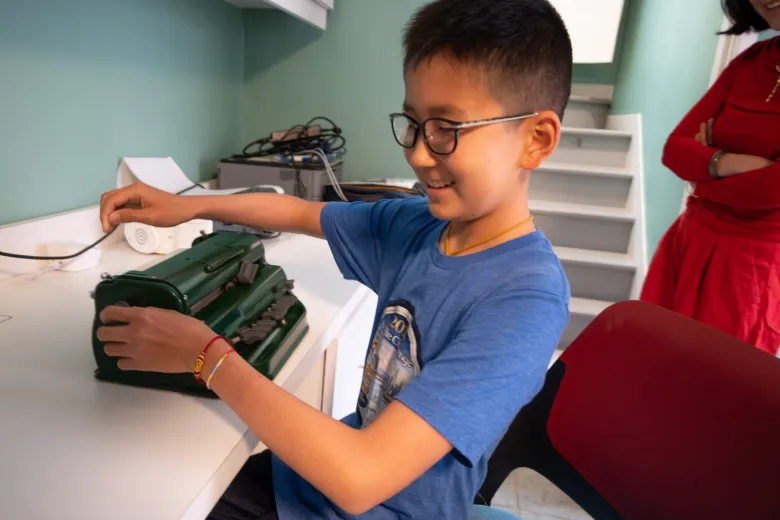
 Kai Wang demonstrates how to use his Perkins Brailler in the basement of his Central Berkeley home on Tuesday. He uses glasses for sun and eye protection. Credit: Hope Muñoz/Berkeleyside
Kai Wang, age 13, lives with his parents, his 8-year-old kid brother and his pet rabbit Snowball in a two-bedroom house in Central Berkeley. He loves chess and science and has memorized Pi up to 225 digits, winning a Longfellow Middle School contest. He co-designed a tactile nature lab at the California Academy of Sciences. He plays viola, violin and drums and has competed nationally in paraclimbing, goalball and long-distance running. And he’s blind, the first Braille-only student to enroll in the Berkeley school district in decades, according to his parents.
In his basement, which his family jokingly calls “Kai’s office,” is a keyboard, a giant stuffed giraffe and a large desk against the wall. Atop the desk sits a dark green mechanical Braille typewriter.
Kai compares the Brailler to ancient technology; the writing system was developed by French teacher Louis Braille in the 1800s and the device Kai uses has yet to be truly upgraded since 1951. He sits down at his desk and begins typing. Raised dots poke into the thick paper that emerges from the top.
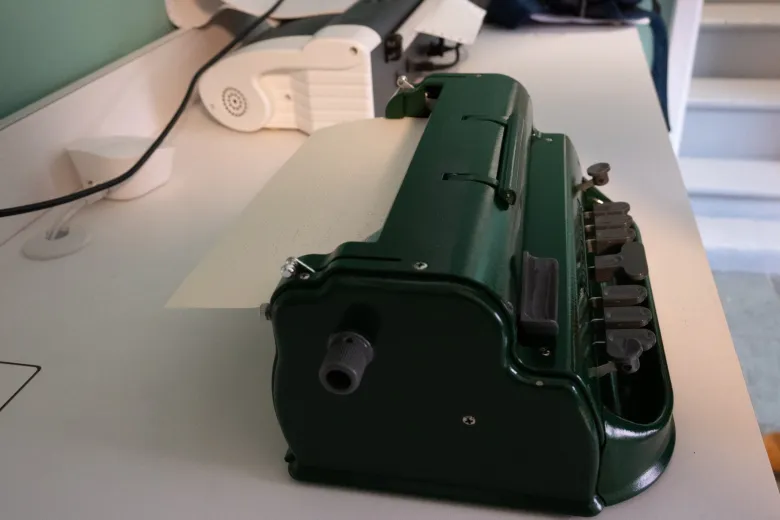 Kai’s Brailler sits on a desk in a part of his home that his family refers to jokingly as “Kai’s office.” Credit: Hope Muñoz/Berkeleyside
Kai is taking a practice test to prepare for the National Braille Challenge finals — the only competition of its kind, put on by the Braille Institute of America. Students are challenged in various categories, including comprehension, proofreading, speed and accuracy.
This Friday and Saturday, Kai will be in Los Angeles at the University of Southern California — one of 50 blind and visually impaired students from across the country and around the globe to qualify for the competition. He is the only California student to make it to the finals this year.
“I’m really excited to compete,” Kai says. “I think it’s a big deal.”
In its 26th year, the competition is not only an opportunity for students to hone their skills but also to connect with peers and promote Braille literacy.
Braille has been in decline since the 1970s, when school districts started de-emphasizing it in favor of audio learning and other teaching methods. New technology — such as smartphones and computer software that reads aloud emails and other digital documents — has allowed people with visual impairments to live more independently than ever, but at the same time it plays a role in eroding Braille’s prominence.
Supporters say it’s a misconception that Braille is hard to learn and inefficient to use, and that it is crucial for the mastery of reading and writing skills. Only about 13% of U.S. blind students could read Braille, according to a 2016 survey. Another study, from 2018, found that 90% of people who are literate in Braille are employed, compared with 33% for those who don’t know Braille.
When Kai was younger, he often wasn’t provided with Braille material and was told that he could just listen to the words.
But it’s not the same, Sun says.
She got the help of the National Federation of the Blind in negotiating a landmark settlement with the Berkeley school district in 2022 to make online learning tools more accessible. The settlement established a process for reviewing the technology BUSD uses and created a system for responding to accessibility complaints.
“Part of my big objective is to protect his Braille literacy,” said Sun, founder of the nonprofit Paths to Accessibility and president of the company Sun Access, involved in developing accessibility-driven products. “I had to reason and then prove to others, saying, ‘Look, listening to a word is different than reading a word.’ You wouldn’t make the sighted kid just listen to the word.”
Kai has been embraced by Berkeley’s blind community
Kai’s daily quality of education has been a toss-up, he said. Some teachers are always prepared, like his science teacher, who uploads lesson plans three weeks out. But often he doesn’t know if he will be provided with accessible materials and be able to complete the same assignment as everyone else.
“There’s a term in the blind education field called ‘accessible material insecurity,’’’ Sun said. “It’s like food insecurity, and you don’t know tomorrow if you’re going to have food.”
While Sun acknowledges the school system is trying to support his education, she says it often misses the mark.
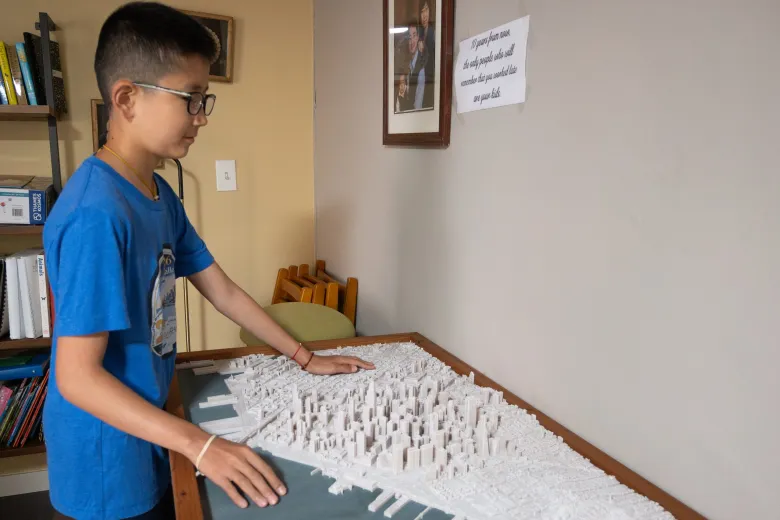 Kai shows his 3D-printed model of San Francisco, a gift from a friend. Hope Muñoz/Berkeleyside
“He’s very open to trying new things,” Sun said. “The only thing he craves for is access. And after you grant him access, he thrives.”
Kai and his family have leaned on Berkeley’s community of blind adults. The city was central in the Disability Rights Movement of the 1960s and 1970s, and today the East Bay Center for the Blind, based in Berkeley, offers events, support groups and Braille resources.
Kai cites Josh Miele — a Berkeley-based author and scientist who won a MacArthur “genius” prize for his work on blind adaptive technology — as a role model.
Miele describes Kai as a very smart and capable kid who has struggled to get the resources needed to reach his potential.
“The blindness is not the amazing part,” Miele said. “The amazing part is really that he has enough energy to not only be a really cool, really smart kid, but to do all of this extra stuff just to do the things he wants to do, and should be allowed to do, without question.”
“Josh is a really good mentor for Kai,” Sun said. “When we have struggles we don’t know, we call him up.”
As a sighted person, Sun says there are some things she cannot teach her son. For example, blind people often use a technique of arching one’s hand over the knife and guiding the blade from above, to cut bread. Rather than trying to teach him, Sun connected him with a blind cook who showed him how. The community has welcomed Kai with open arms. He plays sports with local groups and is the only player under 18 on his goalball team.
“I think there’s a lot of people I played blind sports with who I look up to because they’ve been playing from a very young age and they’re very independent,” Kai said.
Advocating for Braille literacy
In the past, Kai struggled with getting a good teacher for visually impaired students (TVI), but he has formed a close bond with Dustin St. John, whom his mother persuaded BUSD to contract with last school year.
St. John previously had another student from Napa who competed in the National Braille Challenge finals, and he encouraged Kai to try it as well.
“It’s not just a competition,” St. John said. “It’s also a place where they can socialize and get to know their line of peers, which they don’t always get to do because they’re kind of isolated in their own cities and districts that don’t necessarily have people that live the same life they do.”
 Kai’s bunny, Snowball. Credit: Hope Muñoz/Berkeleyside
St. John has been helping Kai prepare for the competition by getting study materials from the Braille Institute’s website and doing practice tests together. They also spend a lot of time going over the rules.
“Kai is very motivated to learn, and he’s very competitive in his education,” St. John said. “He’s just had a great community to help support him the whole way.”
Kai was surprised he made it to the Braille competition finals
As Kai gears up for the competition, he’s feeling a bit excited, but also nervous. A lot of his competitors have done the challenge multiple times before, he said.
“I think the person who got first place last year has been going since they were in, like, first grade,” Kai said. “So I’m a bit overwhelmed because I don’t really know what to expect.”
Kai and Sun were surprised he made it to this year’s finals simply because of his age. The challenge is broken up into age divisions and his group includes seventh, eighth and ninth graders. Kai is in seventh.
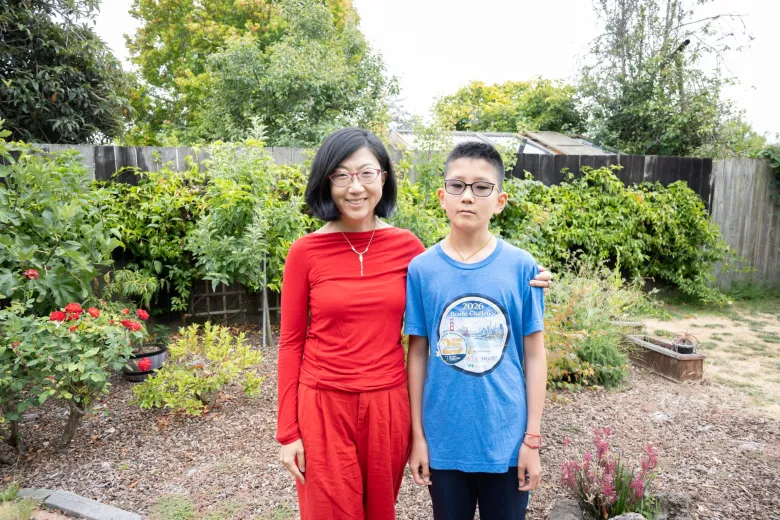 Kai and his mother, Mina Sun, in their backyard. Credit: Hope Muñoz/Berkeleyside
“I think he’ll do really well. It is definitely very competitive,” St. John, said. “There are some extremely bright students who are blind, and I definitely think he’s one of them.”
In Kai’s age group, students are tested in four categories: reading comprehension, chart and graph reading, proofreading, and speed and accuracy. Younger students also have a spelling category.
Kai has been focusing on the speed and accuracy category, where he says students listen to an audio recording and write it out in Braille in real time. They have 25 minutes to get as far as possible.
“In that one, if you Braille things incorrectly, you can get negative points. So, it sets people apart,” Kai said.
On Kai’s side of his upstairs bedroom, which he shares with his younger brother, Skyler, countless ribbons and trophies are on display. They prove Kai is a winner, jumping through hoop after hoop.
Sun says she is confident he will be successful in life, no matter what he chooses to do. Kai, sitting next to her, jokes, “If I’m in front of you, are you going to say that I’m going to fail in life? Probably not.”
His mother doubles down. She cites the high standard Kai holds himself to, and says he is very self-driven and motivated.
“I think he will accomplish great things,” Sun says.
Ally Markovich and The Associated Press contributed reporting to this story.
We know that most readers don’t get to the end of the article. But you did! To support our in-depth, rock-solid reporting, please consider making a donation to our nonprofit newsroom today. We rely on our readers — particularly the ones who read the whole story!
“*” indicates required fields