
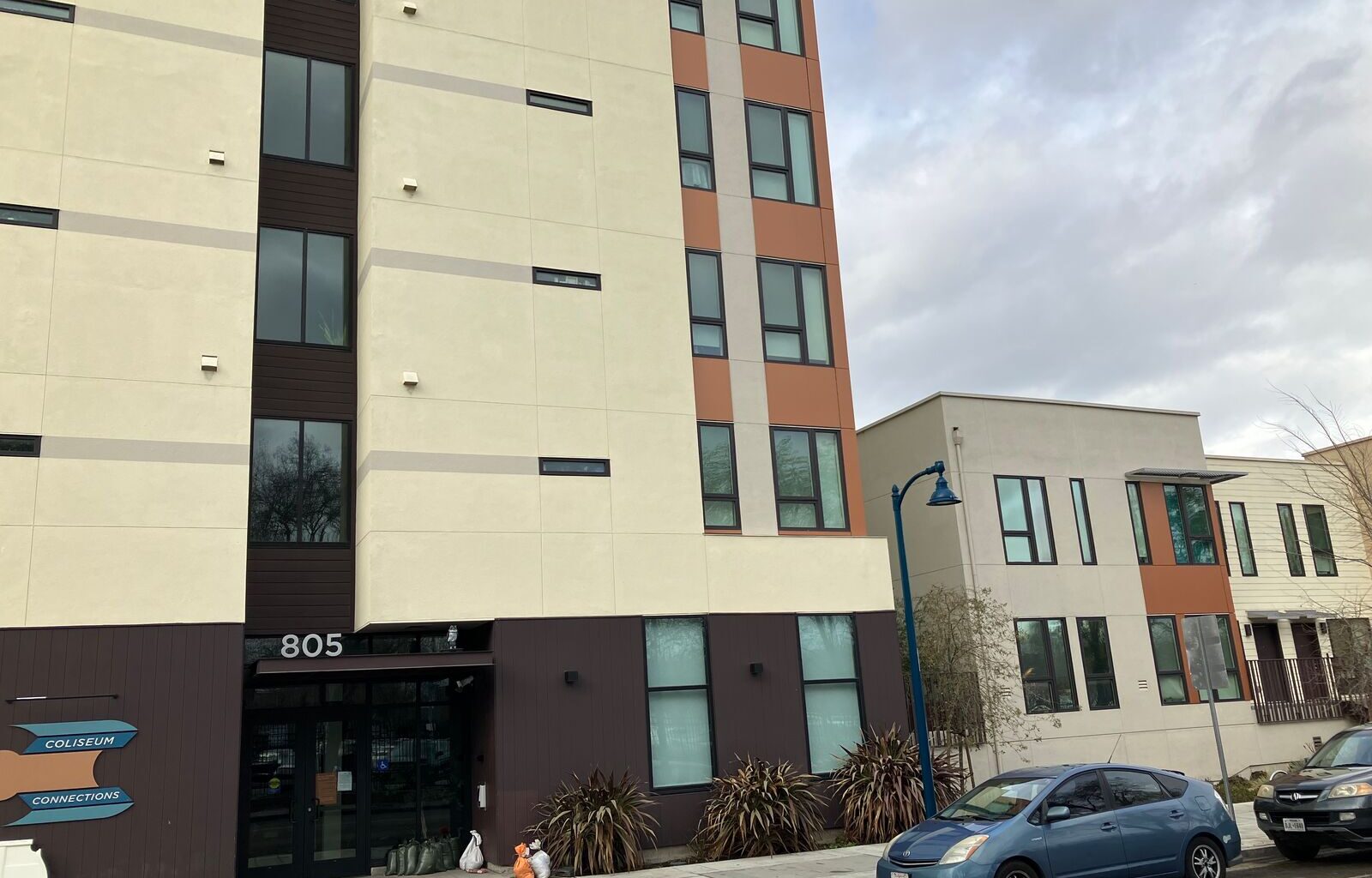
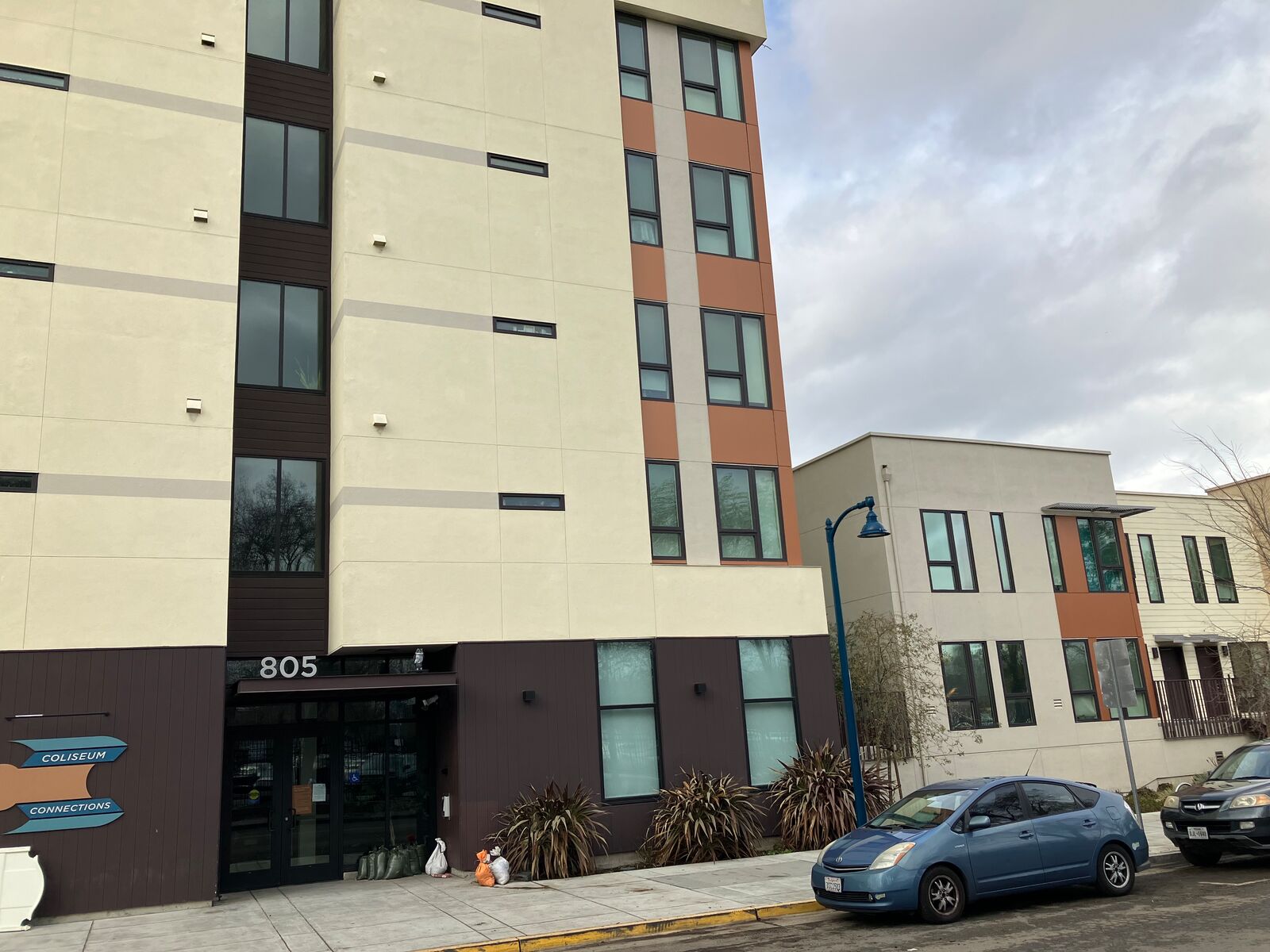
 Coliseum Connections opened on 71st Avenue in 2019. Credit: Natalie Orenstein/The Oaklandside
An East Oakland housing complex that made headlines when a flood displaced hundreds of residents for a year could soon see an ownership change.
The Oakland Housing Authority is beginning to explore taking over Coliseum Connections — a move that appears to be welcomed by most people and agencies involved.
“All the public lenders, BART and the lender — Citibank, support, as we do, OHA becoming an owner in the property,” said Michael Johnson, the current owner and developer of Coliseum Connections. This transfer would “help stabilize the property” after “tenants not paying rent on the heels of COVID and the eviction moratorium from 2020 – 2024,” Johnson wrote in an email.
It’s unclear what the Oakland Housing Authority’s exact role might be, and whether the agency could become the sole or a partial owner. OHA is a federally funded agency that operates about 1,600 public housing units in Oakland and administers Section 8.
Johnson’s company, UrbanCore Development, opened Coliseum Connections in 2019. The property has 110 units, spread among several townhouses and the large apartment building that flooded on New Year’s Eve 2022. Half of the homes are affordable for low-income residents, and the other half are market-rate. A number of families with children live at the site.
The property is located on BART land, near the Coliseum station, and Johnson pays rent to the transit agency.
As 2022 turned to 2023, a vicious storm hit Oakland, and water deluged the main building’s parking garage, damaging the electrical system throughout the property. Tenants had to evacuate on New Year’s Day. Nobody knew it was the last time they’d be able to sleep at home for months.
In the aftermath of the flood, tensions erupted, first between the tenants and Johnson and the property management company, FPI, and then between Johnson and the city. UrbanCore and FPI covered hotel costs for displaced renters for the first few weeks, but the city ended up shelling out more than $5.5 million after that, for both relocation payments and repairs, arguing that Johnson was responsible for paying back much of that.
Johnson instead filed a legal complaint against Oakland, arguing that poorly maintained city infrastructure was to blame for the flood damage. Meanwhile, at least four tenants sued the landlord.
Jasmine “Dream” Braggs, a former tenant who helped organize her neighbors after the flood, said the saga has left emotional “residue.”
“Every time I think about the rain this time of year, or the holidays, it brings back the trauma of it all,” Braggs said in a phone call last week. “Every time you see the Coliseum and drive by it, that’s what a lot of us think about.”
But the chaos that ensued after the flood is unrelated to the talks of an ownership transfer, according to the city.
“Like many affordable housing developments, it’s struggling with rent arrears,” said Oakland housing director Emily Weinstein. “It’s an ongoing concern across the industry.”
A number of local nonprofit developers successfully petitioned the county recently for a $15 million emergency fund to make up for missing rent since COVID-19.
The city, state, BART, and the housing authority are working together to “stabilize” the “distressed asset” and avoid foreclosure of Coliseum Connections, Weinstein said.
“In response to a request from sister government agencies, the Oakland Housing Authority began exploring whether OHA could participate in the effort to preserve affordable housing at the Coliseum Connections property,” said Laura Burch, a spokesperson for the agency. OHA is still in the “preliminary due diligence stage,” and it’s too early to share details on the possible outcome, she said.
In a joint letter to Johnson and associates in February, the city, county, and state housing departments, as well as BART, laid out a litany of compliance issues at the property.
“We have serious concerns related to the operation of the project and the well-being of the residents,” the authors wrote in the letter obtained by The Oaklandside.
They wrote that the owner mismanaged finances, failed to resolve health and safety issues at the property, was behind on rent to BART, didn’t adequately report updates to lenders, and lacked a business tax certificate for the property, leaving the owner delinquent by over $200,000.
The prior year, the state had sent the owner a notice of default on a loan for Coliseum Connections.
Alicia Trost, spokesperson for BART, confirmed that Johnson is delinquent in rent, saying, “BART is in active negotiations with the developer, City and other funding partners to resolve the matter.”
Based in Oakland, UrbanCore both develops and consults on the development of market-rate, mixed-income, and affordable housing. UrbanCore owns a number of properties, with most of its large developments located in San Francisco and Sacramento.
Another high-profile development deal with Oakland was squashed by the City Council in 2022, after Johnson received numerous extensions to find financing and overcome disruptions caused by the pandemic.
Court records indicate Fannie Mae filed a lawsuit last month against UrbanCore for breach of contract at a different property containing several buildings on E. 25th Street in East Oakland. The federal housing financer alleges that Johnson’s company failed to pay to correct documented habitability issues at the property, endangering residents.
Johnson said in late October that he hadn’t seen the lawsuit.
“*” indicates required fields