
San Diego State’s quest to join the Pac-12 Conference dates back so far — six decades — that the conference had a different name, fewer teams and a simple response whenever the Aztecs came knocking: Go away.
That the dream is days away from finally becoming a reality is almost unimaginable to some longtime fans. To others, it’s not what they imagined.
The most passionate Aztecs football fans spoke about the opportunity to compete annually against USC and UCLA, adding Washington and Oregon to the conversation when those teams gained national prominence.
Oregon State and Washington State were never part of that conversation. They are now, as the two holdovers from a conference that collapsed three years ago.
On Wednesday, the Aztecs will join the Beavers and Cougars in the reconstituted conference, along with Boise State, Colorado State, Fresno State and Utah State from the Mountain West. Texas State was added to give the conference eight football-playing schools, the minimum number required by the NCAA for FBS recognition.
Gonzaga, which does not field football, is the conference’s ninth member.
SDSU was on the cusp of joining the Pac-12 in 2023. USC and UCLA had announced plans to leave the conference for the Big Ten, and the Pac-12 targeted the Aztecs as a way to keep the league’s footprint in Southern California.
But on Aug. 4, 2023, eight other Pac-12 schools followed the Trojans and Bruins to other conferences. SDSU’s dream was dashed.
“All the work we had done, the time (put in), it took a good six months to get over that,” SDSU athletic director John David Wicker said in the aftermath.
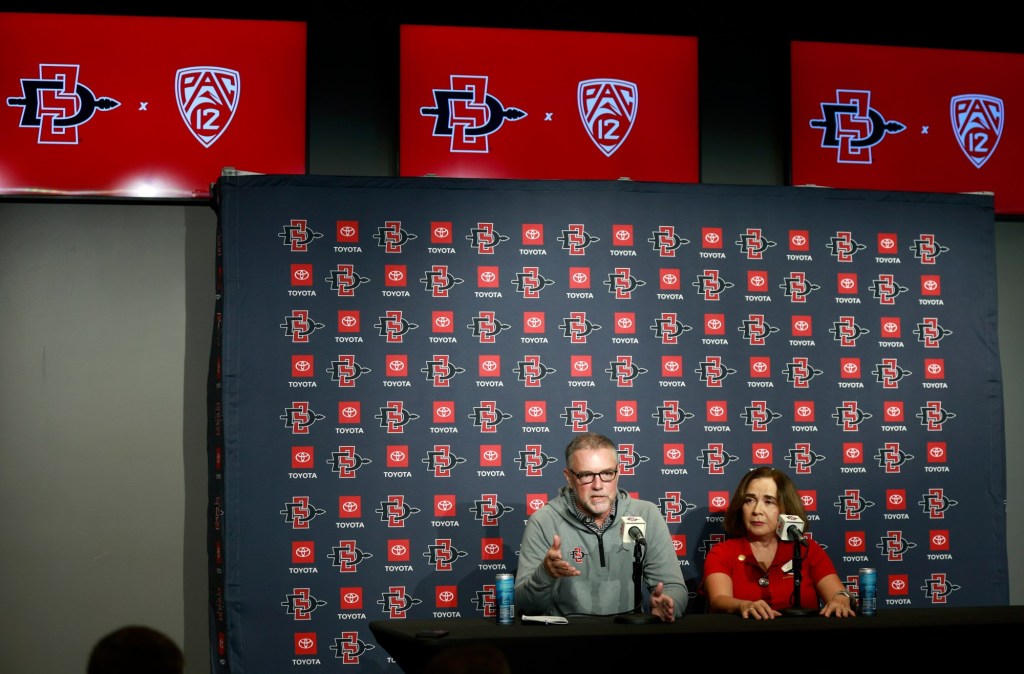
 San Diego State University Athletic Director John David Wicker speaks after a news conference announcing the school is entering the newly re-formed Pac-12 at Snapdragon Stadium on Thursday, Sept. 12, 2024 in San Diego, CA. (K.C. Alfred / The San Diego Union-Tribune)
That explained, in part, why Wicker was overcome with emotion on a September morning in 2024 as he and SDSU president Adela de la Torre announced the Aztecs had been accepted into the new Pac-12.
“I’m thrilled for San Diego State, our fans, our alumni, our donors,” said Wicker, taking a breath as his voice caught on the words. “We’ve worked hard for this. … Everyone feels like this is the appropriate place to be with the current evolution of college athletics, and we’re excited about what it means for us.”
SDSU’s Pac-12 aspirations date back to the 1960s, when the football program gained national recognition under coach Don Coryell. The Aztecs had a stretch from mid-1965 until late 1970 in which they went 55-1-1 on the gridiron. The period included two small college national championships and a No. 14 national ranking.
With it came aspirations of testing themselves against the best teams in the nation.
School president Malcolm Love announced during a banquet honoring the 1967 team that SDSU would be leaving the California Collegiate Athletic Conference. There was a dispute over grants-in-aid to athletes (the CAA voted down a proposal to increase grants from $500 to $1,000), and the Aztecs wanted to position themselves for bigger and better things.
“We’re all excited — the coaches, the players, everyone,” Coryell said then. “Being an independent is a step in the right direction to the Pac-8. And the Pac-8 is our goal. We don’t make any bones about it.”
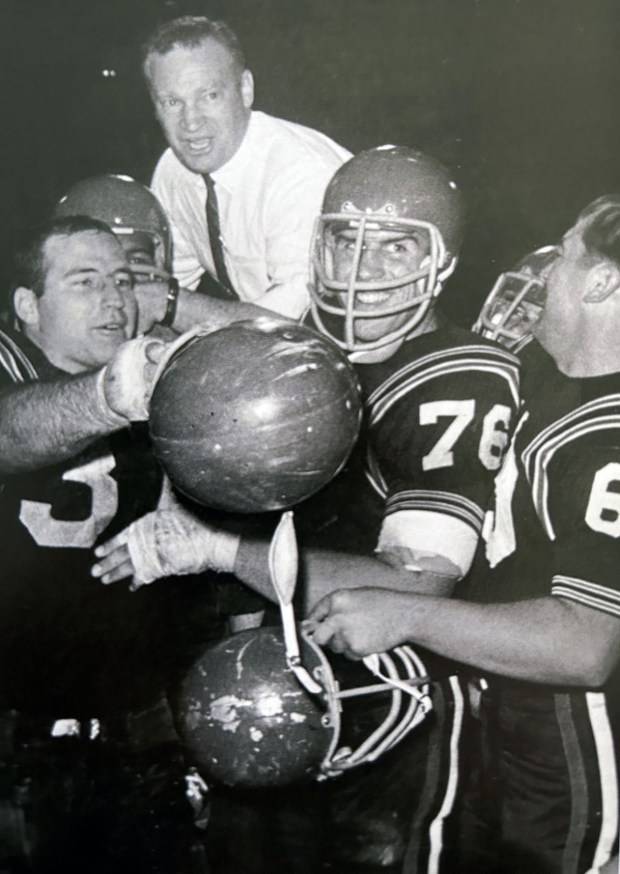 Steve Duich (76) and his Aztecs teammates carry coach Don Coryell off field after capping 11-0 season in 1966.
SDSU anthropology professor Seth Mallios, author of “100 Seasons of Aztec Football,” noted that “the optimism was always there.”
“The football team was always good enough,” he said. “And there are these great soundbites from people like (coach) John McKay at USC saying, ‘We’re never going to let San Diego State get in.’
“He didn’t say why, but it was clear they had everything to lose by elevating San Diego State to the same level. Recruiting the San Diego market was so huge.”
USC and UCLA saw no upside to the Aztecs joining the conference and gaining equal footing when it came to recruiting Southern California in general and San Diego County in particular.
When the Pac-8 eyed the two Arizona schools for expansion in 1976, then-SDSU AD Ken Karr reaffirmed that the Aztecs had their sights on “whatever conference the major conference on the West Coast will become … and that looks like some form of the Pac-8.”
In 1978, Arizona and Arizona State joined what became the Pac-10.
The Aztecs remained on the sidelines. They joined the Pacific Coast Athletic Association after moving to Division I in 1969, and jumped to the Western Athletic Conference in 1978, when Arizona and ASU went big-time.
For decades, SDSU got no closer to a major conference.
A 1985 headline read: “Don’t expect USC or UCLA to hold door open for Aztecs.”
“If you want my opinion,” UCLA AD Peter Dalis said at the time, “I think we ought to be reducing our number of members, not adding new ones.”
Added USC president Dr. James Zumberge: “I would say, at this point in time, that it’s well-nigh an impossibility.”
Zumberge’s comments came after SDSU president Thomas B. Day had broached the idea of the Aztecs joining the Pac-10. A straw poll conducted by the conference’s athletic directors on the matter was 10-0 against expansion.
“I just don’t see it happening, not in the short term,” Zumberge said. “The general impression I’ve received from the CEOs and athletic directors is that the Pac-10 is at its full complement.
“I think all of this talk has been started by Penn State becoming part of the Big Ten (in 1990, after a century as an independent). But the Big Ten-Penn State issue has nothing to do with us or my view on the subject.”
 Pac-12 Conference logo (Pac-12 Conference)
In 1985, SDSU hired Fred Miller, who was Arizona State’s AD when the school joined the Pac-10. But the 1990s came and went with Pac-10 membership unchanged. It remained that way until Colorado and Utah joined in 2011, making it the Pac-12.
The Aztecs moved again, to the Mountain West, at the turn of the century. They nearly moved with Boise State to the Big East as football-only members in 2013, but that fell through when the Big East collapsed.
And so it goes.
“It was so crazy when USC and UCLA were the first two to go to the Big Ten,” Mallios said. “In my mind, that’s when we were being pursued by both the Pac-12 and the Big 12, Snapdragon Stadium was about to open and so many things were lining up perfectly
“As soon as I read that USC and UCLA were going, it was like ‘Damnit, not again.’ Just as we’re about to get the invite to the Pac-12, they split. And then all hell breaks loose.”
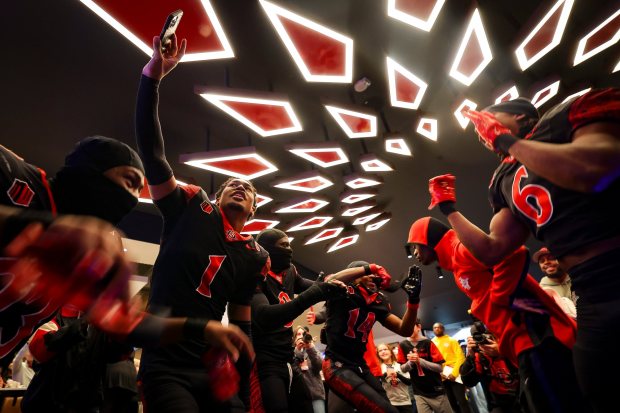 San Diego State opens the 2026 football season against Portland State at 6:30 p.m. at Snapdragon Stadium. (Meg McLaughlin / The San Diego Union-Tribune)
Longtime season-ticket holder Ken Ables attended his first Aztecs game in 1962. His father, Tom Ables, began the family tradition in 1947. Ables acknowledges that this is not his father’s Pac-12, but he is pleased with the move nonetheless.
“We’re not in a conference with USC and UCLA and Oregon and Washington, but I do think it’s an upgrade from the Mountain West,” Ables said. “The best teams from the Mountain West are all moving up. … It should be the best conference outside of the Power Four conferences.”
Added Ables: “Oregon State may not be Oregon, but it’s not Wyoming, either.”
When the move was announced two years ago, one fan on an SDSU chat board wrote: “This is a far cry from the old Pac-12. More like the Pacific Mountain West.”
“There’s always going to be naysayers,” Wicker said then. “There’s always going to be people whose glass is half empty and if that’s how they have to deal with it, I don’t know, you can choose to wake up and be angry about something (or) you can choose to wake up and look at the best of something.
“Obviously, what was Aug. 4, 2023 (when the Pac-12 collapsed), is different than it is today, but that doesn’t mean that we’re not going to go out and bust our tail to make it the best thing it can possibly be and keep moving up.”