
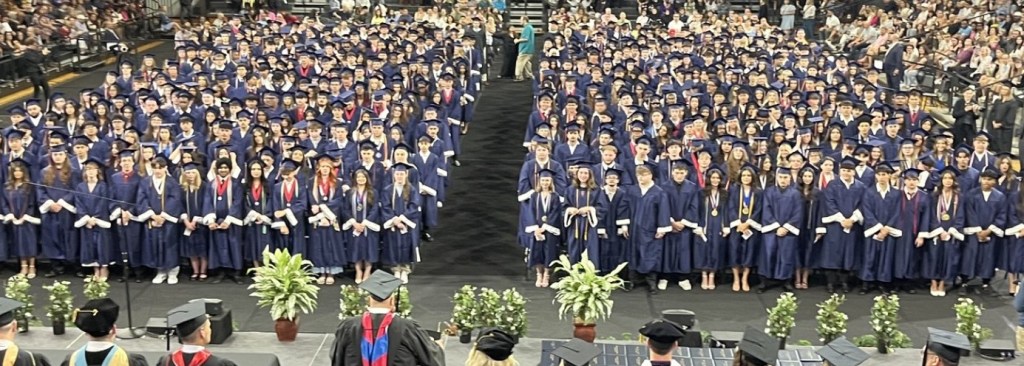
Out of the 8,974 students who graduated from a high school in Macomb County in the 2024-25 school year, 5,336, or 61%, of those students decided to pursue college.
Out of all of the Macomb County schools, International Academy of Macomb had the highest percentage of its grads choosing to pursue college at 94%.
Principal Laura Strong wrote in an email that her school having the highest percentage of college-going grads did not surprise her.
“The vast majority of our students pursue postsecondary education after graduation. They recognize the value of continuing their learning and are eager to challenge themselves academically, whether through a four-year university, community college or another educational pathway,” she wrote.
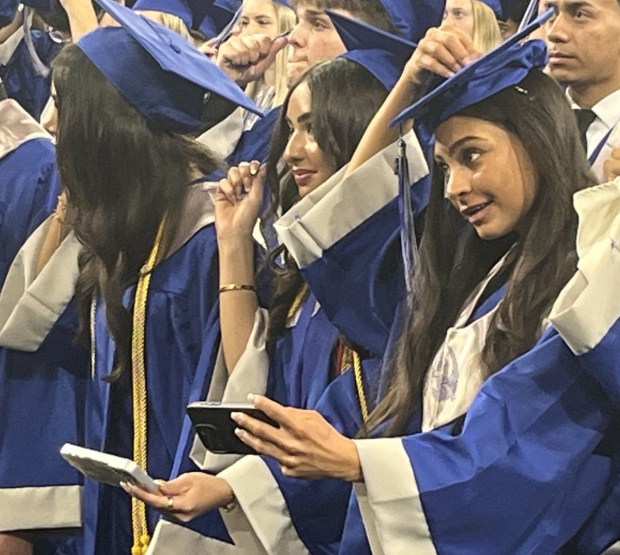 Smiling Eisenhower High School students turn their tassels at the school’s commencement ceremony at Oakland University in Rochester. (COURTESY UTICA COMMUNITY SCHOOLS)
The numbers
Out of all of the students who graduated in Macomb County in the 2024-25 school year, 24% went to community college and 37% attended a four-year university, according to MI School Data.
The schools with the highest percentage of students who went to college are International Academy of Macomb (94%), Eisenhower High School (80%), Dakota High School (77%) and Adlai Stevenson High School (75%).
Of these schools, three of them also had the most populated graduating class in Macomb County: Dakota High School (616 students), Eisenhower High School (578) and Adlai Stevenson High School (563).
Four of these schools also had the highest percentage of graduates who attended a four-year university: International Academy of Macomb (92%), Eisenhower High School (54%), Dakota High School (48%) and Adlai Stevenson High School (47%). Utica High School also had 47% of its graduates attend a four-year university.
The least populated schools in the county did not have the smallest percentage of students enrolled in college. The least populated schools were Mount Clemens High School (43 students, 26% enrolled in college, ranked 33rd in the county), New Haven High School (62 students, 53% enrolled in college ranked 25th in the county) and Arts Academy in the Woods (66 students, 41% enrolled in college, ranked 28th in the county).
Warren Woods Enterprise High School had 39 students in its graduating class and less than 10 of them went to college, so the data could not be accurately calculated because the number showed up as “<10” on the MI School Data website. Mount Clemens High School had 43 students in its graduating class and while 11 of them went to college, less than 10 of them went to community college or a four-year university, so that data could not be calculated for the same reason.
The schools with the lowest percentage of students who went to college are Utica Community Schools Alternative Learning Center (14%), Lake Huron Virtual and Hybrid High School (19%) and Michigan Collegiate High School (24.36%).
The schools with the highest percentage of graduates who attended community college are Cousino Senior High School (32%), Armada High School (32%) and South Lake High School (31%).
All of the schools with their percentages of graduates who pursued college after graduation in the 2024-25 school year are listed below:
International Academy of Macomb (94%)
Eisenhower High School (80%)
Dakota High School (77%)
Adlai Stevenson High School (75%)
Armada High School (72%)
Sterling Heights Senior High School (72%)
Henry Ford II High School (72%)
Utica High School (71%)
Cousino Senior High School (68%)
Chippewa Valley High School (68%)
Romeo High School (68%)
L’Anse Creuse High School North (65%)
Anchor Bay High School (65%)
Warren Mott High School (64%)
Fraser High School (63%)
L’Anse Creuse High School (63%)
Warren Woods Tower High School (61%)
Macomb Intermediate School District (61%)
Fitzgerald Senior High School (59%)
South Lake High School (57%)
Lake Shore High School (56%)
Lakeview High School (56%)
Richmond Community High School (55%)
New Haven High School (53%)
Center Line High School (50%)
Roseville High School (43%)
Arts Academy in the Woods (41%)
Clintondale High School (39%)
Lincoln High School (32%)
Eastpointe High School (30%)
Warren Consolidated Community High School (27%)
Mount Clemens High School (26%)
Michigan Collegiate High School (25%)
Lake Huron Virtual and Hybrid High School (19%)
UCS Alternative Learning Center (14%)
The top schools
International Academy of Macomb Principal Laura Strong wrote that students arrive at the school being well-prepared due to the foundation they gained from attending their home middle schools throughout Macomb County.
“International Academy of Macomb has a strong college-going culture and many of our students enter the school with aspirations for higher education,” she wrote. “Many have intentionally chosen a rigorous academic environment that aligns with those goals.”
Strong wrote that the International Baccalaureate (IB) program also prepares students to develop academic skills, resilience and global perspective that prepare them for college.
To increase college preparedness, she wrote that the school also provides college counseling, assistance with applications and essays, financial aid and FAFSA guidance, scholarship information, college fairs, campus visits and opportunities to learn about how to earn college credits through IB coursework and exams.
Strong wrote that the school also teaches its students to use Xello, a college, career and future-readiness planning program.
Aside from those resources, Strong wrote that one of the school’s most impactful resources is an annual alumni event where former students return to the school to talk with students about college, careers and life after graduation.
“Hearing directly from graduates who have recently navigated these experiences makes the process feel more tangible and accessible for students. The event has been incredibly meaningful and has helped students build connections while gaining valuable insight into different educational and career pathways,” Strong wrote.
Utica Community Schools (UCS) had two of the top four schools in terms of percentage of students attending college (Eisenhower High School and Adlai Stevenson High School). The district also had the school with the lowest percentage of students who attended college after graduation: UCS Alternative Learning Center (ALC).
Mark Dziatczak, the assistant superintendent for teaching and learning, wrote in an email that the district works with students to make sure they have plans after high school, with or without college. He wrote that this past school year, the district worked students to make sure that as many of them as possible completed FAFSA.
“We want each student to pursue their dreams and change the world. It is easier to do that with additional learning beyond high school,” he wrote.
Dakota High School was number three on the list with 77% of its students choosing to attend college post-grad.
Kevin Koskos, the Dakota High School principal, said that over the last few years, the school has expanded its counseling department to be more proactive with kids instead of being responsive.
“Our counselors have really, really been focusing on getting into classrooms, helping kids be focused on their future and understanding, you know, the options that are available to them,” he said.
He said the school also has a student success facilitator who has helped students complete FAFSA. Koskos said that while many of their students do pursue a college education after high school, they also recognize that college isn’t for everyone.
“There’s, you know, a lot of ways for kids to find very prosperous opportunities after they graduate but I think it’s a culture effort on our part as well as an intentional, strategic effort by our counselors to really really focus on, you know, just that forward thinking and goal setting mentality amongst our students,” he said.
Koskos also said that his school’s success of getting so many of its students to go to college isn’t just because of their efforts, he said it’s also because of universities making themselves more accessible through scholarships and financial aid.
Koskos said that more students at the school have started doing dual enrollment, or getting a head-start on their college education.
“I think there’s a lot of different things that are happening simultaneously that are setting our kids up for success, giving them a pathway, creating a level of focus with them that we maybe we haven’t had in the past,” he said.
He said that students have also gone on to pursue skilled trades or even to start their own businesses right out of high school.
Regardless of where students go after high school, though, Koskos said that much of their student success can be attributed to the community.
“Our community is a wonderfully supportive community,” Koskos said. “They have high expectations for us and for their kids and we work and partner wonderfully with our, you know, with our community.”
He said that parents have become increasingly involved in their kids’ school lives and that that is always a factor of success.
The bottom schools
Dziatczak wrote that the ALC is a place for students who have unique needs and need an alternative path to graduate high school.
“Our graduate rates are lower here because alternative paths sometimes take longer than the traditional 4-year student,” he wrote.
Dziatczak wrote that there are sometimes students who need an extra semester or two to graduate high school. He wrote that there are also students at the ALC who dual enroll at Macomb Community College and who take Advanced Placement (AP classes).
The other schools at the bottom of the list like Lake Huron Virtual and Hybrid High School and Michigan Collegiate High School did not respond to requests for comment by press time.