
For most of Southern California, the nightmare quake has one name attached to it: the San Andreas. It’s the fault people watch, blamed for the long-promised “Big One,” and it has stayed ominously quiet in the south since the 1850s.
A new study says the danger no longer sits on that fault alone. The strain is at a thousand-year peak, and a single mountain pass may decide whether a second fault joins in, turning a big quake into something far worse.
Stress at record levels

The warning comes from a team led by Dr. Liliane Burkhard, a researcher at the University of Bern in Switzerland. She and her colleagues set out to measure how much strain the region’s two major faults carry right now.
Faults are cracks where slabs of the Earth’s crust grind past each other and lock. While they stay stuck, tectonic stress builds in the rock around them year after year. Then the fault slips, and all that stored strain bursts out as an earthquake.
Burkhard’s group found this stored strain has climbed to a level the region hasn’t seen in a thousand years. In places, it has already passed the highest mark the model could find across that entire record.
Where two faults nearly meet
Two heavyweight faults carry most of that strain – the San Andreas and the San Jacinto. Northeast of Los Angeles they nearly meet at Cajon Pass, a rugged notch where a break on one fault might jump to the other.
Geologists have a name for a junction like this. They call it an earthquake gate – a spot that decides whether a rupture keeps tearing into the next fault or runs out of room and stops.
A gate that stays shut keeps a quake bottled up on one fault, bad but survivable. Swing it open, though, and one fault hands its energy straight to the next. Two quakes, fused into one.
The gate can swing open
History shows the gate doing both. The last giant quake here, the 1857 Fort Tejon earthquake, tore through more than 200 miles of the southern San Andreas before stalling at the pass, sparing the San Jacinto.
The gate doesn’t behave the same way every time. Whether it opens depends on the state of the faults on either side when the shaking hits, and those conditions change over centuries.
Other quakes pushed straight through the pass and broke both faults as one. Burkhard’s team wanted to know which way today’s conditions are leaning.
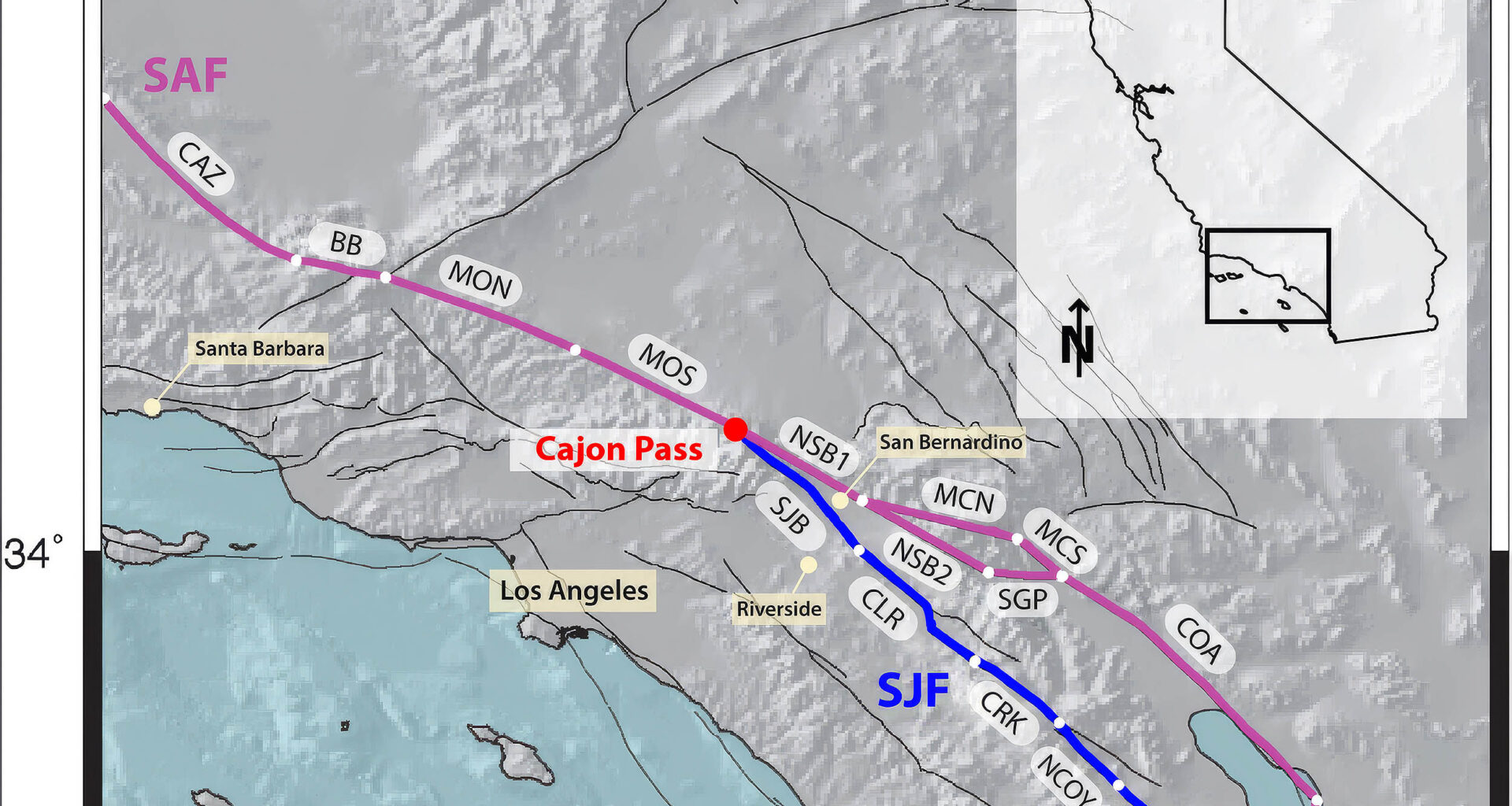
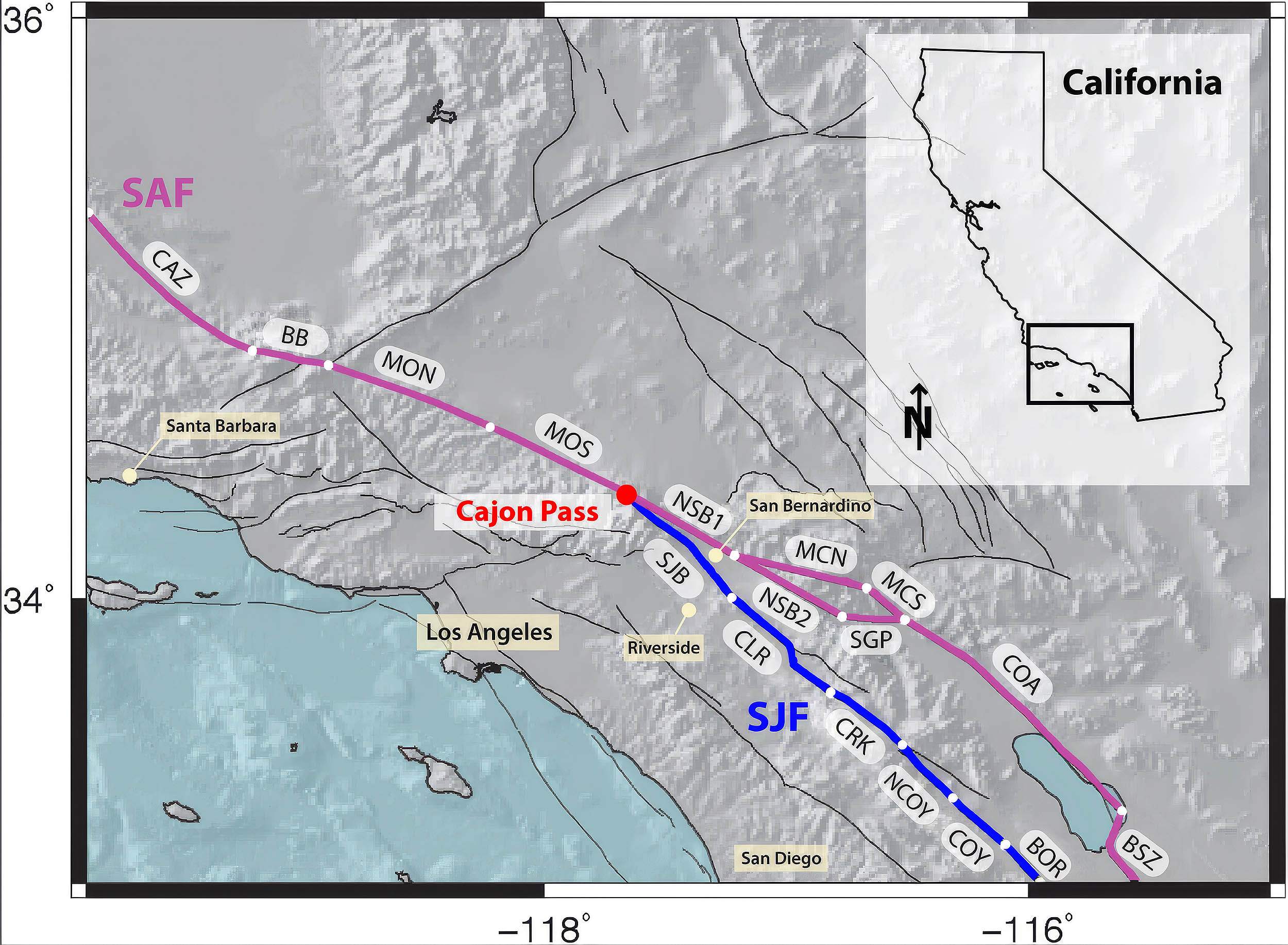 The San Andreas Fault System (SAFS) in Southern California, with the main SAF fault trace in purple and San Jacinto Fault trace in blue. Segment boundaries used in this study are marked by white dots with abbreviated names specified in Table 1; the fault configuration is simplified from Scharer and Yule (2020). Cajon Pass is indicated in red. Credit: Solid Earth. Click image to enlarge.Both California faults dangerously aligned
To weigh that, the team built a model that replays a thousand years of the region’s earthquakes, reconstructed from carbon-dated soil, tree rings, and written accounts of past shaking.
The model tracks how each earthquake adds stress to its neighbors and how that strain creeps back during the quiet years.
Running it forward turned up something the team hadn’t expected to see so clearly. The real risk tracks two things at once: the strain each fault carries and how evenly the two share it.
Right now, both faults are running high – and nearly in step. One stretch of the San Jacinto has pushed past any strain the model recorded in a thousand years, and the San Andreas beside it sits only a little lower. Close enough, almost, to move as one.
Matched tension like that appears to be what swings the gate open and lets a rupture jump across.
The faults showed it in 1812, when one study found a single earthquake tore through both at once. Researchers had long suspected the two could pair up. Seeing it this clearly in the stress is the new part.
Millions near California’s faults at risk
A quake that broke both faults through the pass would dwarf one trapped on a single fault.
The shaking would slam the most densely settled parts of Southern California, including the Los Angeles Basin and the inland valleys to the east. Tens of millions of people would be affected at once.
The pass itself is a chokepoint. Major highways, rail lines, and power links thread through it, so a rupture there could sever key routes just as millions need to evacuate or receive supplies.
For planners, the strain map becomes a working tool. It helps identify where to strengthen buildings and stage supplies. It also feeds the state’s broader forecast, which already puts a major California earthquake as highly likely within the next 30 years.
A warning, not a date
What the study settles is the present state of the system. The southern San Andreas and San Jacinto carry more strain than at any point in the past thousand years, tensed in the pattern that preceded their worst shared earthquakes.
None of that fixes a date on the calendar. “The study is not a prediction of when an earthquake will occur,” said Burkhard, who treats the work as a planning tool rather than a forecast.
What changes now is the quality of the warning. Instead of a vague sense that the Big One is overdue, California has a sharp, physics-based picture of how primed its faults are and a clearer list of scenarios worth preparing for.
The study is published in the Journal of Geophysical Research: Solid Earth.
—–
Like what you read? Subscribe to our newsletter for engaging articles, exclusive content, and the latest updates.
Check us out on EarthSnap, a free app brought to you by Eric Ralls and Earth.com.
—–