
As America approaches its 250th birthday, celebrations are taking shape across the country. There will be parades, fireworks, historical reenactments and commemorative events.
But Oakland County Circuit Judge Michael Warren hopes Americans will also take time to revisit a document that he believes is too often overlooked — the Declaration of Independence.
Warren explores the nation’s founding charter in his new book, “The Revolutionary Words that Forged America: The Definitive Guide to the Declaration of Independence,” a comprehensive examination of the Declaration’s history, philosophy and enduring relevance. The book provides a line-by-line analysis of the document and its often-overlooked 28 grievances against the British Crown.
“I’ve been intensely inspired by the Declaration of Independence since high school,” Warren said. “The words of the Declaration have been my polestar my entire adult life.”
The idea for the book grew out of the Patriot Week Foundation’s American History and Civics podcast, where Warren and others examined the Declaration line by line. What he expected to be a relatively straightforward project quickly became something much larger.
“As America 250 loomed, I was impelled to convert the podcast into a book,” he said. “I thought this would be a short-term, easy project. Several years and over 210,000 words later, I realized more than ever that the Declaration is a miraculous achievement not only for America, but for the world.”
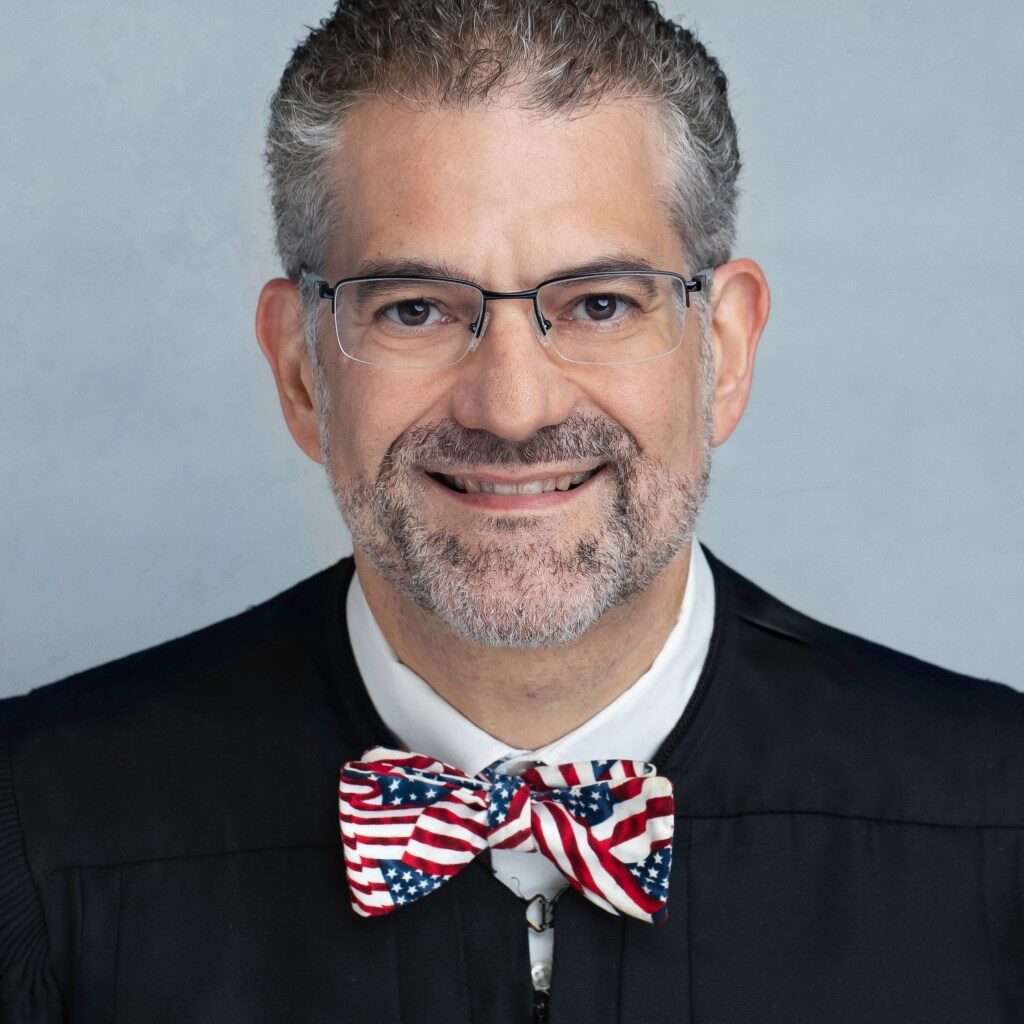
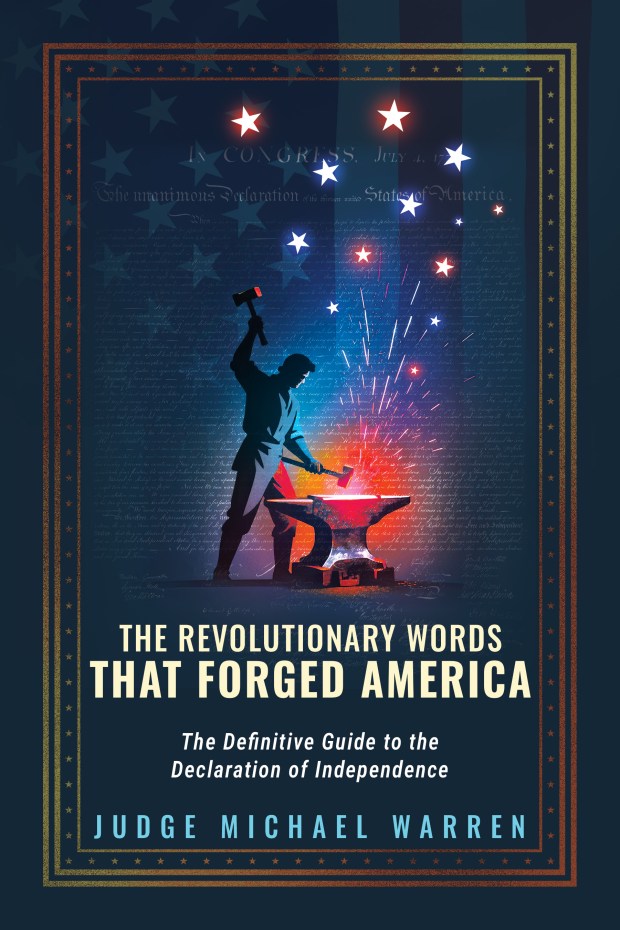 Oakland County Circuit Judge Michael Warren explores the nation’s founding charter in his new book, “The Revolutionary Words that Forged America: The Definitive Guide to the Declaration of Independence.” (Photo courtesy of Michael Warren)
More than a famous sentence
Ask most Americans what they know about the Declaration of Independence, and they can probably recite a portion of one sentence:
“We hold these truths to be self-evident … .”
Warren agrees that it is the document’s most stirring passage, but he believes many people miss the larger story.
“Most people hold a romanticized view of the American Revolution and barely understand anything about the tyrannical oppression the colonists were fighting against,” he said.
That’s why he devoted significant attention to the Declaration’s 28 grievances against King George III.
“Without the grievances, the rest of the Declaration is just a beautiful, empty shell of wonderful poetry,” Warren said. “Americans are rebelling against a bloody tyranny, and the grievances explain why.”
Many of those complaints, he notes, remain surprisingly relevant today because they deal with questions of government power, individual rights and the rule of law.
The foundation beneath the constitution
Warren views the Declaration not as a historical artifact, but as the philosophical foundation of America’s entire legal system.
“The Declaration is the equivalent of the articles of incorporation of our nation,” he said. “The Constitution is the equivalent of bylaws — how the government is to work.”
He points to several grievances that directly influenced the Constitution’s structure. One condemned the British Crown for effectively shutting down courts in North Carolina. Another protested the denial of jury trials.
“We now have a separation of powers, with an independent and robust judiciary,” Warren said. “I’ve personally presided over 420 jury trials, proving that the right to a jury is alive and well.”
For Warren, the Declaration’s six core principles — the rule of law, unalienable rights, limited government, the social compact, equality, and the right to alter or abolish oppressive government — remain central to nearly every debate Americans continue to have.
“Equality is a key first principle, and it is at the heart of the American experiment,” he said.
He notes that abolitionists, women’s suffrage leaders, and civil rights advocates all relied on the Declaration’s promise of equality to expand rights and opportunities for more Americans.
“Abolitionists, women suffragettes, like Susan B. Anthony and Elizabeth Cady Stanton, and civil rights leaders, like Frederick Douglass and Rev. Martin Luther King Jr., relied on the promise of equality to expand who belongs in the social compact and provide rights and equality to all Americans,” he said. “That debate still rages today. Likewise, what rights each individual possesses is always hotly contested.”
Surprising discoveries
Despite decades of study, Warren says his research still revealed surprises. One of the most striking involved the very first grievance listed in the Declaration.
“The king refused to allow very high taxes on the slave trade,” Warren said. “Virginia and other colonies wanted to limit the slave trade, but the king favored it, so he refused to approve the laws. (Thomas) Jefferson, a slaveholder himself, condemns the king for refusing to allow Virginia from taxing the slave trade.”
The discovery challenged some common assumptions about the period and highlighted the complexity of the historical moment.
“Amazing,” Warren said.
A message for the next generation
As the nation prepares to celebrate its semiquincentennial, Warren believes the greatest threat to America is not external, but internal.
“At the core of this menace is something exceedingly simple,” he said. “There is widespread ignorance and disdain of the founding principles and history of America.”
His concern is not merely academic. He sees the Declaration as a living document that continues to offer guidance about citizenship, freedom and self-government. If he could encourage Americans to focus on one idea from the Declaration, it would be the concept of unalienable rights.
“The whole point of government is to protect your God-given unalienable rights,” Warren said. “Most people probably do not understand this today.”
Looking ahead to America’s next 250 years, Warren believes the Declaration still has much to teach. In fact, when asked what lessons it offers about citizenship and self-government, his answer is strikingly simple.
“Everything.”
As Americans gather to celebrate the nation’s founding, Warren hopes they will look beyond the fireworks and festivities to revisit the revolutionary words that launched a nation, and continue to shape it nearly two and a half centuries later.
In his words
America’s Foundation
“The Declaration of Independence forever transforms our understanding of equality, liberty, and the proper role of government.”
Why the grievances matter
“Without the grievances, the rest of the Declaration is just a beautiful, empty shell of wonderful poetry.”
On unalienable rights
“The whole point of government is to protect your God-given unalienable rights.”
A warning for modern America
“The most serious threat to America does not spring from overseas. The threat is from within.”
Why young people should care
“Younger generations are the great heirs of this Declaration of universal principles. We need to revive and rely on it once again.”
His favorite passage
“We hold these truths to be self-evident … .”
“It lays out America’s first principles of the rule of law, unalienable rights, limited government, equality, and the right to alter or abolish oppressive government.”