
For more than 120 years, the Jewish Free Loan Association has had its finger on the pulse of the economic concerns of Los Angeles residents. This is because they have issued interest-free loans to people of all background and needs.
Throughout the decades, they have developed multiple loan programs that respond to needs. In 2026, some of the most intense needs include student loan debt relief, disaster relief and small business loans.
Rachel Grose, the executive director at JFLA, said she has noted many changes since she first started with the organization 24 years ago. One of the major shifts is a disappearing middle class. The clients who once came to Jewish Free Loan Association were the “working poor.” Now, more often, they’re two-income families with professional jobs — and no safety net.
“What has shifted over time, and this is really since 2008, is that the middle class are now the working poor because they are living paycheck to paycheck,” Grose said. “They can be teachers — people with real jobs — two-parent families with two incomes. The cost of living in LA is extremely high.”
Often, she said, those families don’t have the savings to handle additional expenses when something unexpected happens.
The JFLA was founded in 1904 to give interest-free, fee-free loans to individuals and businesses who needed them regardless of their religion, ethnicity, gender or background. Loan recipients must be at least 18 years old and must be able to provide two guarantors for their loans.
The goal was to help people who had urgent needs that might not qualify for traditional loans and would otherwise have to rely on high-interest credit cards. The interest-free loans were designed to promote self-sufficiency and dignity.
Grose said that on her first day with the organization, she opened a thank-you note from a mother who had borrowed just $500. She used it so her children could pick out school clothes and supplies at Target rather than the thrift store. The mother said it made her children feel so much better.
“We’re not talking a lot of money — $500,” Grose said. “LA is an expensive place and a small amount of money had a big impact on a family. I’ve never let go of that.”
The loans, she said, preserve people’s dignity and help them to move forward. As inflation continues to plague the budgets of everyone, the JFLA has seen an increasing amount of senior citizens showing up in their caseload.
“In Los Angeles, senior citizens are the largest group of people becoming homeless,” Grose said. “People who worked their whole life are now on a fixed income and it doesn’t cover their basic living.”
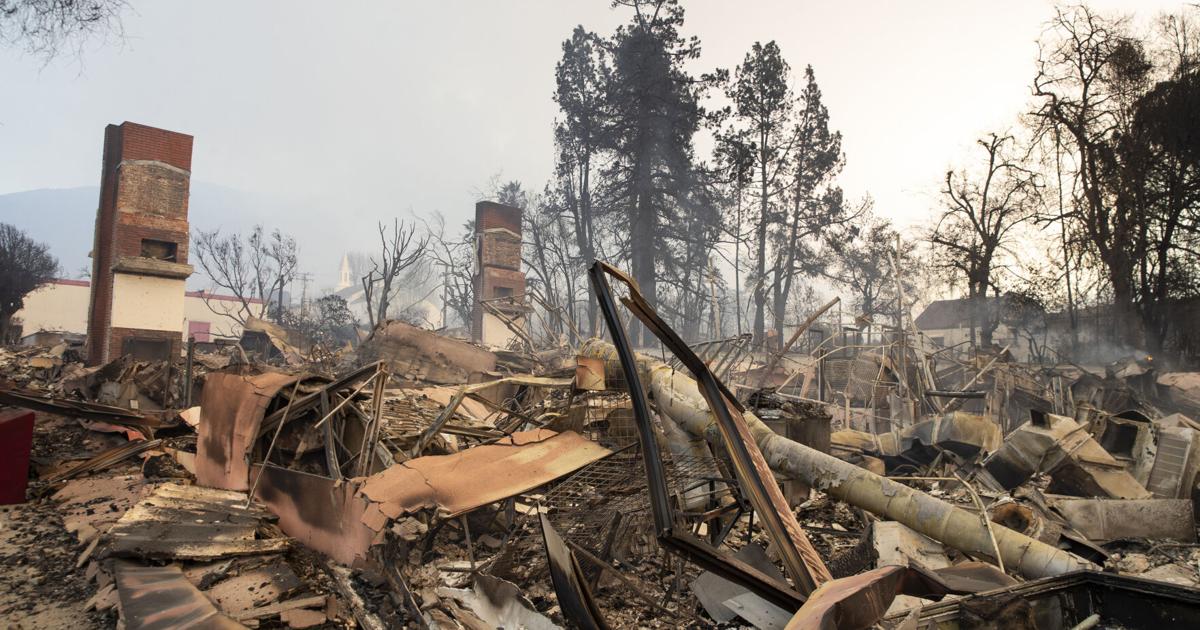
When fire roared through neighborhoods in Pasadena and Palisades, some insurance adjusters moved slowly. By the time policies kicked in — if they ever did — families already needed backpacks, bedsheets, and a way to get their kids back to school. That’s when the calls started coming in to Jewish Free Loan Association.
“That was a real crisis,” Grose said. “I give my team a lot of credit — some of them had to evacuate. Some people had friends or relatives who had to evacuate staying with them. We were each going through the fires in our own way. Everyone was scared and yet, all day long we were doing this work.”
Anne-Marie Molina shared her story with JFLA about how the organization made her family’s recovery possible after the Eaton fires. They lived in Pasadena with their five children and four pets. They did not have renters insurance and had to pay for rent on their home and temporary housing out of pocket.
“We couldn’t find a space big enough for all of us, so our family was split up,” Molina wrote. “We maxed out credit cards and drained our savings just trying to get by. When we finally returned home, we had to replace all of our furniture — and the stress was overwhelming.”
The JFLA loan, Molina said, helped them to reunite under one roof and put air filters in every room without having to be overwhelmed by new debt.
Two other demographics experiencing great need right now include students and small businesses. Increases in tuition and federal changes in student lending rules that have made it harder to access loans have students turning to JFLA.
“We cannot meet the need with the number of students who are coming to us,” Grose said.
As of July 2026, the Grad PLUS loan is being eliminated and loans to graduate students are capped at $20,500 per year or $100,000 total. Professional students are limited to $50,000 per year or $200,000 total. Parent loans are also getting new annual and lifetime caps at lower levels.
Grose points out that the small business community has never fully recovered from the COVID pandemic.
“We’re making many, many more loans and supporting small businesses since COVID than we ever have,” Grose said.
Other funds may not have as high demand as those categories, but they help to chart two decades of life in Southern California. New funds mark a pressure point in the community, including funds to help pay for autism therapies, fertility treatments and citizenship fees.
Grose said that 15 to 20 years ago, autism became better understood and more children were being diagnosed with it.
“Out of that initially was born a loan fund for children with autism, but that was then changed by the donor who really wanted to be able to help children with all kinds of special needs,” Grose said.
Around that same time, she had another donor approach her who wanted to help people with the expenses related to fertility treatments.
One loan recipient’s testimonial on the JFLA website said that he and his husband were able to pursue their dream of “having a child through IVF, egg donation and gestational surrogacy.”
They knew that the process would be emotionally and financially overwhelming. He credits JFLA with helping to ease the pressures related to scale and timing.
“Their support eased the financial strain of an extraordinarily expensive process, but just as importantly, it made us feel seen and supported by our Jewish community. The loan was offered with compassion and respect, allowing us to move forward with dignity and focus on the hope of manifesting the family we always dreamed of, rather than financial fears.”
While JFLA is more than a century old, it’s still expanding and changing. Two major changes have come in access and coverage area.
The first was sparked by the pandemic as the organization went remote. They changed their processes in a way that made it easier for borrowers. In the past, those seeking a loan had to come in for an interview which could mean taking half of a day off work to make it into the office for an interview.
Now all interviews are remote and take only about 15 minutes.
Loans have been limited to those who were living in Los Angeles, Ventura and Santa Barbara counties. As of July 1, 2026, they are expanding to Orange County.
Geography is one of the few restrictions on who can take out an interest-free loan.
“We lend to anyone regardless of religion, regardless of race, regardless of sex,” Grose said. “You do need to be working and you do need to be amongst our geography.”
Whether it’s a wildfire that wipes out a neighborhood or a transmission that dies on the freeway, most of JFLA’s borrowers arrive in the same place: an emergency that can’t wait for bureaucracy or high-interest debt. The loans they leave with won’t make headlines. They’ll show up instead in backpacks and bed linens, in repaired cars and covered tuition bills, in the everyday stability that keeps a bad week from becoming a free fall. As JFLA adds Orange County to its map, its promise remains disarmingly simple — when the bottom drops out, the community is there, interest-free, to help people climb back up.