

Coast Walk Trail and La Jolla coastline require active stewardship
Friends of Coast Walk Trail appreciates the passion many residents have for the trail and the memories it holds for generations of La Jollans.
Many longtime residents remember a different Coast Walk Trail (“Common sense isn’t ‘native’ to recent handling of Coast Walk Trail vegetation,” Our Readers Write, June 18, La Jolla Light). Today’s reality is different. Changing climate conditions, increased visitor use, fire risk — considered a significant issue since the L.A. fires — and coastal erosion continue to threaten both public access and sensitive habitat.
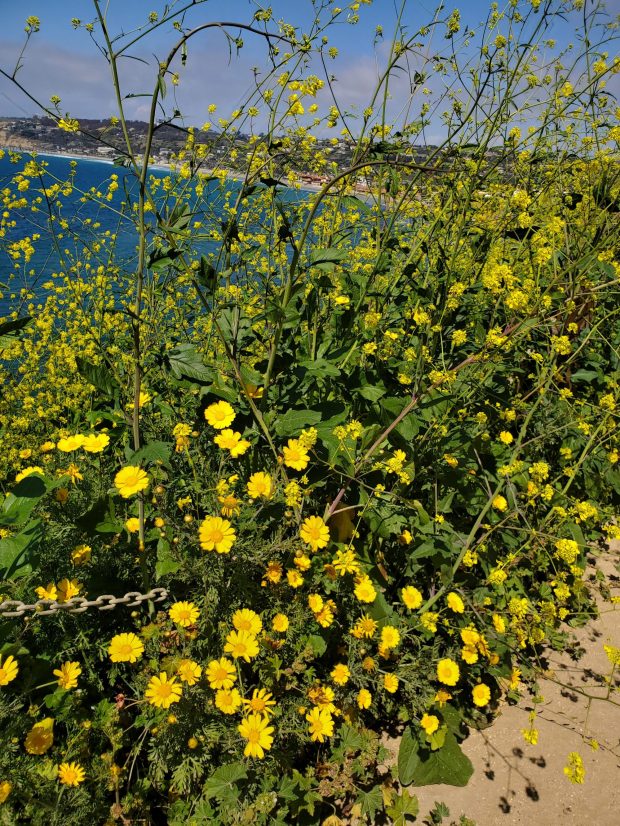 Some of the vegetation along La Jolla’s Coast Walk Trail that is managed by Friends of Coast Walk Trail is pictured in May 2025. (Ashley Mackin-Solomon)
The discussion ultimately comes down to preservation vs. conservation. Preservation seeks to protect a place from change. Conservation focuses on responsible stewardship, allowing people to enjoy and use a resource while managing it so it remains healthy and accessible for future generations.
Managing Coast Walk Trail today requires balancing public safety, fire prevention, erosion control, habitat restoration and public access in the spirit of conservation.
The removal of invasive vegetation is not undertaken lightly. It is performed under city permits and as part of long-term efforts to reduce fire hazards, improve trail safety, control erosion and establish more sustainable native coastal habitat.
Restoration is a process, not a single event, and areas can appear sparse while native plantings become established, particularly during periods of prolonged drought.
Since 2011, Friends of Coast Walk Trail volunteers, with the support of community donors, have planted more than 3,000 native plants along the trail and surrounding slopes. These efforts help stabilize soils, improve habitat value, support pollinators and reduce the long-term dominance of invasive species.
While many assume the challenge is the cost of the plants, successful restoration requires ongoing watering and maintenance during the first 18 to 24 months of establishment. Expanding native restoration efforts along Coast Walk Trail is estimated to require an additional $50,000 to $75,000 in funding, much of it for installation, hand-watering and long-term care. This is a worthy project to undertake if funding is made available.
We have offered for several years to meet with people and discuss these concerns and asked for engagement in the solution while recognizing residents may have differing opinions about the trail. However, stewardship decisions must be guided by current environmental conditions, public safety, permit requirements and long-term sustainability.
Coast Walk Trail cannot be sustained through nostalgia alone. Its future depends on active stewardship, community involvement and a willingness to contribute time, expertise and resources to its care.
Our invitation remains open to anyone who wishes to walk the trail with us, learn more about the challenges and be part of the solution.
— Brenda Fake, on behalf of La Jolla Coastal Conservancy
Here’s one way to solve traffic in The Shores
Ahh, La Jolla Shores … sun sparkling on the easiest, family-friendly waves, kids building epic sandcastles, while many people are stuck on La Jolla Parkway hoping for that summer fun and eager to dive into that cool Pacific Ocean.
Now zoom in on the streets. Avenida de la Playa’s promenade is a pedestrian paradise now, yet the surrounding flats turn into a narrow, two-way tangle. Cars inch along like polite bumper cars gone wrong. Horns beep. Tempers rise with the tides. And somewhere a lifeguard truck or fire engine is creeping toward the sand while every tick of the clock matters for someone in trouble in the water.
I’ve called La Jolla home (on and off) since 1976. I still recall being a teen in the ’80s listening to Blondie on my boombox, rubbing Bain de Soleil tanning lotion on my So Cal skin, sporting a very chic Norma Kamali black swimsuit from Diane’s Bikinis. The Shores was our quiet little secret — easy parking, breezy drives to the beach, no battles for a parking spot.
Today? Summer crowds have turned those narrow streets into a seasonal panic squeeze. The promenade keeps the heart car-free for dining and strolling, but the grid around it still bottlenecks when beach-goers flood in. That’s not just frustrating, it’s risky.
Here’s the fix: Convert key flat streets to thoughtful one-ways. Picture Camino del Oro flowing one direction toward the beach, paired with a parallel like Vallecitos heading out. Simple signage, natural loops, no massive construction — just smarter flow on streets never built for today’s volume.
The biggest winners? Emergency vehicles. Lifeguards, fire engines and ambulances already get promenade exceptions, but imagine clearer, predictable lanes the rest of the way — no two-way standoffs blocking the path, no awkward passing on tight roads. In a rip current rescue or cardiac call on the sand, those saved seconds could be life-changing.
Other perks? Less idling = less road rage. We’ve all “muttered” under our breath circling for parking. Traffic would channel efficiently … no more aimless loops. Bonus room for bike lanes or diagonal spots. It’s different, sure, but paired one-ways work magic in similar narrow coastal grids. Imagine a La Jolla Shores with no more bottlenecking.
After nearly 50 years here, I’ve seen La Jolla adapt smoothly — roundabouts on La Jolla Boulevard, the promenade’s outdoor magic. Let’s keep that spirit alive. One-way tweaks could be the next gentle wave: safer streets, happier drivers and quicker help when someone needs it most.
Who’s in? Chat with neighbors, write to the La Jolla Traffic & Transportation Board or La Jolla Shores Association or drop thoughts to [San Diego] Councilman [Joe] LaCava. Share your traffic tales. Let’s make getting to our favorite family-friendly beach effortless and lifesaving.
One way or another, La Jolla Shores need an improvement.
— Kim McBride
Preserve La Jolla Cove for people
Regarding “Coastal Commission hears about use of rangers, signs and drones at La Jolla Cove” (June 18, La Jolla Light):
I remember the La Jolla Cove of my childhood. Before the sea lions, before rangers with bullhorns, before big signs, before huge tour buses unloading hordes of people and before drones. Also before marathons, car shows, summer concerts and weddings. It was popular then, but not as noisy, not as stinky, the water and sand were cleaner and there were more fish and other creatures to see underwater.
I don’t have a solution to the sea lion problem, but I wonder why we aren’t trying to preserve this wonderful place for people. It’s just one little cove, a very small piece of a very long coastline with plenty of other places for sea lions.
We need more discussion about how sea lions are polluting the water and sand and how allowing large events at the park are negatively impacting a beautiful natural resource. I think Ellen Browning Scripps would agree.
— Angela Shaw
What’s on YOUR mind?
Letters published in the La Jolla Light express views from readers about community matters. Submissions of related photos also are welcome. Letters reflect the writers’ opinions and not necessarily those of the newspaper staff or publisher. Letters are subject to editing. To share your thoughts in this public forum, email them with your first and last names to ashleym@lajollalight.com. The deadline is noon Friday for publication in the following Thursday’s paper. Letters without the writer’s name cannot be published. Letters from the same person are limited to one in a 30-day period. ♦