
For months, Qualcomm told investors to wait.
The San Diego chipmaker insisted its long-teased strategy to capitalize on data centers — one of the world’s fastest-growing sectors — would make sense once executives took the stage during Investor Day in New York City.
Then last Wednesday came, and so did Qualcomm with a number of big-name partnerships — one with Meta and another with Microsoft. The company promised to announce two other major deals by year’s end, capturing billions of dollars in revenue by early 2027.
Qualcomm is known to most as a smartphone chipmaker, but last week, they were selling themselves as an innovation factory — debuting new products for robots, self-driving cars, and most importantly “a particular focus on data centers,” said Stacy Rasgon, senior analyst at Bernstein, “which is all anyone wanted to hear about.”
Qualcomm called for $5 billion in data center revenue by 2027. They project that number to balloon to $15 billion by 2029. Some analysts believe that it’s an optimistic number, others believe it’s conservative — it depends on how bullish you are on aggregate data center demand.
But both camps agree that Qualcomm will only capture about a single-digit percentage of the trillion-dollar market — and that’s really all they need. As revenue for smartphones sunsets, Qualcomm says their data center sales will replace that revenue stream.
Today, smartphone smartphone sales account for 70% of revenue. By 2029, the company projects that number will shrink to a third. Meanwhile, data centers should account for 25% of their revenue in three years, Rasgon explained, citing conversations from a private sell-side panel Qualcomm executives held after the presentation.
Driving this growth is Qualcomm’s new suite of data center products from both in-house R&D and innovation from a wave of recent acquisitions.
In the past 24 months, Qualcomm spent more than $6.5 billion acquiring companies that would help them compete in the datacenter sector — Ventana, Ardino, and more recently, Alphawave and Modular.
Now, the company is flexing their new CPU’s with “high-bandwidth-compute” — Qualcomm’s term for a new silicon architecture that leverages power-efficient memory.
Whether their custom innovation is competitive is a question investors and analysts still have.
“I don’t know if they have some secret sauce,” said Rasgon. “I mean, Nvidia has so much money, if they saw something compelling, they would just do it themselves, right?”
Daniel Newman, CEO of Futurum, also hedged Qualcomm’s first-generation custom silicon. “First-generation silicon is never great,” he said. “So the question is, how quickly can Qualcomm apply its capabilities, its technologies, its resources, as engineering to develop custom silicon that performs so that these hyperscalers ramp up.”
But both Newman and Rasgon emphasized the inelasticity of the market — basically, the demand is so high that hyperscalers are going to buy what’s on the market.
And that’s not to discount Qualcomm’s innovation capabilities, they both said, acknowledging the San Diego company’s legacy of R&D.
“It’s never too late for Qualcomm,” said Amon during his opening address last week. “Because this is a market that moves very, very fast, so if you have technology leadership, there’s always room for you.”
Executives were quick to tout that legacy, too.
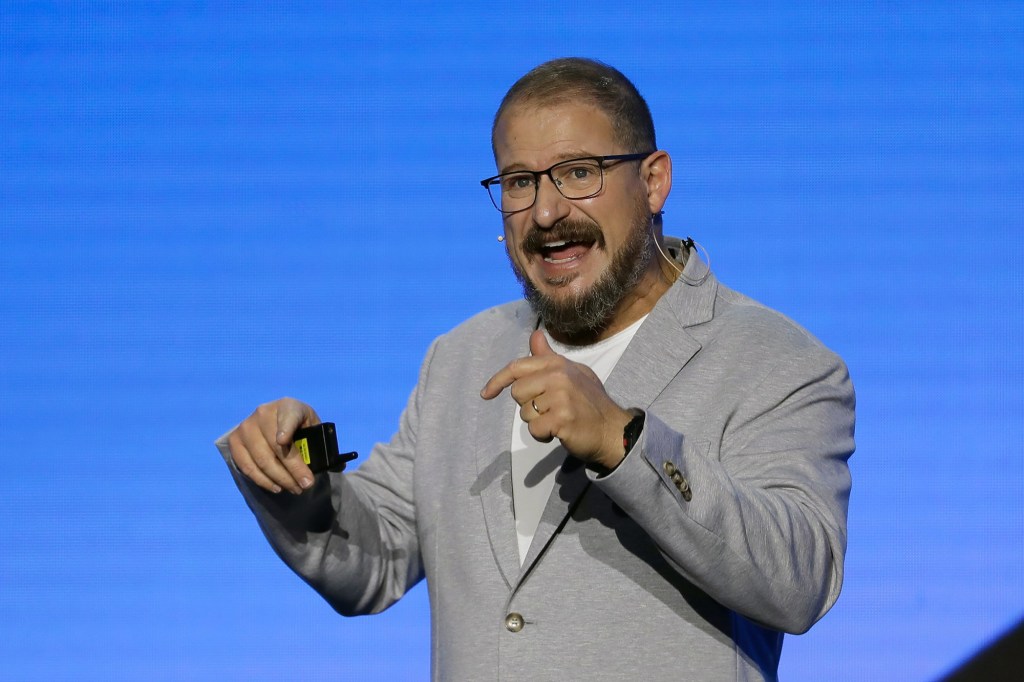
“People cannot like the company about many different things, but I never met anybody that says Qualcomm does not have solid technology capabilities, and I think that’s what we put into work,” said Cristiano Amon, CEO of Qualcomm, on stage during Investor Day. “Our customers believe in Qualcomm, and that is true, especially when we enter new markets.”
Both Mark Zuckerberg, CEO of Meta, and Satya Nadella, Microsoft’s chairman and CEO, each recorded a video announcing their Qualcomm partnerships that played on a big screen over the stage during Investor Day.
Qualcomm is delivering custom silicon for Meta, and according to Newman, Microsoft’s deal — though not publicly disclosed — was for Qualcomm’s AI250 accelerators.
The two other hyperscalers that will be announced by the end of the year are thought to be ByteDance, TikTok’s parent company, and Amazon, Newman guessed.
“I walked out of Qualcomm’s investor day feeling pretty positive. The data center story, the numbers, and the narrative all sounded good,” said Rasgon.
Qualcomm’s stock has been volatile in the days since its Meta announcement, when it jumped 15% in after-hours trading before losing those gains. It closed Monday at $188.72, down 67 cents.