
Published Jun. 30, 2026at6:00am
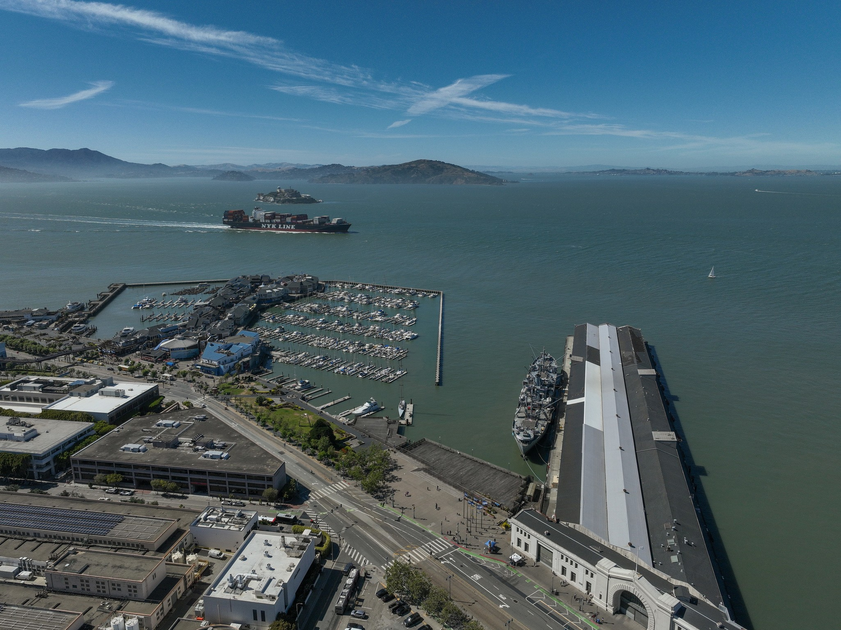
The Port of San Francisco controls 7.5 miles of waterfront, from Fisherman’s Wharf to the southern shoreline in Bayview. That stretch of land is governed by a five-member commission appointed by the mayor and confirmed by the Board of Supervisors. Three of those five seats are sitting on expired terms; whomever Mayor Daniel Lurie picks to replace them will steer San Francisco’s waterfront for the next decade.
These new port commissioners will inherit a rare opening — a chance to decide whether San Francisco keeps building things or only invents them.
For a decade, the tech boom was driven by software companies. The next wave is physical, driven by AI, with money pouring into companies that make physical things, from robots and grid batteries to defense systems and machines that manufacture drugs. Investment in robotics and physical-world hardware hit $26 billion last year (opens in new tab), six times what it was in 2019. Those companies need three things: engineers, capital, and space. San Francisco has more of the first two than anywhere. The third it is running out of.
Space is what creates blue-collar jobs, and the building is happening elsewhere. Hadrian, which makes precision parts for rockets and jets, opened a plant this winter in Arizona (opens in new tab) and a $2.4 billion Navy-backed facility in Alabama (opens in new tab). Saronic, the Austin firm building autonomous Navy ships, is adding 1,500 shipyard jobs in Louisiana (opens in new tab). General Matter is reviving nuclear fuel production in Kentucky (opens in new tab), and Anduril is putting up a 5-million-square-foot factory (opens in new tab) outside Columbus, the largest jobs deal in Ohio’s history.
The closest thing to this energy near San Francisco is an hour north, where California Forever spent years quietly assembling farmland for what would be the largest U.S. manufacturing park and shipyard (opens in new tab), because no California city would make room for it. (The San Francisco Standard’s chairman, Michael Moritz, is an investor in California Forever.) San Francisco barely makes room for manufacturing. The city zones about 7% of its land for industry, versus 19% in Santa Clara and 28% in Shenzhen, China, where the world’s hardware gets built. Seven percent is not enough to support an industrial future. Founders, engineers, and capital all stay; the manufacturing jobs leave. Invented here; built elsewhere.
“What kind of a society are we going to have if it consists of highly paid people doing high-value-added work — and masses of unemployed?” Intel’s Andy Grove asked in 2010, watching Silicon Valley send its factories overseas. Sixteen years later, San Francisco is running the same experiment. The work that’s leaving is the rare kind that pays well without a four-year degree — a wage premium for skilled production work documented by Brookings (opens in new tab), MIT (opens in new tab), the Century Foundation (opens in new tab), and the region’s own Bay Area Council (opens in new tab).
A large part of the problem is how the city treats its land: The state has mandated that San Francisco plan for 82,069 homes by 2031 (opens in new tab). But nothing in the law protects industrial land, so that is what gives way. The city keeps converting industrial land to housing and offices. The city’s abundance debate is right to focus on housing. But to focus on housing at the expense of the city’s industrial capacity is a false choice — especially for the port. It holds the largest stretch of that industrial land, and its records (opens in new tab) show a reduction of about 43% in the last decade. Some is gone for good. The rest the port reclassified itself, turning parcels at Pier 70 and Mission Rock into ground leases for housing and offices. The port faces a multibillion-dollar bill to shore up an aging seawall, and real estate is the fastest money it has. But trading the city’s last industrial land for near-term cash forfeits an economic future that could dwarf it. On land this scarce, the port’s newest leases on those piers went to equipment storage: parking for machines.
There is an irony here: Nearly every cubic yard of concrete poured in San Francisco is batched at two plants on the port’s industrial piers. The city cannot build housing without the industrial land it keeps converting to housing.
I spent a recent morning a mile inland from Pier 70 in the American Industrial Center (opens in new tab) in Dogpatch, (opens in new tab) a century-old, family-owned can factory. It has four floors with freight elevators and a separate utility meter on every unit. Machine shops, a chocolate maker, and biotech labs share it with apartments on the block. A company can start in a few hundred square feet and grow to forty thousand. The center has stayed full through every downturn since the 1970s, because a building made for many kinds of work doesn’t empty when one stalls. The port could steward its waterfront the same way, as a landlord to many industries rather than a seller of single-use parcels.
The people whom the mayor appoints will run the port, setting its leases and budget and managing the executives who run it day to day. What they cannot do is rezone the waterfront or rewrite Proposition H, the 1990 measure that locked in public and maritime uses.
But they can say what the industrial waterfront is for. Recent commissions answered that question by leasing it off for real estate, retail, and parking. A new commission could answer differently: hold the piers for industry, write leases that bring in manufacturers instead of storage, and incorporate these changes into the strategic plan. The port has shown this foresight before. The cruise terminal was a bet a generation ago, and today it posts record traffic on a waterfront that has otherwise stalled. The next bet needs to be industrial. The city keeps inventing the next economy. Whether it keeps the jobs too or ships them to Ohio is a choice it makes on 7.5 miles of land that most San Franciscans never think about.
Ashwin Lalendran is a longtime San Francisco resident and cofounder of IndustriousAF, a nonprofit working on the workforce, institutions, and alliances of American industrial renewal. He is a venture investor specializing in critical infrastructure, advanced manufacturing, energy, and defense systems.