
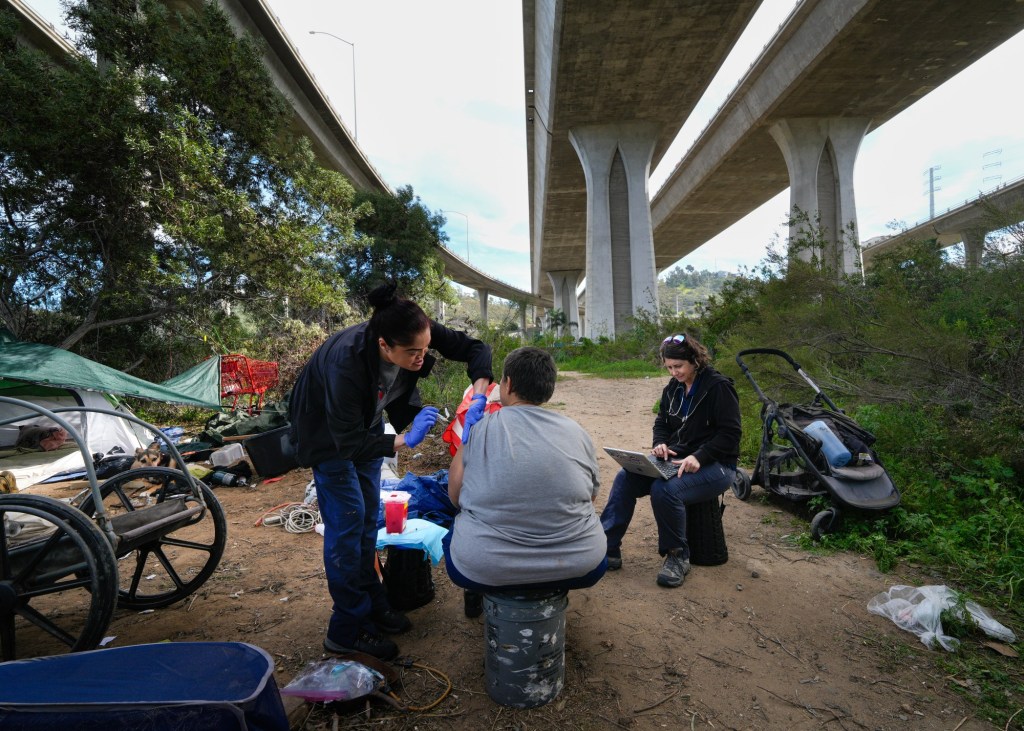
I’m on the Regional Task Force on Homelessness mailing list. I read the emails about their conferences and strategy sessions — the data dashboards, the “coordinated entry optimization,” the “person-centered frameworks.” The conferences happen at venues with valet parking and catered lunches. They invite government officials, academics, philanthropists, housing developers, service providers.
They don’t invite homeless people.
I know, because I was one. I’ve slept on concrete in this city. I’ve had my backpack dumped on wet pavement by a police officer at 6 a.m. and been told to move along — where, it never mattered, just somewhere not there. And I’ve sat in the intake offices that are supposed to be where help lives, carrying a folder of paperwork I’d hauled around for weeks, answering the same questions for the fourth clipboard in a row.
Not one of those clipboards ever asked if I was a veteran. I am. Third Marine Division. That single question would have unlocked doors the system kept shutting in my face. Nobody asked. When I left, I wasn’t helped — I was counted. A tick mark on a grant report, evidence the system was working, because the system measures encounters, not outcomes.
That’s the part San Diego refuses to look at. We audit the wrong things. We count beds and intakes and “clients served” and impressions, and we never audit the gap between what these agencies claim to do and what actually lands on the ground.
Look at the gap. San Diego’s homelessness budget hit $315.9 million in 2025 — a 54% jump in a single year. In the first quarter of that year, the system housed 2,985 people. In the same quarter, 3,189 people newly became homeless. We are spending a third of a billion dollars to run as fast as we can and stand still. The Point-in-Time Count went from 8,576 in 2018 to 10,605 in 2024. More money, more staff, more conferences — more people on the street.
The enforcement side runs the opposite direction at the same people. The city cleared the encampment at one East Village corner 107 times in a single year. Same corner. Same people. Because displacement isn’t a solution — it’s a performance of one. It generates a data point — “encampment cleared” — that justifies next year’s enforcement budget. A four-month outreach effort along the San Diego River cost $3.6 million and moved 48 people into temporary shelter and eight into long-term housing. That’s roughly $64,000 per person sheltered, most of them temporarily. A year’s rent on a City Heights studio runs about $18,000. We spent more than three times what it would have cost to simply hand someone the keys.
The Regional Task Force, the county’s official coordinating body, reported $19.3 million in revenue in 2023. I don’t doubt the people there work hard. But I want to ask the two questions this entire system is built to avoid.
What breaks if it’s true? When an agency says it “coordinated” the regional response, ask what breaks if that’s true. Nothing breaks — because coordination doesn’t claim to house anyone. It’s the perfect unfalsifiable metric. You can’t measure whether coordination happened. You can only attend the meeting. And attending the meeting becomes the proof the meeting was necessary.
Who pays? The people outside the building pay. The catered lunch costs more than a week of meals for the people the conference is about. They aren’t in the room. Some of them are literally on the sidewalk 50 feet from the entrance, invisible to everyone walking in with a lanyard. When the agency does want their input, it sends a survey — which means their experience gets extracted, formatted and consumed as data, which is a different thing than being heard.
There’s even a program for this. It’s called lived-experience advocacy, and to be certified to speak about the homelessness I lived, I was directed to complete hundreds of hours of online training modules — taught the agency’s vocabulary, its frameworks, its jargon. The same jargon that excluded me in the first place. A friend of mine finished the hours, got certified, showed up ready to work and was paid less than the colleagues who’d never spent a night outside. The certification didn’t make him an equal. It made him a credentialed token.
I’m not writing this to burn anyone down. I’m writing it because I’m still on that mailing list, and every email is an invitation to a conversation about me that I’m not allowed to join.
So here is the only question that matters — the one no dashboard, no strategy session, no Point-in-Time Count will ever ask:
Did the help land? Or did it just look good leaving our hands?
I’m not hard to find. I’m right outside.
Condrey is a writer, veteran and formerly homeless resident of San Diego.