
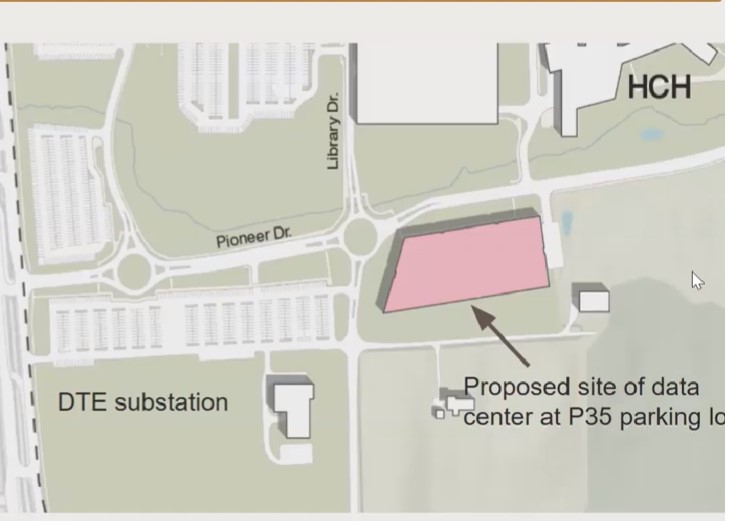
After nine months of soliciting feedback from students, administrators and other organizations, Oakland University is moving forward with a proposed on campus data center.
The board of trustees voted June 26 to advance the data infrastructure project, which would replace OU’s current computing infrastructure currently housed in Dodge Hall and North Foundation Hall. The new facility will expand research space and host a new artificial intelligence institute.
Unlike the large-scale commercial facilities proposed elsewhere in the state, the proposed facility is purpose-built for university and regional use. Compared to a hyperscale data center, OU’s proposed facility would use 2% of the power and less than 2% of the land.
OU has partnered with Ohio-based developer Fairmount Properties for the new building.
The university has been getting feedback on business interest in the 26 megawatt Edge center, has held listening sessions with student groups and verifying the site will be compatible with the energy that DTE can provide and the needs of the university.
The proposed site has been relocated from parking lot P-35 to an area adjacent to lot P-37 — moving the facility farther from Hillcrest Hall, the Native American Heritage site, and campus biological preserves while rerouting industrial traffic away from busier campus areas.
“Our faculty have made it clear that advanced computing infrastructure is a baseline requirement to support both next-generation research and the student learning experience,” said Amy Banes-Berceli, vice provost at Oakland University. “This project will provide students with high-performance computing clusters standard in today’s workforce, while enabling OU to meet the technical thresholds required to compete for federal research funding.”
Two types of data centers – Edge and hyperscale – are distinguished by physical proximity to end-users and physical sizes of the buildings.
Edge data centers are closer to end-users and are often smaller in size. They can be in an office or local warehouse, in cell towers, or in regional centers. Because of the smaller size, Edge data centers consume less energy because they have less processing power.Hyperscale data centers are typically spread over hundreds of acres and consume enough energy to power cities.
“While OU may attract hyperscale-level tenants, this is not a hyperscale data center,” said Penny Vigneay, OU’s executive director for economic development. “Hyperscale data centers (are) those are extremely large facilities with thousands of servers. This is not that.”
The partnership with Fairmount Properties is a public-private model, meaning it will be built at no cost or operational risk to the university. A dedicated portion of the facility will serve OU exclusively; remaining space will be subleased to industry partners, generating revenue and creating student internships and applied research pipelines.
“This represents a transformative opportunity to elevate Oakland University as a premier regional destination for technological innovation,” said Brian Calley, board chair. “By leveraging this unique partnership, we can open direct pathways to high-tech jobs and internships for our students while driving collaborative economic growth across the region.”
Development agreements will be drafted over the summer. Formal due diligence is scheduled to begin in October 2026, and includes comprehensive environmental, site, and infrastructure assessments. A project steering committee will include student and faculty representatives alongside university leadership.
“The due diligence phase is exactly where we will gather the hard data needed to thoroughly address our community’s environmental and infrastructure questions,” Calley added, reaffirming the board’s commitment to OU’s highest standards of sustainability.