
The film program at Long Beach City College is hiring more full-time faculty and bolstering its curriculum — because it has seen a steady increase in enrollment.
The LBCC film program’s enrollment has grown 16% over the past five years. It offers associate degrees for transfers, which guarantee students admission as juniors to a Cal State University campus or another participating institution. Students graduating from LBCC with a certificate of achievement in film production, meanwhile, can go directly to working for top media companies.
The changes coming to the film department reflects similar developments for the rest of LBCC. In December, for example, LBCC announced its first bachelor’s degree, becoming the first community college in the U.S. to offer a bachelor’s in library and information science.
The digital media arts program, meanwhile, is experiencing similar growth to the film department — with enrollment rising by 25% over the past five years. That department is anticipating hiring two new full-time, permanently funded faculty members, pending approval by LBCC’s Board of Trustees, and Janét Hund, dean of the School of Visual, Performing Arts and Cultural Programs said in a statement that she hopes to add internships or work experience to the program while also exploring additional digital media arts certificates.

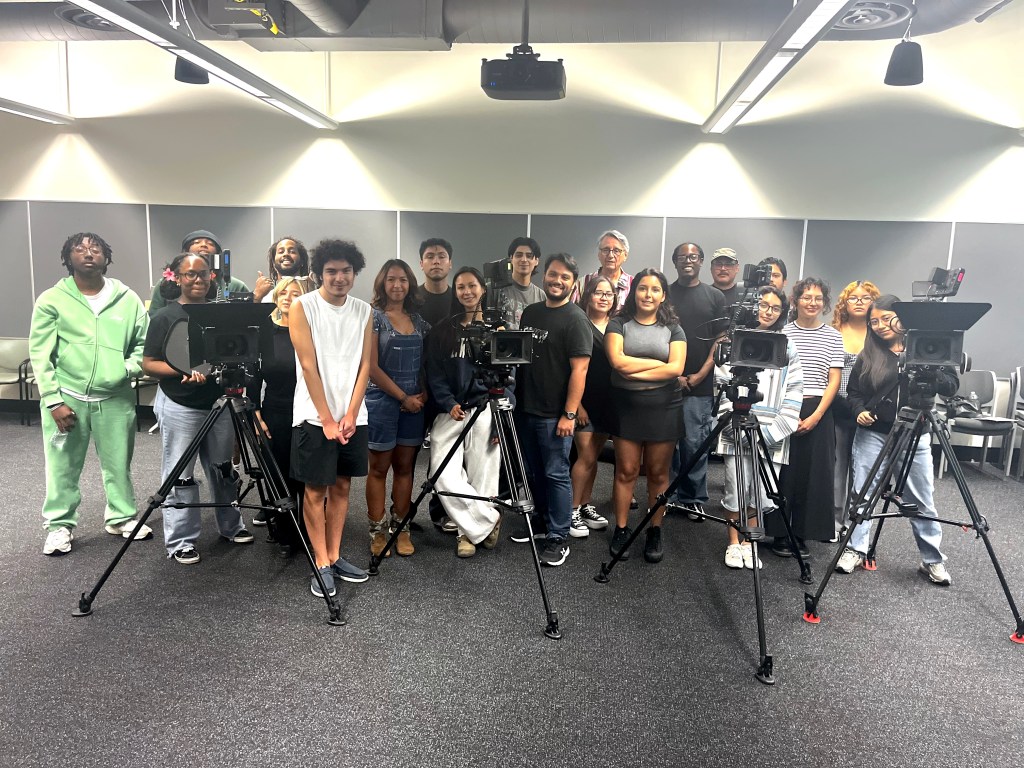
David Parrish’s assistant camera class is part of the film program’s summer intensive offerings. (Courtesy of David Parrish)

Students practice with equipment in David Parrish’s assistant camera class. (Courtesy of David Parrish)
Show Caption
1 of 2
David Parrish’s assistant camera class is part of the film program’s summer intensive offerings. (Courtesy of David Parrish)
But it’s not just academics that are evolving at LBCC — but also the campuses.
Building E, a student life facility, is under construction and estimated to be completed in 2027. And earlier this year, LBCC opened the Jenni Rivera Performing Arts Center and Building MM, home to science and manufacturing programs.
As for LBCC’s film department, it introduced the film production certificate about 10 years ago, said film production professor Eli Daughdrill. For students who want to work instead of transferring to a four-year university, the program recommends them to companies like Warner Bros. and Netflix after they complete their certificate.
Alumnus Brian Abarca earned his certificate and was accepted to the Warner Bros. Discovery Access program. Upon completing training in this program, LBCC graduates can be hired to work on Warner Bros., Discovery or HBO productions.
Abarca went on to work on the camera team for “One Battle After Another,” which won Best Picture at the 2026 Academy Awards. Abarca became the second LBCC alum in two years to work on a Best Picture film. Stephanie Guzman, class of 2014, worked as a camera assistant on “Anora,” which won in 2025.
“The core faculty were all on the same page about wanting to create a film culture,” Ben Sampson, assistant professor of film studies, said in an interview. “We want to create a place where people who want to make movies and people who love movies want to celebrate them.”
Part of the certificate requirement is to take summer courses, added about three years ago, each designed around a specific job. The four classes, offered only during the summer, are assistant camera skills, assistant editor skills, grip and electric swing skills and film set management skills.
“They really prepared me for doing grip and electric work, so I don’t feel clueless on sets,” Ashton Sharp, who is in the class of 2026, said in a statement, “and I can really put my best foot forward early in my career.”
Sharp is completing his certificate in film production this summer.
These courses train students in the lab with hands-on experience, Daughdrill said. This allows students to start on film sets in positions like assistant camera, lighting and production assistant, and work up to directing, cinematography and scripting, which the program also teaches.
“I’m trying to move straight into the industry,” Sharp said. “With the work I’ve gotten so far, I can say the film program has prepared me tremendously.”
David Parrish, professor of cinematography, taught the four-day summer intensive on assistant camera skills last week.
“I am preparing them to work in the film industry,” Parrish said in an interview. “When these opportunities come, they get on set. They look and feel like they belong there and can make a difference in the production.”
Community colleges are changing the path into the film industry, Parrish said. LBCC students, for example, work on films their first year, gaining real production experience and building a portfolio, while four-year colleges often don’t allow students into production classes until their third year.
The LBCC film department also offers students two digital MAC labs with editing software — with 50 stations total. Parrish’s class worked with four digital cameras and high-quality lighting this week.
Sampson, meanwhile, has spent the past four years, working with the film department to hire full-time faculty and make the film history curriculum more engaging for younger students. Next semester, he will teach a course on Mexican directors Alejandro G. Iñárritu, Guillermo del Toro and Alfonso Cuaró. He previously taught another class on all-female directors.
“We’re all very conscious about diversity and the representation of voices,” Sampson said, “both in front of and behind the camera.”
When he evaluates adjuncts, Sampson added, he ensures their syllabi includes films that reflect the diversity of LBCC’s student body.
Parrish’s assistant camera class was 50% women, which he said the industry needs.
Before coming to LBCC, Sampson worked as an adjunct professor in Los Angeles. Hiring adjuncts instead of full-time teachers is a problem across colleges, he said.
“I gave my all to those courses, but at the same point, I was teaching seven courses across four different schools,” Sampson said in an interview. “You’re busy; you can’t invest in schools, which is why full-time faculty is essential.”
Sampson, in fact, partially attributed increased enrollment in the film department to hiring full-time faculty — because professors can invest more time in students.
“Students want to be there, and there’s this real general excitement about it,” Daughdrill said. “There’s a definite correlation with the program getting more organized and having more specific goals over the last decade and the rise in numbers.”