
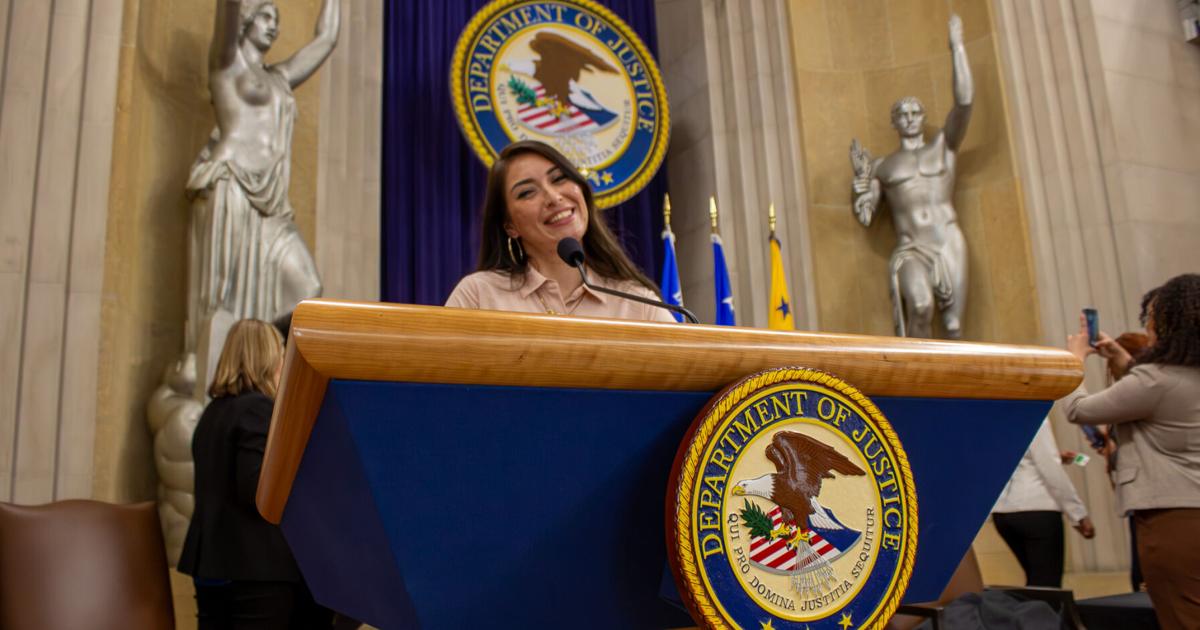
Paloma Foster, a re-entry student parent at UC Berkeley, died June 21 at age 35.
Foster impacted many organizations on campus, serving as a Golden Bear Orientation leader, ASUC Equity and Systems Impact Commission chair and an adviser on the California Policy Lab’s Criminal Legal Research Advisory Board. She was also a policy fellow with Berkeley Underground Scholars, a campus organization for incarcerated and formerly incarcerated students.
UC Berkeley alumna Marlo De La Mora described meeting Foster at Transfer Weekend. She said Foster made her feel accepted as an older student on campus, and the pair became best friends.
“She just made me feel so welcomed, and that we were gonna do this journey together, and she was a beautiful spirit inside,” De La Mora said. “She always used to tell me that she had my back. She was like, ‘I got you, girl. No matter what, I got you, girl.’”
After experiencing incarceration and the foster system, Foster was passionate about public policy work and motivated by her personal experiences to reform the criminal justice system. A Regents’ & Chancellors’ Scholar at UC Berkeley, she was majoring in political science, with minors in public policy and ethnic studies.
CPL researcher Alissa Skog noted that Foster, a first-generation Mexican American, encouraged her fellow researchers to consider the intersection of criminal justice and the immigration system and to provide resources in multiple languages for record relief, the process of making employment easier for people with criminal records.
Talley Michelé became friends with Foster through Underground Scholars and worked with her on the CPL’s Criminal Legal Research Advisory Board. Michelé said they bonded over their passion for advocacy and the Los Angeles Dodgers.
“She was a really good problem solver, brainstorming a mile a minute, and she would get it done,” Michelé said. “If you’ve ever heard of the saying, ‘I’ve got the Midas touch, everything I touch turns to gold,’ that was Paloma.”
Everyone around Foster described her as a loving mother who was always talking about her son, Cairo. Michelé described him as Foster’s “anchor” and “her reason why” for everything she did.
Institute of Governmental Studies’ events and communications coordinator Ezra Hom-Bristow — who met Foster during Democracy Camp in Washington, D.C., an experiential learning program for students interested in public service — said she was “extremely magnetic” and “passionate in a way that invited people in.”
“She showed up each day and was such a light and an example for how to keep going in the face of what feels like insurmountable odds,” Hom-Bristow said. “I would just want folks to know and remember the example that she set as a fighter, but someone who fought with deep love in her heart and her feelings on her sleeve, and how much strength it takes to be that kind of a person, to be that kind of an advocate.”