
A few years back, we had a new writer covering San Diego State who grew frustrated with the Mountain West during the Aztecs’ trip to the Famous Idaho Potato Bowl or some such postseason assignment and called it a “Mickey Mouse” conference.
It was a humorous aside and quickly passed from the public’s consciousness. But several veteran staffers, well-versed in the Mountain West’s fumbles and foibles, henceforth referred to the conference as M-I-C (an ode to the old M-I-C-K-E-Y M-O-U-S-E song) in group texts.
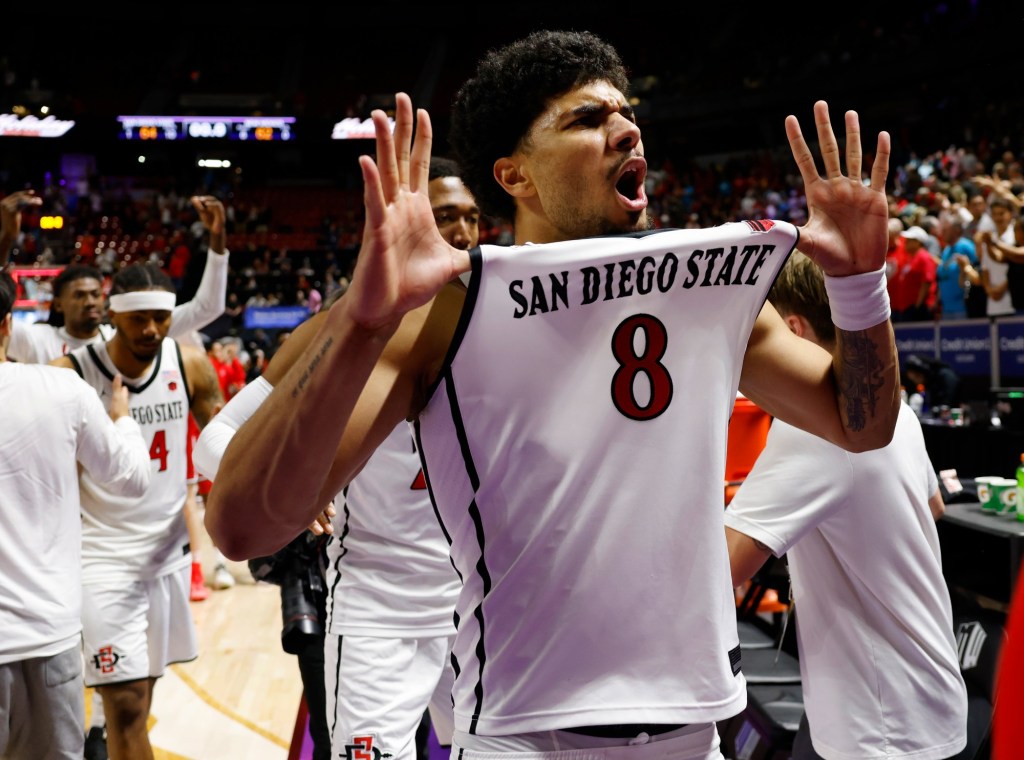
M-I-C is officially in SDSU’s rearview mirror Wednesday as it formally joins the Pac-12 for what may only be a six-year commitment before another spasm of conference realignment across college athletics. Coaches and administrators say all the right things when asked about their level of nostalgia for a conference that was home to Aztecs sports for 27 years.
Privately, there is little love lost.
“Let’s call it what it is,” Utah State basketball coach Jerrod Calhoun said after no Mountain West representative, in a conspicuous departure from past years, attended their NCAA Tournament games at Viejas Arena. “A very ugly breakup.”
The Mountain West was formed in 1999 as a breakaway conference from the Western Athletic Conference. Craig Thompson served as its commissioner for 23 years before being replaced by Gloria Nevarez.
Thompson wasn’t always immune to criticism, especially for being the only Division I conference that annually held its basketball tournament in a member’s home arena. But he was a pro who grew the Mountain West into a mid-major basketball power and helped it weather defections by BYU, Utah and TCU, now all members of power conferences.
Nevarez has presided over the Mountain West’s entirely avoidable dismemberment and inevitable slide. The Mountain West is replacing SDSU, Boise State, Colorado State, Utah State and Fresno State with … UTEP, Hawaii (in all sports), UC Davis, Northern Illinois and the North Dakota State Bison.
The Mountain WAC, one of its most prominent remaining coaches disparagingly calls it.
The exodus by the five so-called “Pac-stabbers,” first revealed in September 2024 and made official a year ago, was purportedly based on economics and exposure, joining Oregon State and Washington State in a relaunched Pac-12 with the hope of attracting a more lucrative media rights contract and establishing itself in the vacant space between power conferences and mid-majors.
That may amount to a break-even venture for SDSU and others, at least at first. The TV money will be worth several million dollars more per year, but that is partially offset by an estimated $10 million per school in exit fees from a recent court settlement. There are also poaching fees from Oregon State and Washington State that will flow into Mountain West coffers and help soften the blow of a smaller TV contract.
So why leave then?
Some of it was rooted in ego and self-preservation, certainly, seeking at least the perception of higher ground as the tide of red ink rises around college athletics’ have-nots. Some of it was a growing impatience for promised merit-based revenue distribution and minimum financial standards for the Mountain West’s bottom-feeders. Some of it was sheer frustration with the frequency of M-I-C moments.
Thompson was a sage executive with decades of backroom brokering experience and healthy, respectful relationships with his presidents and athletic directors. Nevarez never moved to the conference headquarters in Colorado Springs, Colo., working remotely from her home in Lake Tahoe.
She was so disconnected that she had no clue SDSU, Boise State, Colorado State and Fresno State were leaving until media reports trickled out. (Utah State joined them a few days later.) She attended an SDSU-Oregon State football game at Snapdragon Stadium a few days before, oblivious to the impending machinations of their athletic directors and presidents.
Former New Mexico basketball coach Richard Pitino was in bed scrolling through social media on his phone when he saw the posts. He turned to his wife and said, “This is not good.”
At basketball media day a month later, Pitino elaborated: “I can’t understand why we’re breaking up. We could have done all this in the Mountain West, I really believe that. … I would have thought, how do we work together to work this thing out? It turned into ‘Game of Thrones’ all of a sudden, where everybody was stabbing everybody else in the back.
“I’m very disappointed in it, because I felt we should have been the marquee conference in the West. … I felt like this is a no-brainer to work together.”
SDSU and Boise State had wanted out for more than a decade, convinced they had outgrown the breakaway WAC conference. They tried in 2012 in an ultimately unsuccessful bid to join the Big East in football and Big West in other sports. This time, they persuaded three other schools to bounce, too.
It was, to hear coaches and administrators from the departees privately tell it, as much out of economics and exposure as exasperation. They were fed up.
There was the ill-fated decision in 2024 to join the Big Ten’s basketball officiating consortium when the group that serviced a half-dozen leagues in the West dissolved with the Pac-12 and everyone else went to the Big 12 consortium. The Big Ten didn’t have enough quality referees, let alone enough based on the West Coast, and the result was a stream of inexperienced, inadequate crews dispatched to the often intense environments of Mountain West arenas.
The issue was raised multiple times during the first season. Nevarez and her staff ignored pleas for change.
Then this year, a young official was sent to work his first career Mountain West game at Viejas Arena for an early January encounter against Boise State. He gave an incorrect hand signal for a foul, allowing SDSU forward Jeremiah Oden to play in the third overtime with five fouls and make a 3-pointer. The Aztecs won by three.
In Boise State’s previous game, the Mountain West office announced that Broncos coach Leon Rice had passed SDSU’s Steve Fisher for the most career wins in conference play. Except he hadn’t. The conference office had inadvertently counted conference wins from Rice’s first season at Boise State, when it was still in the WAC.
Adding to the awkwardness: The conference’s coach of the year award is named after Fisher.
Or there was football media day the year before. The conference cut a deal with Circa Resort & Casino in downtown Las Vegas to host the event, neglecting to realize it is a 21-and-over facility and Boise State star running back Ashton Jeanty wasn’t yet 21. He had to host interviews off-site in another hotel.
Or the decision to allow early entry to Grand Canyon, which was initially scheduled to join the conference after SDSU and the others had left. The five departing schools began hearing rumors last spring — Grand Canyon coaches were insisting they were coming in 2025-26 — and voiced their stern objection. Nevarez assured ADs and presidents there was nothing to see here.
Once the five had submitted their formal notice of departure and forfeited their voting rights, the conference extended an early invitation to Grand Canyon. Never mind that the Mountain West had already released a women’s volleyball schedule, which had to be frantically adjusted just weeks before the season.
Or when, in a stroke of scheduling fortune, Utah State and New Mexico met on the final day of the regular season for the men’s basketball title. The conference’s media rights contract, it turns out, didn’t compel TV partners CBS and Fox to televise games in the season’s final week, and both networks declined because of commitments elsewhere.
So the Aggies and Lobos played on the Mountain West Network, the conference’s streaming site.
Which crashed.
At this year’s conference basketball tournament, after seating media at courtside tables for 26 years (just as the NCAA Tournament does), journalists were moved upstairs to an obstructed view section behind the basket while their tabled floor seats were sold for $895 (plus another $600 if you want access to a hospitality room).
When, as a former board member of the U.S. Basketball Writers Association, I texted Nevarez to express disappointment with the decision and lack of outreach to find a more suitable seating location, she offered a four-word response:
“Yes, trying something new.”
During the semifinals, a conference staffer handed the Utah State band white headbands adorned with a Mountain West logo. They put them on … inside out, hiding the logo.
A week later, the departing Aggies, the Mountain West’s only NCAA Tournament entry, knocked off Villanova and played No. 1 seed Arizona close at Viejas Arena. Nobody from the conference office was there to watch. Cal Baptist, which is moving from the WAC to Big West, also played at Viejas and had representatives from both conferences there.
A very, very, very ugly breakup.
In the coming weeks, the Aggies, Aztecs, Rams, Broncos and Bulldogs will be donning uniform logos from a reconstituted Pac-12 that may or may not be the financial boon they hoped while the Mountain West charts a new course with the North Dakota State Bison.
Did the “Game of Thrones” really come to this?
Yes, trying something new.