
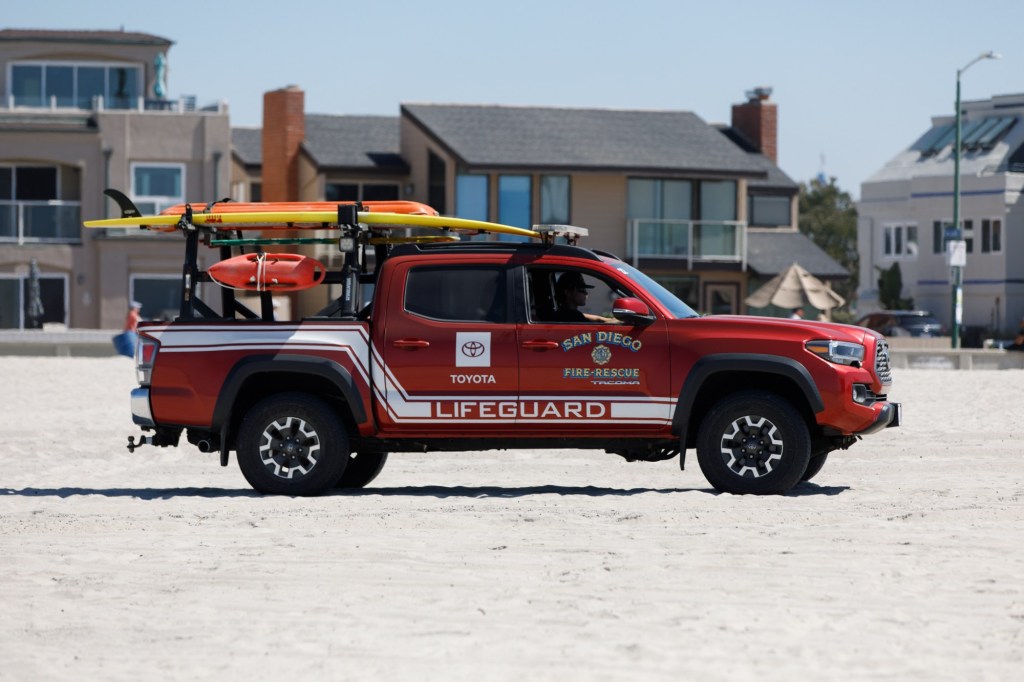
San Diego counts almost everything at the beach: visitors, rescues, boats, trucks, towers and prevention actions.
But we still do not adequately count one of the most important things: hazardous exposures lifeguards face when sent into polluted water, toxic air, flood channels, boat fires, sewage-impacted surf and aging coastal facilities.
San Diego lifeguards serve more than 21 million beach visits each year, protect roughly 93 miles of coastline and average 9,000 rescues and 450,000 preventive actions.
Our lifeguards are an elite public safety workforce. And the job is getting more hazardous.
In 2023, Assembly Bill 699 tried to extend additional presumptive injury protections to year-round, full-time lifeguards in the San Diego Fire-Rescue Department’s Boating Safety Unit. It focused on conditions recognized for other safety officers, including heart trouble, cancer, post-traumatic stress disorder and biochemical exposure.
Gov. Gavin Newsom vetoed the bill. But his message also acknowledged the core issue: Lifeguards engage in hazardous responsibilities. His concern was that any new presumption should be supported by clear and compelling evidence.
If the state wants evidence, San Diego should build the record.
Lifeguards are a 24-hour rescue agency responsible for water rescues, boat rescues, marine firefighting, cliff rescues, underwater search and recovery, and swift-water and flood response and enforcement along our coast, bays and waterways. Some lifeguards are also peace officers, emergency medical technicians, dispatchers, flood rescuers and marine firefighters.
It means the exposure profile is different from a lifeguard program built around seasonal beach coverage. The risks are not theoretical. Lifeguards respond to boat fires, fuel spills, sewage-contaminated water, biological hazards, traumatic deaths, nighttime rescues, flood channels and dangerous surf. They face relentless UV exposure, orthopedic injuries, smoke inhalation and repeated contact with water the public is warned to avoid.
UCSD researchers have found that sewage-polluted coastal water can become airborne through sea spray aerosols. Research on the Tijuana River has also linked polluted water to dangerous air-quality conditions, including elevated hydrogen sulfide levels.
This is not about what lifeguards touch. It is also about what they breathe. The first fix: exposure tracking.
If a lifeguard is sent into polluted water, that exposure should be logged by shift, location and incident. If they respond to a boat fire, sewage spill, toxic plume, flood rescue, contaminated river channel or hazardous beach closure area, the city should create a record in real time.
Years later, when a lifeguard gets sick, no one should have to reconstruct a career of exposure from memory, guesswork and old duty rosters. That is not bureaucracy. That is evidence.
The city should also review whether existing presumptive protections are broad enough for marine rescue work. Lifeguards should not be forced to prove the obvious every time a job-related illness develops slowly instead of dramatically.
When conditions warrant, lifeguards should have dry suits, gloves, eye and face protection, respiratory safeguards, rinse stations and post-incident monitoring.
A lifeguard station is not a “Baywatch” prop. It is a workplace, dispatch point, equipment hub and public safety facility. San Diego should inspect lifeguard facilities for mold, ventilation, air quality, structural safety, decontamination capacity and basic habitability.
The city is now in active negotiations with Teamsters Local 986, San Diego lifeguards. This is the right moment to put the issue where it belongs: at the bargaining table and in the city’s long-term public-safety planning.
The city should prioritize frontline lifeguards’ health and safety through a proactive system: mandatory exposure logs, appropriate health protections, screenings, decontamination standards, facility inspections and transparent reporting to the City Council and public.
By providing coverage proactively, the city can protect its workforce upfront, reducing the need for lifeguards to pursue retroactive relief through legal battles. That approach protects lifeguards, but it also protects taxpayers.
When the city documents hazardous exposures in real time and addresses foreseeable risks upfront, sick or injured lifeguards are less likely to be forced into disputes over whether the job made them ill.
Protecting lifeguards is not a special favor.
It is basic maintenance on the human infrastructure that keeps San Diego safe.
We ask lifeguards to run toward the water when everyone else is running out. The least we can do is make sure San Diego has their backs when they come ashore.
Kostrinsky is a small-business owner and public policy consultant specializing in government infrastructure, labor relations and legislative advocacy. He lives in Del Cerro.