
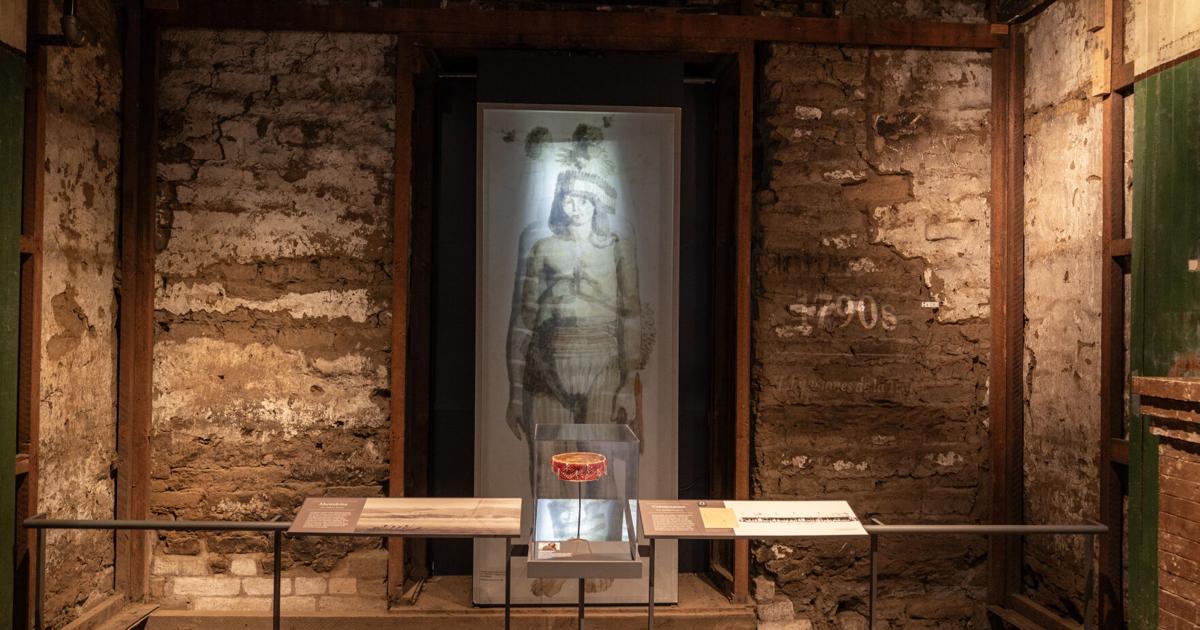
A crew digging a trench in a road in the Presidio of San Francisco during the last week unearthed multiple colorfully painted pieces of pottery that appeared to be from the Spanish colonial days more than 200 years ago.
Such discoveries are routine when digging in hot spots around the Presidio, a military base that was founded by a Spanish expedition in 1776 during the same summer that the Declaration of Independence was signed.
Occupying land that Indigenous people had inhabited for eons, the Presidio operated as a military base under Spanish, Mexican and U.S. rule, and it was the nation’s oldest military post when the Army left and it became a federal park in 1994.
“It’s remarkable, the amount of the span of history that is held right here at the Presidio San Francisco,” said Kari Jones, an archaeologist at the Presidio Trust, the federal agency created to manage the former base in partnership with the National Park Service.

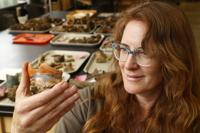
Kari Jones, an archaeologist at the Presidio Trust, shows off a fragment of Spanish colonial pottery recently discovered at the Presidio that exemplifies the voluminous history of the longtime military base founded by the Spanish in 1776.
Craig Lee/The Examiner
Across its rich history, the Presidio’s story has been marked by triumph and tragedy.
It played prominent roles in major events on the local, national and global stages, including the founding of Yerba Buena, the pueblo that became San Francisco; dispatching troops to fight Native American tribes around the west; taking possession of the Philippines in the Spanish-American War; directing the internment of Japanese Americans during World War II; and hosting a missile-defense launch site.
Today, the Presidio is a financially self-sustaining national park of nearly 1,500 acres that attracts almost 10 million visitors a year. It has restored wildlands, views of the Golden Gate Bridge and San Francisco Bay, hiking and biking trails, hotels, restaurants, a 600-seat theater, a golf course, 30 archaeological sites and 551 historically significant buildings, 83% of which have been fully or partially rehabilitated for use.
About 3,000 people renting former military housing reside there, and nearly 400 public, private and nonprofit organizations are tenants as well.
The Presidio — the name comes from the Latin praesidium, for “protection” or “garrison” — encompasses so many major historical moments that it can be challenging to convey a clear narrative about it, Jones said.
“There’s just a lot of threads that come together in one place, which is a great opportunity, but it does make it hard to tell a coherent story,” she said.
“El Presidio” was founded in June 1776 — along with with what became the nearby Mission Dolores — by an expedition of Spanish subjects, including men, women and children who had walked from as far away as modern-day Mexico to establish a northern outpost of the Viceroyalty of New Spain. The party was launched under Lt. Col. Juan Bautista de Anza with a mandate from the Spanish crown to defend against other potential colonists, such as the British, French and Russians.
The travelers settled near the current Presidio Officers’ Club, which has elements that might date back 250 years. It stands at the edge of the Main Post parade grounds, a large rectangular lawn. Today, the Officers’ Club hosts a museum, event spaces and a Mexican bistro.
A short walk away is where a Pacific Gas & Electric crew digging near the intersection of Funston and Moraga avenues turned up the pottery and other artifacts — including thick pieces of dark glass and apparently butchered animal bones.
An archaeologist must watch such digs to prevent damage to historical resources. Finds such as the pottery shards are examined in a nearby archaeological lab, then stored in a neighboring facility that contains more than 526,000 relics, including a 19th-century wooden piece of a water flume, a child’s toy gun from the 1950s and an empty tin of three Merry Widows condoms, which were very popular in the 1920s and 1930s.
Archaeologists dug into the walls of the Mesa Room at the Officers’ Club; visitors can see exposed wood boards and painted burlap that were applied in layers during remodels over the years. Underneath are the original adobe walls.
Last Saturday, a group called Los Californianos staged a 250th-anniversary celebration of the De Anza party’s arrival in the middle of the parade grounds near the club. The annual event featured actors and musicians in period costume and a reading of settler names.
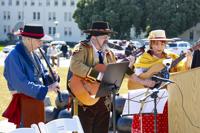
From left, Ron Cohen, Lance Beeson and Marilyn Merlino of Los Arribenos de San Francisco perform at a celebration marking the 250th anniversary of the de Anza expedition. Beeson said he is a descendant of Joseph Moraga, Anza’s second in command.
Craig Lee/The Examiner
Carol Eber, a Petaluma resident who traces her family back eight generations to the Anza party, said that while the nation’s origins on the East Coast are worthy of celebration, so is the history of Alta California — the Spanish name for a vast area claimed by Spain that included California.
“Our ancestors walked over 1,000 miles on foot with no trail,” she said. “They came as far as San Francisco.”
“The West Coast was developed and settled by Mexico and Spain, and that is an important part of our continent and our history,” Eber said.
The Presidio was not much to look at in its early years, said Robert Cherny, a professor emeritus of history at San Francisco State University and the author of the recently published “A Short History of San Francisco.”
“It was really very slow to develop as a military post,” he said.
Nevertheless, the arrival of Europeans spelled disaster for the Yelamu, a tribe of the Ramaytush Ohlone peoples of the San Francisco Peninsula. Ohlone people were brought into the nearby mission to work and not allowed to leave, Jones said, and soldiers from the Presidio would collect those who fled and inflict punishment on them and their family members. Many Indians died of disease.
Mexico took control of the Presidio after winning independence from Spain in 1821. In 1834, land near the bay was distributed to residents in a port area called Yerba Buena, which later became San Francisco. By 1835, the Presidio had largely been abandoned with the movement of troops to Sonoma.
“By the end of the Mexican period, it had really fallen into complete disarray,” Cherny said.
Pride coincides with the finalizing of The City budget and LGBTQ+ orgs are calling for the restoration of nearly $3 million to their programming

Yet the future of the space, which supports one of The City’s emerging creative communities, remains uncertain
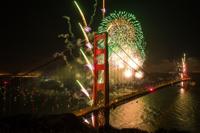
In honor of the country’s 250th anniversary, The City will launch fireworks from the Golden Gate Bridge, host block parties and stage a two-day jazz festival
That changed after the U.S. Army took possession of the base in 1846 during the Mexican-American War — and with the discovery of gold nearby in 1848, which triggered San Francisco’s rapid growth. President Millard Fillmore reserved the Presidio for military use in November 1850.
The Army in 1853 began building Fort Point, a four-tiered brick-and-granite facility designed to house cannons overlooking the Golden Gate. Fears of a possible Confederate attack during the Civil War drove further investment.
“California gold played a major role in stabilizing the economy of the North during the Civil War, so it was really important to protect it,” Cherny said.
One legacy from that period is a row of 1860s-vintage houses on Funston Avenue that today makes up San Francisco’s oldest streetscape, Jones said.
In the 1870s and 1880s, the Presidio sent troops to fight Indigenous populations, including the Modoc in the Lava Beds area near the Oregon border and the Apache in the southwest, among others.
“A lot of the activity and action here was to take control of the West for the United States,” Jones said. “It’s the story of the American West, right here. And then it becomes the story of American imperialism.”
By the 1890s, the Presidio had become a major military installation and a base for the projection of American power into the Pacific, which got a jump start with the Spanish-American War of 1898 and the United States taking control of the Philippines. The United States fought Filipino rebels until 1902 (the country became independent in 1946).
“From then on, the Presidio remained for many years the most important post supplying U.S. troops in the Pacific,” Cherny said.
Among the regiments that went to the Philippines from the Presidio were segregated units of African Americans widely known as the Buffalo Soldiers. Members of those units fought indigenous peoples while helping settlers develop western states.
Some of them were also among Presidio troops that patrolled three newly created national parks in the Sierra Nevada — General Grant (King’s Canyon), Sequoia and Yosemite — before the creation of the National Park Service in 1916.
In 1898, the Army built what became Letterman Army Hospital on the Presidio, its first permanent general hospital. It became one of the nation’s largest hospitals, treating 73,000 patients in 1945, and operated until the base closed.
Following the 1906 earthquake and subsequent fire, the U.S. Army provided food, clothing, shelter and protection to San Francisco residents. Thousands of refugees lived for months on the base in tents and in shacks, some of which were later moved off-base.
In 1914, troops under the command of General John Pershing were dispatched from the Presidio to try to catch Pancho Villa south of the Mexican border. During the expedition, Pershing’s wife and three daughters died when their home on the base burned.
The Army completed Crissy Airfield in 1921, and it became the site of the first dawn-to-dusk transcontinental flight landing. Later, during World War II, buildings at the airfield were used as a top-secret Military Intelligence Service Language School for training U.S. soldiers of Japanese descent to translate, interrogate and decode in Japanese.
It was also at the Presidio that Fourth Army commander General John L. DeWitt, in accordance with a presidential order, signed directives for the internment of about 110,000 Japanese Americans following the Japanese attack on Pearl Harbor in December 1941.
During World War II, the Presidio served as the headquarters for the Western Defense Command, which, among other things, oversaw the massive logistical operations required to retake Guam in 1944.
In 1968, 27 prisoners in the stockade at Fort Winfield Scott in the Presidio engaged in a peaceful protest against jail conditions, with many expressing opposition to the Vietnam war, and were convicted of mutiny. A guard had earlier shot and killed a prisoner, and a massive antiwar demonstration involving active military and veterans came right to the gates of the Presidio, according to the Presidio Trust. Years later, the military overturned the convictions on appeal and reduced their sentences.
While the Presidio played an important military role in the Korean and Vietnam wars, in 1972 — at the urging of then-U.S. Rep. Phillip Burton of San Francisco — Congress created a new national park, the Golden Gate National Recreation Area, that was to include the Presidio if the Army should ever leave.
That became a reality after 1989, when the Department of Defense said it would close bases across the nation. Rather than selling the land, U.S. Rep. Nancy Pelosi championed an innovative funding and management model passed in 1996 with bipartisan support that created a new federal agency — the Presidio Trust — to manage the former base in partnership with the National Park Service.
The deal required the organization, overseen by a board of directors, to fund its own operations by rehabilitating and leasing the buildings left by the Army. The Presidio Trust became financially self-sufficient in 2013.
The nonprofit Golden Gate National Parks Conservancy has marshaled philanthropic support at the same time. It led the capital campaign that raised more than $98 million for the Presidio Tunnel Tops park that opened over the U.S. Highway 101 tunnels in July 2022.
In February 2025, President Donald Trump directed the Presidio Trust to cut its functions to the legal minimum. The trust issued a report indicating that its operations are called for by law and it operates in the black.
In May, Trump replaced the Trust’s six board members with his own appointees, including Lynne Benioff, co-chair of Time magazine; Trevor Traina, a technology entrepreneur and diplomat; John Bickford, managing partner at Local Capital Group; Laura Arrillaga-Andreessen, a Stanford Graduate School of Business educator and founder of the Laura Arrillaga-Andreessen Foundation, the Silicon Valley Social Venture Fund and the Stanford Center on Philanthropy and Civil Society; James Burnham, general counsel at xAI and X; and Kyle Corcoran, CFO at Redpanda, who holds the seat reserved for military veterans.
The new board of directors has not yet met.