
Published Jul. 2, 2026at6:00am
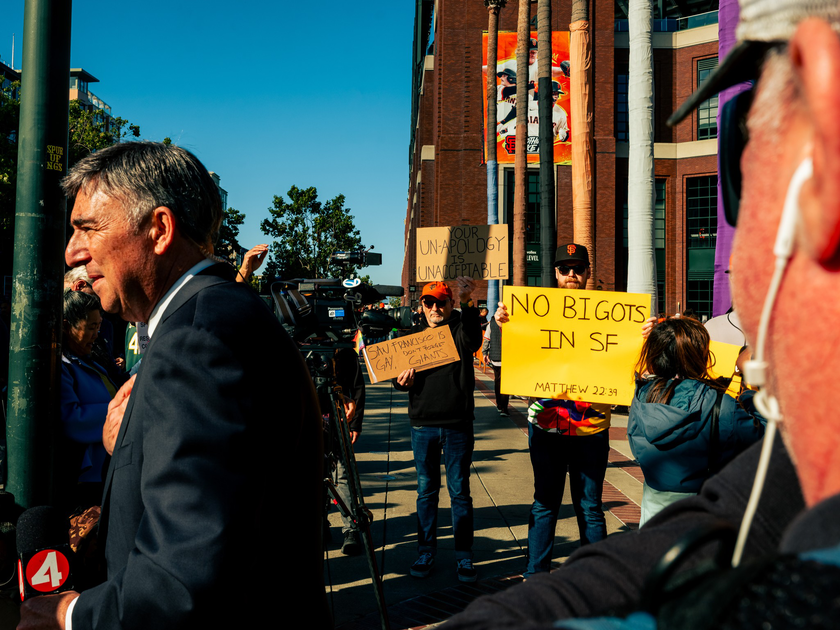
When three Giants pitchers — Landen Roupp, Ryan Walker, and JT Brubaker — defaced their colorful Pride Night caps with Biblical verse in late June at Oracle Park, it triggered a chilling flashback.
In 1995, the late Billy Bean of the San Diego Padres skipped his partner’s memorial service to play in a game. Terrified of losing his job in a homophobic franchise, he kept his grief private.
“There’s no crying in baseball,” he told himself — and suited up anyway.
Before taking the field, as he recounted to me years later, Billy scrawled “SAM, RIP” on the underside of his cap. While playing right field, between pitches, he pulled off his cap and ran his fingers across the words, his silent memorial to the man he loved.
The contrast between Billy’s message and that of the Giants pitchers is telling. The pitchers cited versions of a Genesis passage, scrawled in white letters on their black fabric caps, to exclude. By weaponizing Scripture, they targeted the rainbow flag, perhaps the ultimate expression of belonging, created in San Francisco by Gilbert Baker in 1978 to symbolize the rainbow of difference in a community of Pride — queer and non-queer alike — which now unites millions across the globe.
The biblical verses cherry-picked by the “Genesis Three” were all too predictable, given MLB’s lack of inclusion training and the cover MAGA has provided to renewed expressions of Christian nationalism. From their public statements, at least, it does not appear that the players gave a moment’s thought to the message they were sending to closeted teammates, let alone to fans struggling with the fear of being themselves, who show up at the park to cheer them on.
But the real heartbreak was watching franchise leaders — especially our beloved Buster Posey, the president of baseball operations — stonewall, resorting to corporate deflection. Buster told the media, “I’m only going to answer baseball questions,” which had the perverse effect of not only increasing the outcry but of reminding everyone that the team is mired in fourth place in the National League West, a whopping 18 games behind the Los Angeles Dodgers.
The corporate-speak signals that the Giants are losing more than games on the field; they are losing touch with the very soul of San Francisco. Sports franchises have a unique responsibility to understand and reflect the fabric of the city they represent. We buy the tickets, we tune in to the games, we buy the merch, we OK the real estate transactions. By treating community alienation as a public-relations gambit, the franchise’s leaders have abandoned the progressive identity that once defined it.
San Francisco is a city built by transplants seeking a freer life — fewer than 5% are multigenerational. People gravitate here for a range of reasons: a tech gold rush, a temperate climate, and, most of all, an inclusive culture that makes everything possible and beautiful. For the 20%of San Franciscans who identify as LGBTQ+, this city is a sanctuary from the Christian values employed against them in their hometowns, sometimes by their own families — and now by players on the team of their adopted home.
The pitchers have a right to their views, however misguided. In a time of intense division, even San Franciscans rarely align on the color of orange and black, let alone team promotions, from Faith and Fellowship Night to the various “heritage” events. People can’t even agree on which bobblehead promotions — Rafael Devers, anyone? — to attend. Young players arrive unprepared for the city’s intense sexual and cultural landscape, and no one expects them to adopt a particular ideology. All we ask is that everyone on the team is open to local culture and, most important, respects it.
Thus it is incumbent on franchise leaders to ensure that the entire organization respects, or at least understands, local LGBTQ+ history. This is not a hard thing to impart; examples abound a stone’s throw from the park. Everyone, from pitchers to the rookie manager and novice president, should understand a bit about the history of the gayborhood, the role it played in the birth of the international marriage equality movement, and what the Pride flag, which flies high over the Castro, represents. The decades of sacrifice that went into securing this sacred ground for a despised minority are legendary.
The Giants don’t have to venture far. One of the faces on the team’s wall of fame, at Oracle on King Street, belongs to Jeremy Affeldt, who played seven years at the park, serving as a left-handed setup man and winning three World Series titles — the kind of career the Genesis Three can only dream of. A conservative Christian, Affeldt describes being so homophobic before joining the Giants that he refused to leave his hotel room near the ballpark when he played for a visiting team.
San Francisco changed Affeldt. After meeting a young gay barista at a local cafe, he underwent a radical transformation, described in his 2013 memoir “To Stir a Movement: Life, Justice, and Major League Baseball.” He later challenged church leaders to stop judging LGBTQ+ people, writing that “Jesus walks with the gay community” and urging Christians to show unconditional love.
Billy knew whereof Affeldt spoke. He spent his career yearning for even the smallest opening for inclusion, the chance to be himself. Scarred by the experience of missing his partner’s memorial and many equally devastating ones, he quit the game he loved, but that didn’t love him back, in 1995. Finding the baseball closet untenable, he left millions on the table.
When he recounted the story of his baseball cap to me at his Miami Beach home while writing his 2003 memoir, “Going the Other Way: Lessons From a Life In and Out of Major-League Baseball,” we sat together and wept. We cried for Sam, lost too young to AIDS, for Billy, denied the right to properly mourn his life partner, and for all the other young athletes never allowed to be themselves.
His redemption arrived in 2014, when he was named MLB’s senior vice president for diversity, equity, and inclusion. Until his death at 60 in 2024, Billy crisscrossed the dusty trails of small-town ballparks, convincing minor leaguers that the importance of inclusion is that it allows everyone to be their best and most competitive selves.
This season’s apparent corporate retreat undermined decades of progress in which the Giants established themselves as MLB leaders. In 1994, the Giants became the first MLB team to hold “Until There’s a Cure Night,” memorializing the enormous toll of AIDS on the city. At the 2016 Pride Night, CEO Larry Baer welcomed Billy and me into his box, where, wrapped in Giants Pride rainbow scarves, we strategized for a level playing field. Even this year, just steps from the clubhouse, the Giants hosted a Pride party under the bleachers where the local drag queen Juanita More held forth, unafraid.
Eight years later, the underlying situation is arguably worse, especially with the Giants’ abdication of leadership. Of 780 active major leaguers (30 teams with 26 players each) and 4,950 minor leaguers, exactly zero are out — a statistical possibility only in intensely anti-gay environments.
In 1980, a decade before Billy was drafted by the Detroit Tigers, one of those brilliant transplants seeking refuge in San Francisco was former major leaguer Glenn Burke. The inventor of the high-five had been hounded out of the game by two homophobic managers, the Dodgers’ Tommy Lasorda and the A’s Billy Martin. And like many others yearning for the freedom to be their authentic selves, he retired and headed to San Francisco, where he found queer joy in the Gay Softball League, where his exploits are legendary to this day. Rejected by baseball, he fell into addiction, lived on the streets, and died of complications from HIV in 1995 at age 42.
Billy Bean and Glenn Burke are gone. But their stories live on, and San Franciscans expect their institutions to reflect their demand for respect. To win back the soul of the city, the Giants’ leaders should break down the walls they have built between the clubhouse and the city the team claims to represent.
They will be welcomed with open arms.