
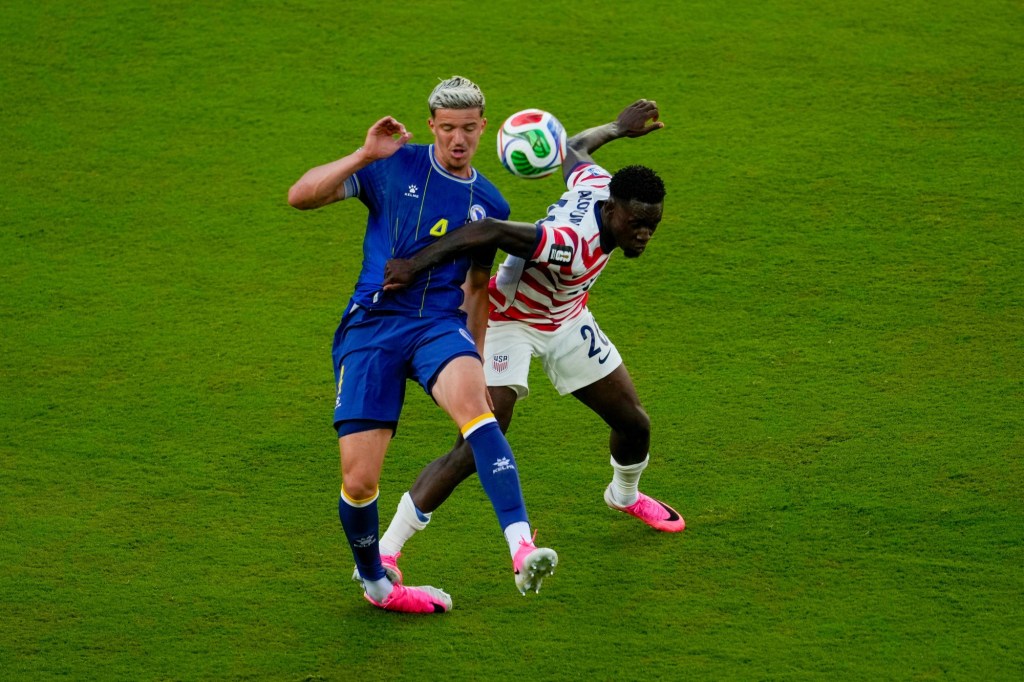
SANTA CLARA – Three thoughts on the U.S. national team’s 2-0 win against Bosnia and Herzegovina in the round of 32 on Wednesday night at Levi’s Stadium:
1. Seething red
The first question: Was it a red card?
The short answer: Yes and no.
The Video Assistant Referee booth did what it’s supposed to do and what it has been criticized in this World Cup for not always doing. It sent Brazilian referee Rafael Claus to the sideline monitor to review what he had missed on the field, the cleats of U.S. striker Folarin Balogun’s right boot plunging into the calf and Achilles tendon of Bosnian defender Tarik Muharemovic, then gruesomely rolling his ankle upon impact.
The slow motion and stills looked worse than live action. And video doesn’t always reveal intent.
But Claus judged it worthy of expulsion, and the U.S. was soon seeing red, literally and figuratively.
“For me? Never a red card,” coach Mauricio Pochettino said. “Never an intention to step on the player. It was a normal action in football that happened by accident.”
By the letter of the law, it certainly qualifies. The law: “Any player who lunges at an opponent in challenging for the ball from the front, from the side or from behind using one or both legs, with excessive force or endangers the safety of an opponent is guilty of serious foul play.”
If there’s a lesson in this, it’s that exposing your studs with an opponent’s flesh in the vicinity, as innocent as it might seem, thrusts your fate in the hands of the three people in the VAR booth and, ultimately, one person on the field.
Balogun and the Americans, though, do have a legitimate gripe on a couple fronts.
First, VAR is supposed to use regular-speed replays, and not slow-motion, to determine the “intensity” of a foul. And Claus was shown frame-by-frame shots of Balogun’s cleats colliding with Muharemovic’s leg.
Second, consistency.
“There have been many other plays like that throughout the tournament on other players that a card wasn’t given at all,” midfielder Weston McKennie said. “I don’t know the protocol of how they come to the conclusion.”
He’s referring, no doubt, to Lionel Messi. Photos of the Argentine’s cleat in a similar place on the back of an Algerian player’s leg began immediately circulating on social media Wednesday night.
No card, no sideline video review, nothing.
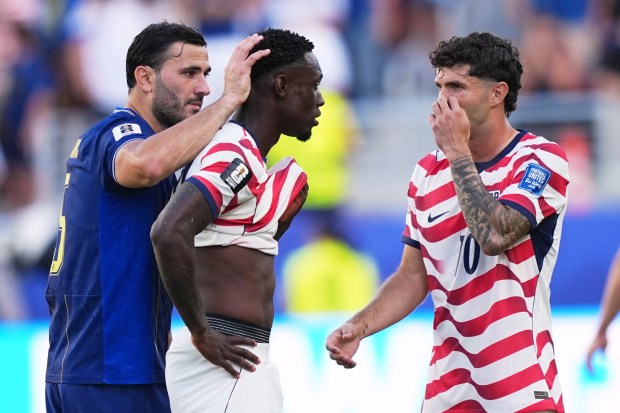 U.S. striker Folarin Balogun (20) gets a pat on the head from Bosnia’s Sead Kolasinac (5) and words of encouragement from Christian Pulisic (right) after getting a red card in their World Cup match on Wednesday in Santa Clara. (AP Photo/Martin Meissner)
2. Seething red, part II
Second question: Can they appeal Balogun’s automatic one-match suspension for the round of 16 against Belgium?
The short answer: No.
This has been FIFA’s longtime policy in World Cups, accepting the referee’s decision without reproach. The only internal review can lengthen a ban, not shorten it, as Qatar’s Assim Madibo learned after he broke the leg of Canadian striker Ismael Kone and had his suspension extended from one to five matches.
England’s Premier League mandates a one-match suspension for a red from two yellow cards, two matches for a straight red and three for a particularly excessive offense. However, that can be reduced — and regularly is — upon appeal.
Major League Soccer and Liga MX issue one-match suspensions for all red cards that also can be appealed.
Not in the World Cup. FIFA regulations state: “No protests may be made about the referee’s decisions regarding facts connected with play. Such decisions are final and not subject to appeal.”
“Typical FIFA,” midfielder Tyler Adams said afterward, shaking his head.
“A bit bogus,” midfielder Weston McKennie said.
“That should be fair,” Pochettino said, “to appeal and demonstrate that it wasn’t a red card.”
Pochettino then added the obligatory qualifier: “This is soccer, this is football.”
And this was not Messi or Cristiano Ronaldo.
The Portuguese star was sent off for violently elbowing an Irish player in their penultimate World Cup qualifier last fall. Such an offense usually carries a three-match suspension, which would have covered the final qualifier and the first two matches of the World Cup.
And FIFA did indeed elevate it to three matches but noted in the fine print that the last two would be deferred for a one-year “probationary period” given Ronaldo’s exemplary behavior record (it was his first red card in 226 international appearances). In two other red card cases reviewed by FIFA on the same day, players from Armenia and Burundi were both handed three-match bans without deferment.
Ronaldo sat out Portugal’s final qualifier, a 9-1 win against Armenia, and was free to play in the World Cup.
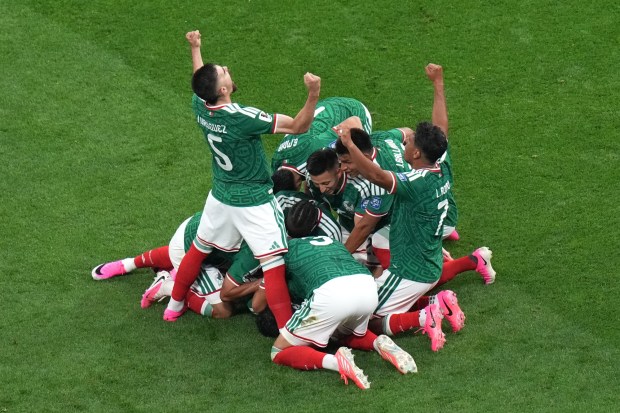 Mexico’s Raul Jimenez (9) celebrates with teammates after scoring their second goal during the World Cup round of 32 soccer match against Ecuador in Mexico City on Tuesday. (AP Photo/Silvia Izquierdo)
3. The host bump
Host nations historically experience a healthy performance “bump” at World Cups.
A Dutch professor quantified it, examining 4,091 matches played in the World Cup or continental championships and finding that home soil improves chances of victory by 22%. Or put another way: Say a team has a 40% chance of winning against a superior opponent at a neutral site; now it becomes a slight favorite.
Over 19 World Cups, the host nation has outperformed its typical World Cup run in 16.
So far, that form is holding true in 2026. All three co-hosts are in the round of 16.
But that was expected, given the advantages the host nation is accorded in the draw and geographical placement. The real test comes now.
Canada vs. Morocco (Saturday at 10 a.m. in Houston): Canada screwed itself with a 2-1 loss against Switzerland in the group stage finale, bumping it to second place and south of the border for the knockout round. And into the (far) more difficult side of the bracket.
Instead of staying in Vancouver, it was shipped to Southern California for a 1-0 round of 32 victory against South Africa and now to Houston, not exactly a city with a bunch of expats. If the road doesn’t end there, it almost certainly will in the quarterfinals against France.
Mexico vs. England (Sunday at 5 p.m. in Mexico City): At No. 4, the English are the highest ranked of the co-host’s round of 16 opponents yet, as former center back Sol Campbell told Sky Sports: “No Mexico player gets in the England team – we’re by far the better team. But at 7,000 feet?”
If the England coach Thomas Tuchel were smart, he would have moved his team’s base camp to Denver or another high-altitude locale, knowing there was an excellent chance they were headed to Estadio Azteca for the round of 16.
Short of the two weeks required for full acclimatization, his team will find out what San Diego State basketball teams have for years playing in the Mountain West at 7,000-plus feet: They’re gonna feel like they’re running in quicksand. (Ask Ecuador, which was based in Columbus, Ohio, and was chasing shadows all night in a 2-0 loss in the round of 32.)
Mexico has never lost in 10 all-time World Cup matches at the Azteca, outscoring opponents 18-2. If they make it 11 straight, though, they head to Miami and sea level for the quarterfinals, likely against Brazil.
USA vs Belgium (Monday at 5 p.m., Seattle): On paper, the Red Devils are a tough draw —a team that embarrassed them 5-2 in a March friendly and probably would have beat them 12-1 instead of 2-1 in the 2014 round of 16 in Brazil had it not been for goalkeeper Tim Howard’s record 16 saves.
In reality, it might not be so bad. Belgium’s aging golden generation has looked pedestrian for much of this World Cup, getting excoriated by media back home and needing a miraculous escape after trailing Senegal 2-0 on Wednesday. The lopsided March win could breed complacency among the Belgians and vengeance among the Yanks. And the crowd in Seattle is the loudest in America.
It gets significantly bumpier from there, with Spain looming in the quarterfinals and France in the semis — arguably the two best teams in the tournament so far.