
The contract
The Philadelphia Flyers tendered an offer sheet to Anaheim Ducks restricted free agent forward Leo Carlsson for five years at an average annual value of $18 million.
The drama of this year’s NHL offseason has reached an entirely new level. You’d have to go all the way back to 2012, when the Flyers inked Shea Weber to a 14-year, $110 million deal, which the Nashville Predators matched, to find the last offer sheet as bold and aggressive as this one. (Sebastian Aho’s offer sheet from Montreal in 2019 was for less than half the money.)
Carlsson is already a No. 1 center at 21 after a breakout season in which he recorded 67 points in 70 games, in addition to an impressive playoff. He’s an elite, buttery smooth playmaker, boasts a 6-foot-3, 208-pound frame, and has added a wicked shot and finishing ability to his offensive arsenal. Carlsson’s skating has also improved massively since his draft year, giving him a rare, tantalizing blend of power, speed and finesse. There’s no question he has the potential to become a franchise player when you combine all of those traits with his two-way intelligence and puck thievery on the defensive side.
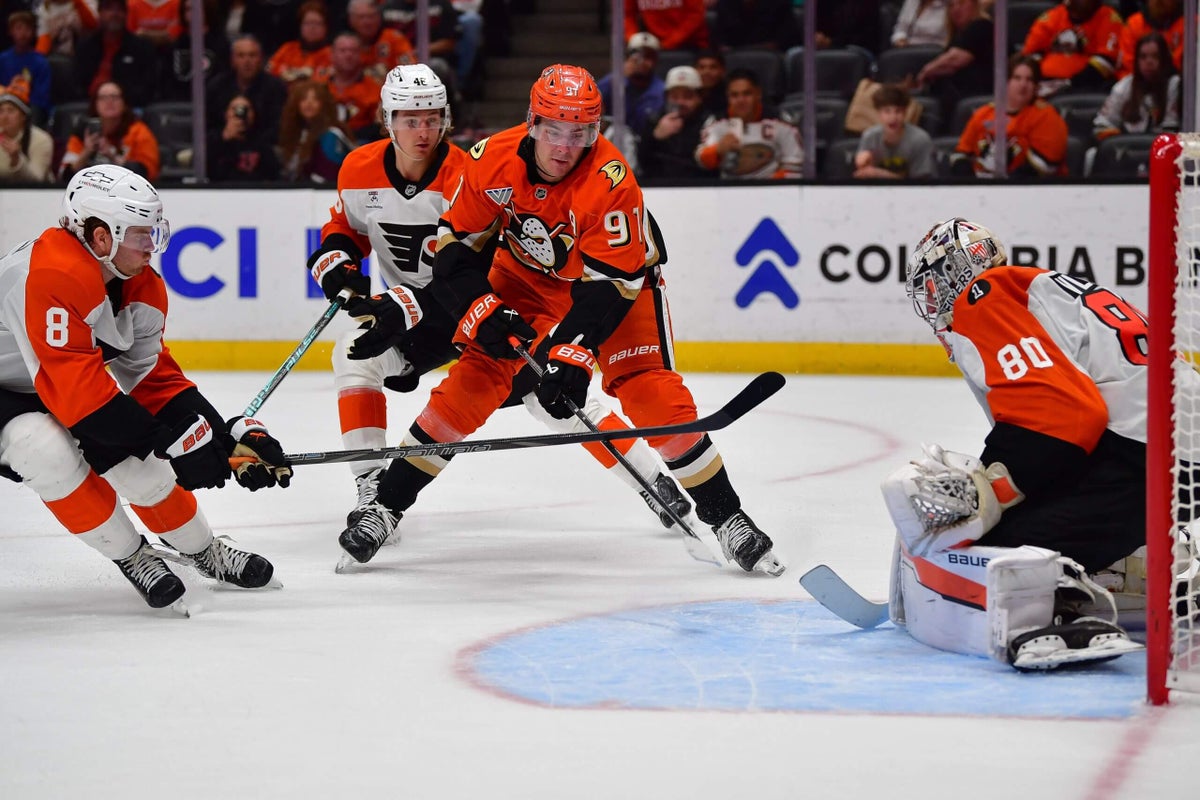
Leo Carlsson finishes off the 2-on-1 chance
However, it’s also true that an $18 million AAV is a huge overpayment, even in this rising cap world. Carlsson will become the highest-paid player in the NHL next season, eclipsing Kirill Kaprizov’s $17 million AAV. There’s a $4 million per year difference between Carlsson and the No. 3 highest cap hit for 2026-27, which belongs to Leon Draisaitl. $18 million is what teams should be paying Hart Trophy-caliber forwards or Norris-caliber defensemen in the coming years.
As exciting as Carlsson’s ceiling is, he’s likely to fall well short of that bar — colleague Dom Luszczyszyn’s model projects Carlsson’s value at $12.8 million annually over the next five years.
For the Flyers, though, overpaying is worth it to potentially land the talent. Philadelphia desperately needs a No. 1 center for its young core. They’re absolutely loaded with skilled wingers such as Porter Martone, Trevor Zegras (he mostly played wing), Travis Konecny, Tyson Foerster, Owen Tippett and Matvei Michkov, and coach Rick Tocchet has turned them into an excellent defensive team. But their top-six center situation has been one of the worst in the league.
It’s next to impossible to land No. 1 centers via trade or free agency, especially one as young and high-potential as Carlsson, and drafting one is an enormous long shot too because the Flyers are too good to collect top-five picks moving forward. With that context in mind, Carlsson is worth the overpayment, especially when you think of how terrifying he and Martone would be together.
Philadelphia has $29 million in projected cap room for next season. New contracts for RFAs Zegras and Jamie Drysdale will eat up some of that space, and Michkov will need a new deal next summer, but the possibility of adding Carlsson at $18 million isn’t going to handcuff Philadelphia moving forward.
The compensation of four first-round picks would be justifiable, too. If Carlsson joins the Flyers, who already won a playoff round last season, you can bet that those future first-round picks will be in the mid-to-late range. Mid-to-late first-round picks can churn out useful NHL players, but the odds of landing stars with those selections are usually slim. Philadelphia can especially justify it because it has a strong prospect pipeline (ranked No. 8 by colleague Scott Wheeler in April) and it owns Toronto’s first-rounder, which it would keep in 2028.
Flyers fans shouldn’t get too excited, though, because the odds of the Ducks matching this offer sheet seem very high. Yes, it would screw up their salary cap structure and internal cap dynamics, which would potentially inflate RFA Cutter Gauthier’s next contract as well, but the alternative of losing your elite young center is worse. Subtracting Carlsson would set the Ducks back for years, which seems untenable considering how long they’ve been rebuilding, especially just as their team is ascending.
Broadly speaking, this is going to have fascinating implications for the rest of the NHL as well.
Firstly, it’s a reminder that the teams that wait to pay their young stars (Carlsson was extension-eligible last offseason) rather than re-signing them before their entry-level contracts expire will likely regret it, which is something NHL agents warned about amid the skyrocketing cap. The Montreal Canadiens, for example, went to work early, signing Lane Hutson, Juraj Slafkovský and Ivan Demidov.
Carlsson’s offer sheet could also reset the market for young players. What does RFA Connor Bedard’s next contract look like now? Bedard has outproduced Carlsson over the course of their respective ELCs. What about Macklin Celebrini next summer?
Philadelphia’s offer sheet will likely get matched, but this is going to hurt Anaheim and create a massive ripple effect around the NHL.
When grading this offer sheet for Philly, we can’t just look at the contract’s pure efficiency and value. If that’s the only lens we use, it’s obviously a significantly inflated deal that Carlsson is very unlikely to fully live up to. However, for a team as desperate for an elite center as the Flyers, one that’s positioned with the wingers and team around him to potentially take a huge leap forward, it’s a smart swing, even if the odds are stacked against them actually landing the player.
Offer sheet grade: B