
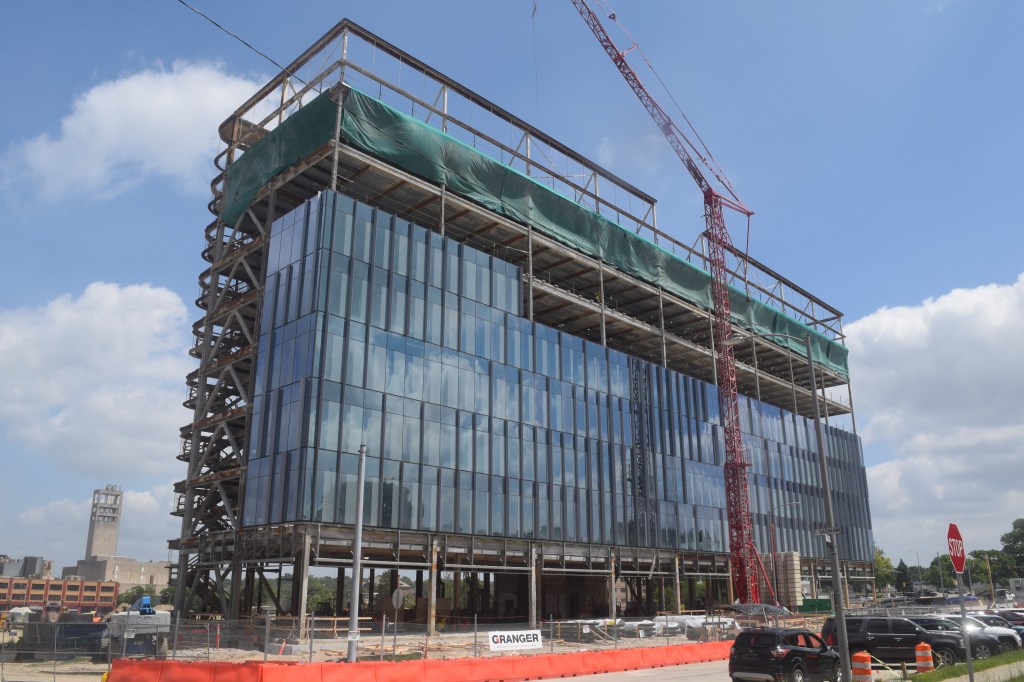
After decades of population decline tied to the collapse of manufacturing and the loss of thousands of automotive industry jobs, Pontiac is growing again.
The latest data marks a significant shift for Pontiac, whose population fell from more than 85,000 residents in 1970 to 61,606 in the 2020 U.S. Census.
Pontiac’s population now stands at 62,077, adding 475 new residents between 2020 and 2025, outpacing Ferndale, Farmington Hills, Walled Lake, Birmingham and Royal Oak.
Recent estimates suggest the trend may continue as new housing developments come online and investment returns to the city.
According to estimates from the Southeast Michigan Council of Governments, Pontiac added 691 occupied housing units between 2020 and 2025, signaling stability for a city that has struggled to reverse years of decline.
“There’s many alternative universes where we stagnate or shrink further,” Mayor Mike McGuinness said. “Pontiac is in a season of growth, of rebuilding, and the numbers reflect that.”
City leaders, housing officials and business executives say new housing developments, downtown investment and a renewed focus on affordability are attracting residents.
“Pontiac remains one of the most affordable communities in Oakland County. Home prices and rents are significantly lower than neighboring communities,” said Vern Gustafsson, with the Pontiac Housing Commission. “I would say that the redevelopment activities going on in the city of Pontiac in regards to investment, adaptive reuse projects, and new housing developments are attracting residents.”
Decline over decades
The city experienced a steady exodus of well-paying automobile manufacturing jobs over several decades from its peak in the 1970s, gradually accelerating as its main employer, General Motors, scaled back operations.
According to data from the U.S. Bureau of Labor Statistics and media reports at the time, hourly workers for GM peaked at over 30,000 across several massive manufacturing complexes in the city.
But starting in the 1980s, GM permanently closed the Pontiac Foundry then the Pontiac Assembly plant shedding over 6,700 manufacturing jobs. The closures continued in the 1990s as the automaker shuttered Pontiac Central Assembly then the Plant 9 Engine facility.
In the early 2000s, parts suppliers, another source of jobs in the city, relocated in response to automation, corporate consolidations and new manufacturing plants built outside the state. During this period, Michigan lost over 211,000 auto-related jobs.
In 2009 the city hit rock bottom. Hit with a global recession, GM declared bankruptcy and disolved the Pontiac Motor Division as it reorganized, and closed the Pontiac East Assembly and GMC Truck & Coach manufacturing facility shedding thousands of jobs.
In April 2009, city unemployment hit a staggering 27.2%, more than three times the national average.
As jobs fled, so did revenue from property and income taxes. In 2008, according to media reports at the time, there were over 1,000 home foreclosures. The city’s budget deficit of over $7 million prompted Gov. Jennifer Granholm to appoint an emergency financial manager.
In 2017, after a decade of outside management, the state returned financial control to the city’s elected officials and the long journey of rebirth began in earnest.
Today, roughly 1,100 auto industry jobs remain and unemployment for June 2026 was 8.1%, thanks to job growth in the healthcare, logistics (including the Amazon fulfillment center), and service sectors. That’s significantly lower than the 2009 crisis but still higher than the 5% statewide average.
“We lost 33,000 jobs,” McGuinness said. “It completely altered our physical landscape, the hope landscape, the workforce development landscape. It’s actually impressive that we’re still standing, that we’re thriving and growing despite that.”
Population growth
According to U.S. Census estimates, the city’s population growth has been roller coaster ride since 2020.
For the Census count that year, Pontiac registered 61,602 residents. Estimates for 2021 showed 62,134 people called the city home, an increase of 532. But numbers decreased between 2022 and 2023 before rebounding in 2024 and 2025.
2020: 62134, 532 increase
2022: 61,961, 172 decrease
2023: 61,689, 272 decrease
2024: 61,855, 166 increase
2025: 62,077, 222 increase
The net change in Pontiac’s population between 2020 and 2025 is 475 residents. That puts it 14th among 62 municipalities in Oakland County, outpacing several prominent communities:
Oxford Township: 419 new residents
Ferndale: 246
Farmington Hills: 171
Walled Lake: 167
Birmingham: 158
West Bloomfield: 132
Royal Oak: 48
Milford: 33
Lake Orion: 13
Rochester: -136
Affordability key to growth
A 2024 city survey on housing needs included a survey for employees at United Wholesale Mortgage, Pontiac’s largest employer. The mortgage lender, headquartered in the city, employs approximately 9,000 workers.
Of the 683 UWM employees who responded to the survey conducted in December 2024, affordable housing, neighborhood safety and attractive housing options were identified as the most important factors influencing decisions about where to live.
Among employees already living in Pontiac, affordable housing was cited as the city’s greatest strength, followed by job opportunities and proximity to friends and family.
“We have almost 600 of our team members living here now and that’s up from 400 a few years ago so Pontiac’s once again become a great place for young people to live,” said Lee Jelenic, chief innovation officer at UWM.
Among employees who do not currently live in Pontiac, affordable housing, neighborhood safety and housing quality were the most important factors influencing whether they would consider moving to the city. Of the respondents, 244 said they would not consider relocating to Pontiac, while 129 said “maybe” and 38 said “yes.”
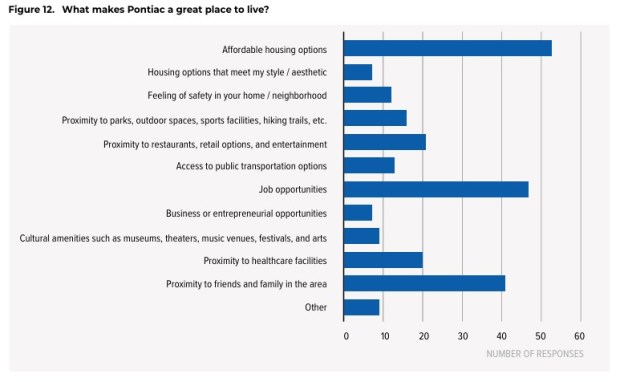 A survey of UWM employees shows what aspects of Pontiac made them choose to become residents.
photo by Matt Fahr
“Regardless of what the affordability threshold may be, it is clear that affordability, and likely attainability, are housing components the city must prioritize to attract and retain residents,” the report concluded.
But Jelenic said UWM is glad to be part of the ecosystem of a city that is on a positive path forward.
“I think the city deserves a lot of credit because they made some decisions to reorient their downtown and to tear down parking garages and some other things that were literally bifurcating the downtown,” said Jelenic. “it has become a much more walkable, livable area.”
He added, “I think really what you’re starting to see is … people will lump Pontiac or Saginaw or Flint, some of these areas or these cities together, but Pontiac is starting to look like the leader and emerging into what the modern version of these cities look like.”
The housing study also found that Pontiac remains one of the most affordable communities in Oakland County, with rents and home prices significantly lower than neighboring communities. The city’s affordable housing opportunities have become increasingly attractive to younger workers seeking alternatives to more expensive surrounding suburbs.
“What I’m seeing more is that there’s more affordable housing in Pontiac than there is anywhere else in Oakland County,” said Candice Ridley, president of the Pontiac Education Association. “With millennials and zennials trying to get into the workforce and getting into apartments and homes of their own, that’s what they’re looking for.”
Pontiac has also created unique programs to help residents who choose the stay in the city. It currently has 2,214 housing units operating under Payment In Lieu of Taxes, or PILOT, agreements that provide tax incentives in exchange for affordable rents. City analysis found that residents in those units pay an average of $1,139 per month, including utilities, compared with the citywide average rent of $1,328.
For every dollar in tax revenue the city forgoes through PILOT agreements, residents receive an average monthly rent reduction of $8.31, according to the study.
Rebuilding the city
Housing officials believe continued development could help change perceptions.
“We have an initiative labeled as 100 Homes for Pontiac,” said Vern Gustafsson, planner and director of the Pontiac Housing Commission. “Building a series of single-family homes, affordable homes and also market-rate homes to increase assessments and land value.”
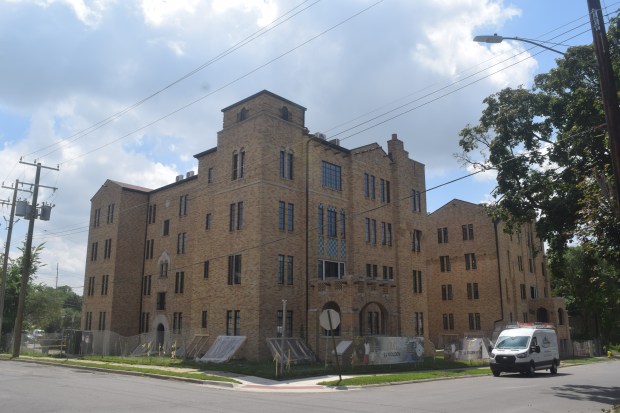 Casa Del Rey Apartments, an historic apartment building at 111 Oneida Street—that’s been dormant for 20 years is one of the many projects going on around Pontiac.
photo by Matt Fahr
The Pontiac Housing Commission and its partners plan to construct 100 new homes on vacant residential lots over the next three to five years.
Several large residential projects are already underway.
Mayor McGuinness pointed to the redevelopment of the historic Pontiac State Bank building, where 114 loft apartments are opening this year. Another 50 apartments are expected to come online soon through the rehabilitation of the long-vacant Casa Del Rey Apartments. A 54-unit housing development by Lighthouse of Oakland County is also under construction on Auburn Avenue.
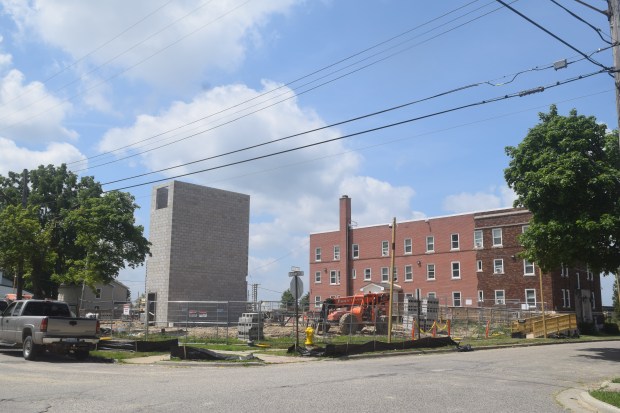 Projects, like this apartment development behind Lighthouse of Oakland County, are helping to solidify residents staying in the city and continuing the population growth seen over the last five years.
photo by Matt Fahr
Additional apartment construction near Golf Drive has attracted workers from United Wholesale Mortgage, according to city officials.
In downtown there will soon be a refurbished Judson St. building, which will house 700 county employees, and the start of ground preparation for two new parking decks on the former Phoenix Center site.
Construction crews have begun installing the new facade on the Judson building, with exterior work set to begin this summer. The project is on track for phased occupancy between September and November 2027.
Beyond affordability
But affordability alone will not determine whether Pontiac’s growth continues.
Community leaders caution that redevelopment must benefit longtime residents and avoid repeating past mistakes.
“There is a very real, justifiable fear among residents that this resurgence is being designed for everyone except the people who actually live here,” said Kaino Phillips, president and CEO of the Clarence E. Phillips Ascend Foundation.
Phillips said residents want investment that reflects Pontiac’s African American and Latino communities and creates opportunities for local entrepreneurs. He also warned against poorly constructed housing developments that may appear affordable initially but become costly over time.
“There is a fear of cheap, quickly thrown-together ‘affordable’ housing that looks good on paper but deteriorates rapidly due to poor development standards,” Phillips said. “Past projects in the region have suffered from cutting corners (like developers skipping essential weather-wrapping), leaving residents to foot million-dollar repair bills down the line. True affordability must include structural longevity.”
Pontiac’s demographic profile reflects its diversity. Nearly one-quarter of residents identify as Hispanic or Latino, while Black residents account for approximately 43% of the population. More than 19% identify with two or more races.
For many residents, the city’s future depends on whether it can build upon its affordability while improving public safety, schools and neighborhood quality, but Phillips wants that future to include those who endured the hardships of the past.
“The political fallout from these choices shows that the public is watching closely,” he said. “While some leaders managed to offset the backlash due to their standing across multiple districts, the message from the community is clear: revitalization cannot come at the expense of the people who stuck by the city.”
Ridley believes stronger community connections will be critical.
“What I’m hoping this means is that we’re going to have more people who will stay in Pontiac and make the community stronger and the bonds between the people stronger,” she said. “When we have those strong bonds between people, we have that sense of community. It helps our students.”
McGuinness acknowledges Pontiac still faces significant challenges, but says momentum is building.
“The excitement is there, the energy is there,” he said. “The feedback that I’m getting from residents and employees and businesses is that Pontiac is on the move. Pontiac is getting better.”