
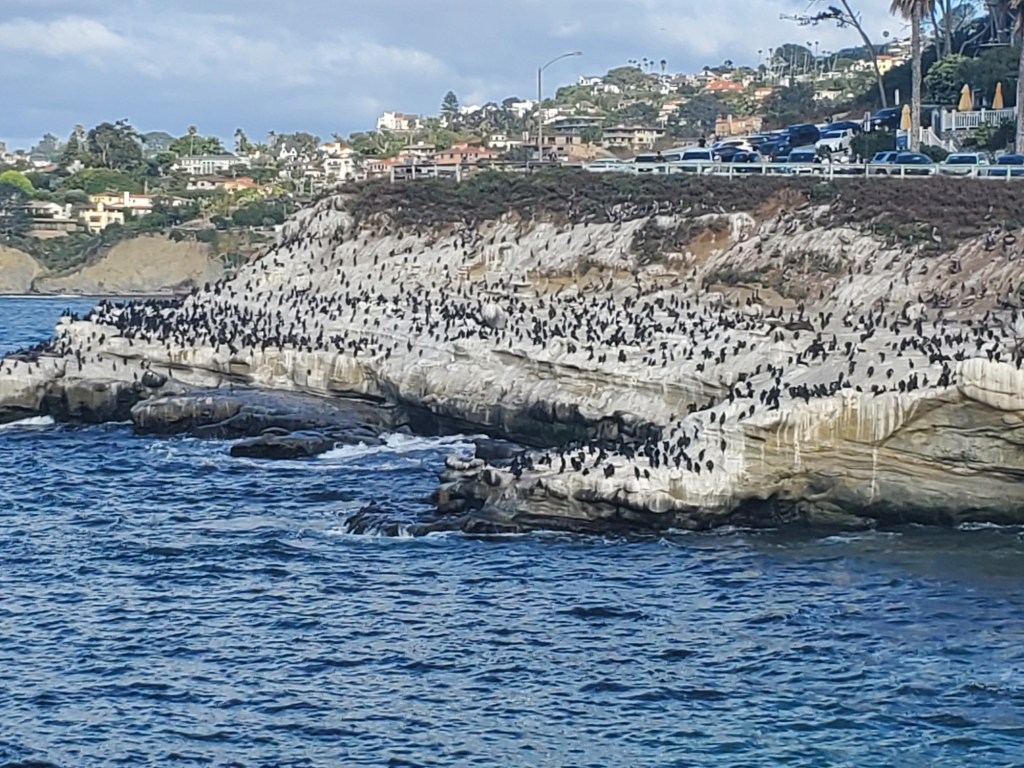
Adding to the list of concerns that have been raised surrounding the city of San Diego’s plans to spray a bacterial agent on the bluffs over La Jolla Cove, local residents are expressing worries that a similar product may have contributed to the recent decline of kelp off La Jolla.
An application filed in early June by the San Diego Parks & Recreation Department seeks a coastal development permit from the city to “abate noxious odors where accumulated bird and sea lion excrement pose a health hazard to the public.”
The area covers about 2,180 square feet of the bluffs overlooking La Jolla Cove north of Coast Boulevard.
The city intends to spray a non-pathogenic bacterial agent onto the bluffs to effectively “eat” the animal waste. The product, BIOCAAC (Bioactive Odor Counteractant and Cleaner), is from Coronado-based Ark Environmental Solutions.
“BIOCAAC is a water-based blend of cultured, non-pathogenic bacteria and surfactant, similar to those in household soaps, which acts as a foaming effect to prevent the application from running off the bluffs,” city spokesman Benny Cartwright previously told the La Jolla Light. “The bacteria activates when diluted with water [approximately 100 gallons of water for every 10 gallons of product] and then digests and accelerates the breakdown of animal waste, reducing the odors associated with high ammonia levels and harmful bacteria. The byproducts of that breakdown are water, oxygen and carbon dioxide. Once the medium dries out, the bacteria dies and stops working.”
Funding for the project, which would cost about $325 per application, would come from the city’s general fund. The spray is expected to be applied as needed rather than on a set schedule.
The city of San Diego conducted a similar spraying effort in various intervals from 2013-2023, some more publicly than others. While the city declared the program a “success” in 2013, it quietly resumed the spraying in 2015. The product being considered this time is different from what had previously been applied, but both used surfactants.
Though the U.S. Environmental Protection Agency states that “most daily-use surfactants are safe in small, diluted quantities,” some expressed concern about its use at The Cove.
The EPA also says “concentrated exposure can cause skin irritation, eye damage or respiratory issues,” and local swimmer Eric Fletcher says he’s concerned about potential harm to humans and the environment and whether something like this is even needed.
He took his concerns to local boards, including the La Jolla Community Planning Association during its June 4 meeting and the La Jolla Parks & Beaches group on June 22.
Following these meetings, Fletcher spoke with local oceanographers to better understand the potential impacts of exposure to these products, and obtained a schedule of when the city conducted sprayings in the past.
With information from the two combined, he said he learned about potential impacts of these surfactants to kelp and that the spraying events coincided with periods of kelp die-off in recent years.
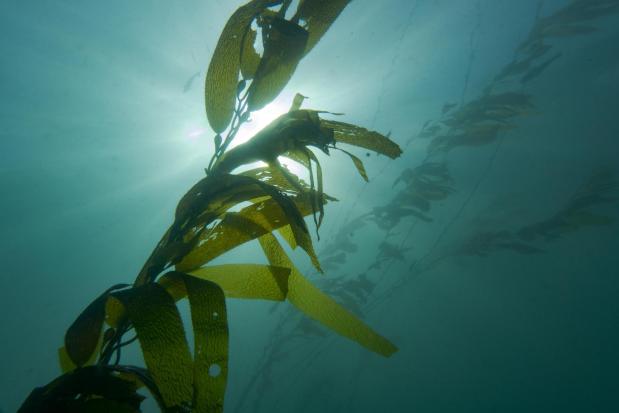 Strands of kelp rise from a thinned kelp forest in La Jolla, Calif., Tuesday, Dec. 2, 2025. (AP Photo/Annika Hammerschlag)
Data provided by the city shows a guano-eating bacterial agent was applied 23 times in 2020, 17 times in 2021, eight times in 2022 and twice in 2023.
Soon after, in summer 2023, local scientists reported that the two largest kelp forests on the West Coast — off La Jolla and Point Loma — had been slowly getting smaller, especially in the kelp beds off northern La Jolla between Marine Street Beach and La Jolla Shores. La Jolla Cove is in this area. Kelp beds off southern La Jolla were showing patchy regrowth, but those in northern La Jolla appeared decimated.
“I’m not sure why that is,” Ed Parnell, a marine ecologist at UC San Diego’s Scripps Institution of Oceanography in La Jolla said at the time, and that the La Jolla kelp “should be doing better than it’s doing.”
Although they cannot say for sure and have no scientific background, Fletcher and some others are concerned the biological agent might have played a part.
“Giant kelp is highly dependent on an external mucus layer to protect itself from disease and stress. Surfactants dissolve this protective layer, leading to rapid tissue rot,” Fletcher told local boards via email. “Furthermore, these chemicals alter the rock surface tension on the seafloor within the benthic boundary layer, mechanically preventing microscopic kelp spores from naturally attaching to the reef to grow and regenerate.”
He said the timing of these die-offs “aligned with when the city was spraying.”
Agreeing, local waterman Kurt Hoffman said he has observed the decline in kelp in recent years, and questions whether the spraying was a factor.
“It’s a big issue,” he told the La Jolla Light. “I’ve been concerned about this for the last few years … and while [climate change is likely] a factor, the stark difference in the health of the kelp beds from north La Jolla to south La Jolla has to be related to something we are doing. In other areas, the kelp is fine. But in north La Jolla the kelp devastation is a big concern. I jumped to the conclusion of sea lions being the cause … but this spray issue could be more of a reality. That could be the issue.”
Hoffman said his observations come from “50 years of fishing out there” and that he finds the change “alarming.”
It is not yet known when the city plans to resume the sprayings.