
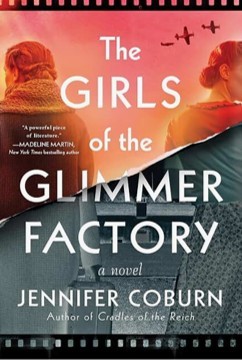
Reviewed by Pennell Paugh
July 5, 2026 (San Diego) — San Diego author Jennifer Coburn releases a new novel, The Girls of the Glimmer Factory. Like Coburn’s recent novel, Cradles of the Reich, this is a historical novel staged during the Third Reich in World War II.
The book follows two main characters. Hannah is a Jewish prisoner. She lives in a Nazi work and artistic camp called Theresienstadt located in Dresden. Hannah cuts mica which was used by Germans to keep vacuum tubes in radios from shorting out. While living in the camp, Hannah and her fellow prisoners are fed an insubstantial diet, work long hours daily, and live in crowded barracks.
Theresienstadt is filmed as a model ghetto in Nazis propaganda films to convince the world that the Jewish people live well in camps while German citizens suffer daily privations for the war effort.
The second character, Hilde, is a childhood friend of Hannah’s, though she is a true believer in the Nazi cause. While working for the Reich Ministry of Enlightenment and Propaganda, Hilde participates in the making of propaganda films. Her last film is about Theresienstadt where she enlists Hannah as an assistant. Hilde learns that once the filming is finished, prisoners at the camp will be sent to Auschwitz where they will be murdered. Hilde plots to save her friend.
The lives of the two women are arduous and troubled. They both struggle, experience thwarted dreams, and become stronger over time.
Below is an excerpt from the novel:
“Berlin, October 1944
“Four fashionable young brunettes huddled around a table in an immaculate dormitory room playing bridge, chatting affably as a maid appeared with an enamel pot and refilled their coffee cups. The ladies’ hair was neatly rolled, and the eldest of the group had tied a cloth into a flirty bow atop her head. Another twisted her pearl necklace as she contemplated her next move, then laid down a card. A new servant approached carrying a silver tray piled high with almond cookies, but the women declined with the lift of a palm or polite shake of the head. No, no, I’m watching my figure, their gestures said.
“In another quarter of the Dresden Barracks at the Theresienstadt camp, a mother balanced a girl of about six or seven years old on her lap as the two shared a rocking chair and flipped through a storybook. The child smiled at the fairy tale as her mother’s T-strap high heels tapped the floor planks. A record spun on the gramophone beside them.
“A dozen men in yarmulkes gathered around a conference table, perusing papers in front of them, some squinting through their eyeglasses. At the head, a member of the Council of Jewish Elders lifted a finger. He paused to look at his dozen colleagues, then smiled broadly and moved his lips. Because this segment of the film was narrated, it was impossible to know what the old man said, but the others nodded in agreement, and one jotted notes with his fountain pen.
“The film narrator’s resonant voice told viewers, ’While the Jews sit in the Theresienstadt settlement with coffee and cake, German soldiers bear all the burdens of a terrible war, want and deprivation, to defend the homeland.’”
Jennifer Coburn is an award-winning writer of the travel memoir, We’ll Always Have Paris, a mother-daughter adventure through Europe. She is the author of six contemporary novels and contributor to four literary anthologies. Coburn has written for U-T San Diego, Washington Post, Miami Herald, Mothering magazine, The Huffington Post, Salon.com, and numerous other newspapers and magazines. Two of her novels were chosen as winners in the Best Fiction category of the San Diego Book Awards. She lives in San Diego with her husband, William, and their daughter, Katie.
When Coburn is not going down historical research rabbit holes, she volunteers with So Say We All, a live storytelling organization, where she is a performer, producer, and performance coach. She is also an active volunteer with Reality Changers, a nonprofit that supports low-income high school students in becoming the first in their families to attend college.