
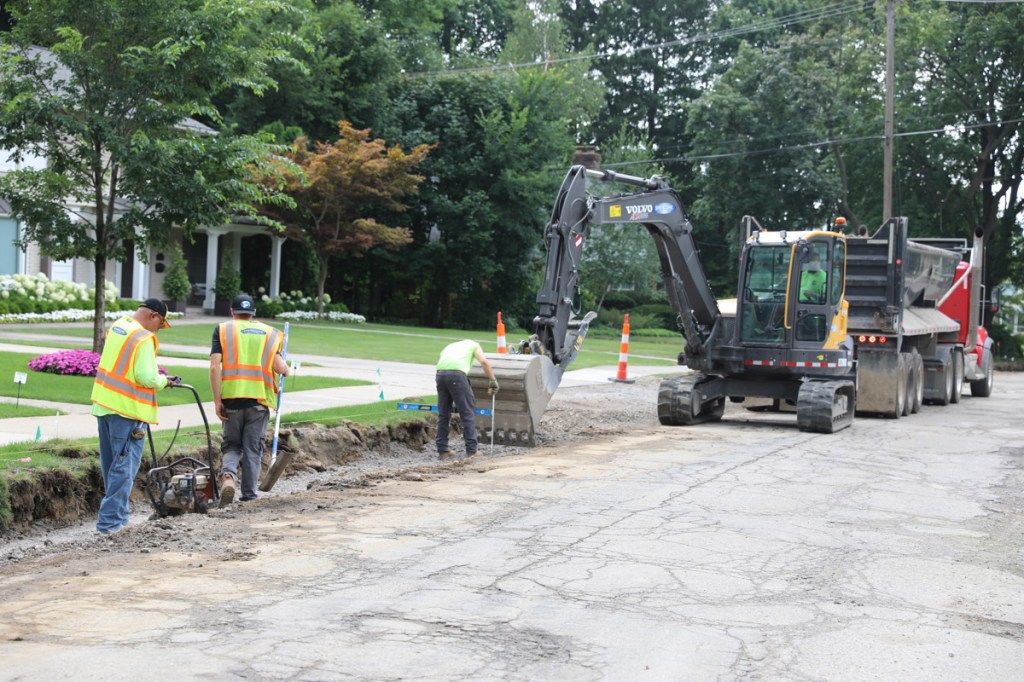
Voters in three Oakland County communities will decide in August whether to continue or expand funding for road, sewer and infrastructure improvements through local millages and a bond proposal.
The ballot measures in Bloomfield Township, Huntington Woods and Madison Heights focus on transportation infrastructure, but each would fund different types of projects and carry different tax implications for property owners.
BLOOMFIELD TOWNSHIP
Voters are asked to renew a road maintenance millage of up to 0.65-mills for 10 years beginning in December 2027.
The proposal would renew a previously approved millage that expires in 2026 and is expected to generate about $3.93 million in its first year if approved.
According to the township website, the funding supports routine maintenance of subdivision roads, including snow plowing, salting, sweeping, pothole patching and gravel road grading. The township maintains 176 miles of paved subdivision roads and 37 miles of gravel roads.
Bloomfield Township is unique in Michigan because it directly provides subdivision road maintenance to residents through an agreement with the Oakland County road commission. Under Michigan’s Public Act 51, state road funding cannot be used to reconstruct or replace subdivision roads or pave gravel roads because those roads primarily benefit nearby residents rather than through traffic.
The township currently levies about 0.69 mills after required tax rollbacks. A homeowner with a taxable value of $200,000 pays about $138 annually toward subdivision road maintenance. The millage funds routine maintenance rather than major road reconstruction projects.
HUNTINGTON WOODS
Voters will decide on a $17 million bond proposal to finance road, sewer, water main and park improvements.
The proposal would authorize the city to issue bonds up to 20 years. The estimated tax rate in 2027 would be 1.98 mills, with an estimated average annual levy of 1.91 mills over the life of the bonds.
The money will be pay for $13 million in road reconstruction, water main and sewer improvements, $2 million in rear-yard sewer lining and repair programs, and $2 million for parks and recreation improvements.
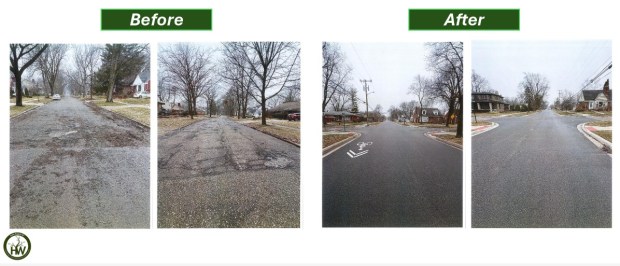 Huntington Woods shows off their past work with road millage funding. This year residents are being asked to approve a $17 million bond proposal to finance road, sewer, water main and park improvements.
photo courtesy Huntington Woods
According to the city, about 6.2 miles or roughly one-quarter of Huntington Woods’ 24.75 miles of roads, require full reconstruction.
The bond would cost the owner of a home with a market value of $600,000 and a taxable value of $300,000 about $581 annually, or $48 per month.
MADISON HEIGHTS
Voters will consider Proposal R-4, which would amend the city charter to authorize a 2-mill levy for 10 years beginning in 2027 to fund residential street repairs and related sewer reconstruction.
If approved, city officials estimate the millage would generate $2.42 million in its first year.
Officials describe Proposal R-4 as a replacement of the existing 2-mill road levy approved by voters in 2016, which expires after the 2026 summer tax bill, rather than a new tax.
Officials estimate the owner of a home with the city’s average taxable value of $63,156 would pay about $126 annually, or roughly $10.50 per month.
“It’s passed every 10 years. So 1996, 2006, 2016 and 2026. This will be the fourth time we’ve asked voters to approve it,” said Madison Heights City Manager Melissa Marsh. “The 2016 millage is expiring this July. So in order to continue that investment, we’re asking the residents to pass it again.”
According to the city, previous road millages have funded the repair or reconstruction of nearly 35 miles of residential streets over the past three decades.
Marsh explained why the millage will become part of the city charter rather than a basic millage renewal.
“It’s been, that 2-mills has been rolled down to 1.813 due to Headlee rollbacks. And so we’re asking people to approve it for 2 mills, so it’s not a renewal,” said Marsh. “But for all practicality, a renewal of a millage that has been on resident’s tax bills since 1997 after it was approved in August of 1996. But, technically I can’t say renewal. So we call it a replacement and it’s basically just a continuation.”