
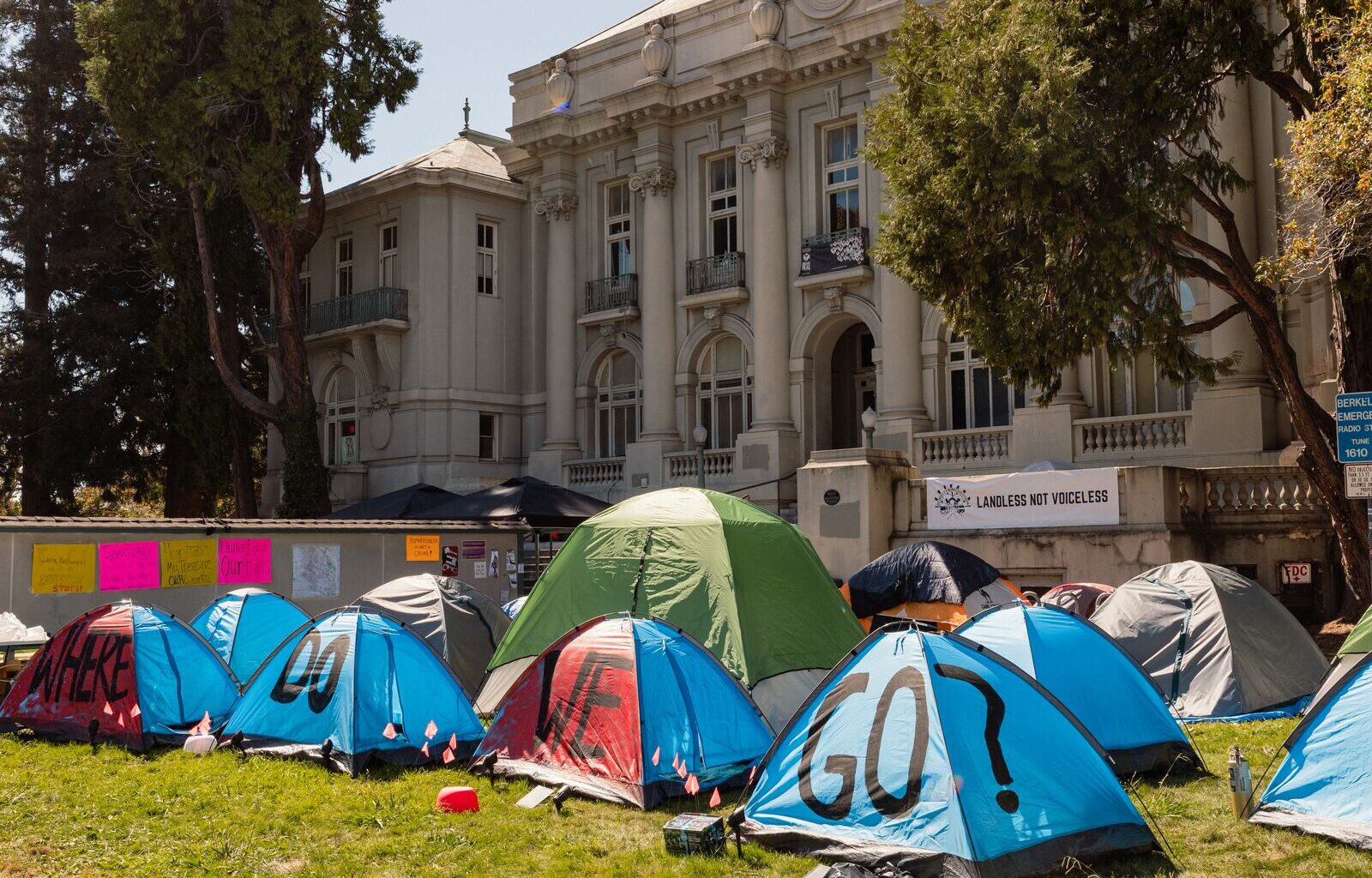
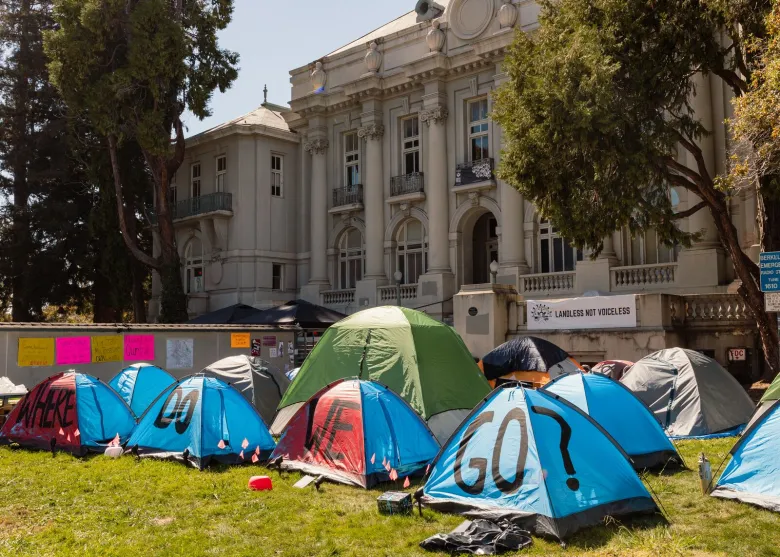
 A protest homeless encampment outside Berkeley’s Old City Hall in October 2024. A winter homeless shelter serving many Berkeley residents has been run by the nonprofit Dorothy Day House and, until the most recent season, opened each winter inside Old City Hall. Credit: Ximena Natera/Berkeleyside
In closing a $30 million deficit last month, Berkeley leaders dismantled some longstanding pieces of the city’s social safety net by eliminating a groundbreaking mental health crisis team and shuttering a winter shelter that served many older homeless residents.
The Mobile Crisis Team, a mental health response unit that has operated alongside Berkeley police since 1979 and may have been the first of its kind in the nation, will shut down this month. Clinicians, advocates and city workers warn that the cuts will leave vulnerable residents with fewer places to turn, while police — who are also facing a staffing crisis — will be the default responders to even more psychiatric emergencies.
The cuts come in the wake of other closures of mental health and homelessness services.
The city’s Specialized Care Unit, a non-police mental health response team, was handed off to Alameda County last year, after years of understaffing, lack of funding and slow response times. And last month, the Berkeley Wellness Center, an arts-focused space for people living with mental illness, shuttered after losing funding from Alameda County. Both closures were driven in part by Proposition 1, a 2024 state measure that restructured behavioral health funding more toward housing and addiction and away from general community programs.
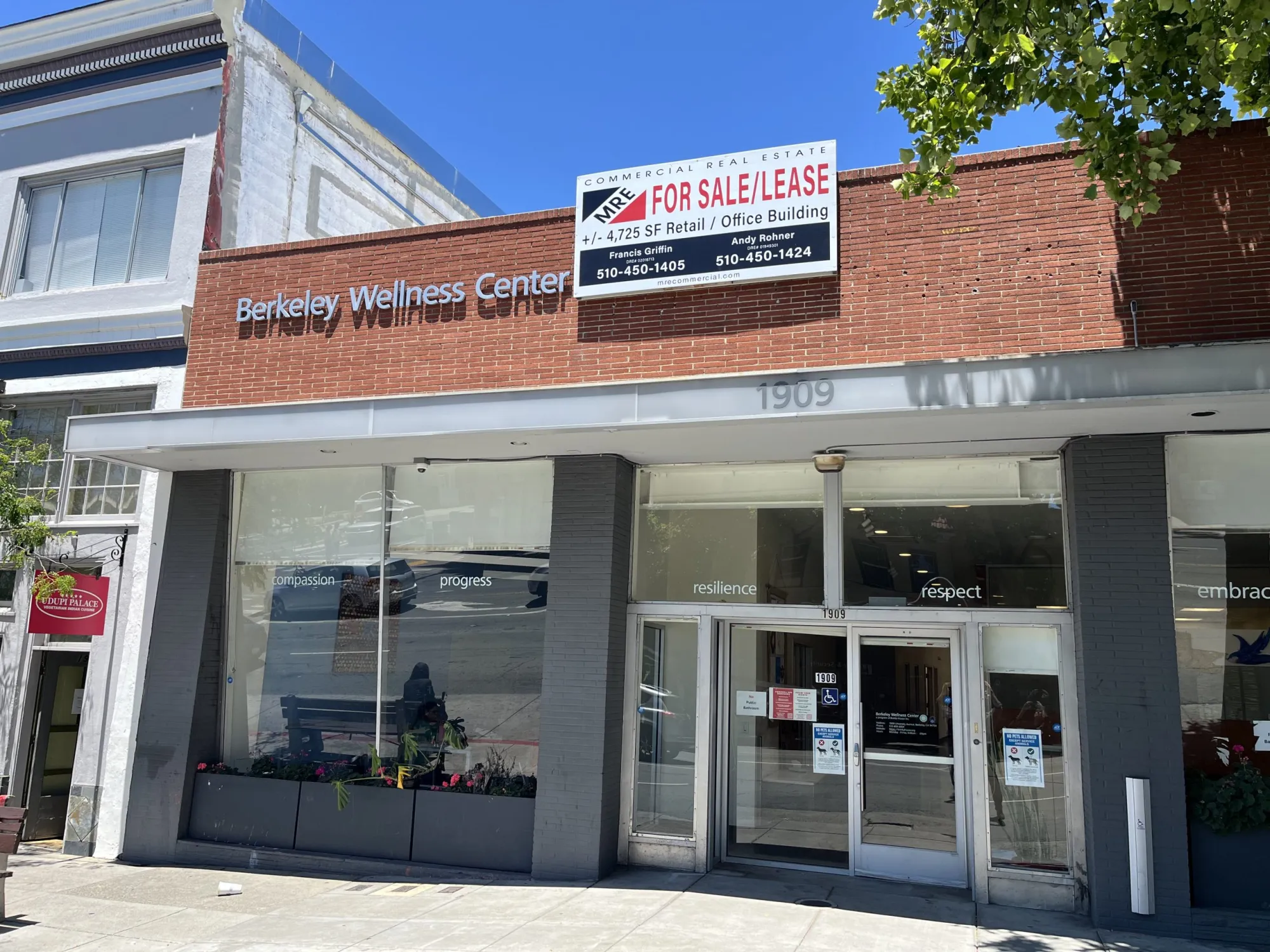 The Berkeley Wellness Center on University Avenue closed in June. Credit: Nathan Dalton for Berkeleyside
Jennifer Wydro, a psychologist who worked on the Mobile Crisis Team for 21 years until her position was cut, said the move to shut down the unit will mean Berkeley offers less support to people experiencing mental health crises.
“It’s especially shocking in a city that seems to pride itself on an independent and progressive take, and really wants to focus on the mental health of its community,” Wydro said.
The whole team is expected to disband on July 17.
Officials say cuts were tough but necessary. Not everyone agrees.
Wydro described Berkeley’s Mobile Crisis Team as helping people who are “about to, or have already hurt themselves, hurt someone else, or are very close to death due to not being able to care for themselves.”
She said the Mobile Crisis Team has provided an emergency psychiatric evaluation for a student threatening a mass shooting at a school, mediated a standoff with a methamphetamine user threatening strangers downtown and assisted the police with a man who barricaded himself inside his house against officers investigating a report of domestic violence.
The city’s police union has warned that shifting psychiatric emergencies onto officers is untenable with staffing at record lows.
“Responsibility for wellness checks and psychiatric emergencies will shift solely to police,” Neil Egbert, president of the Berkeley Police Association, wrote in a June 29 op-ed in The Berkeley Scanner. “The city expects us to absorb more work, respond to more calls and fill more gaps in the fraying social safety net, all while eliminating the [currently vacant] positions we would need to do so responsibly. That is not a sustainable public safety model. That is an unfunded mandate handed to a department already running on fumes.”
A 2023 report by the city found that as a result of understaffing, the Mobile Crisis Team had been dispatched to fewer than 5% of mental health incidents in the previous six quarters, though the report accepted the data it used was “insufficient to fully assess the outcomes of BPD’s response to behavioral health and homelessness-related crises.”
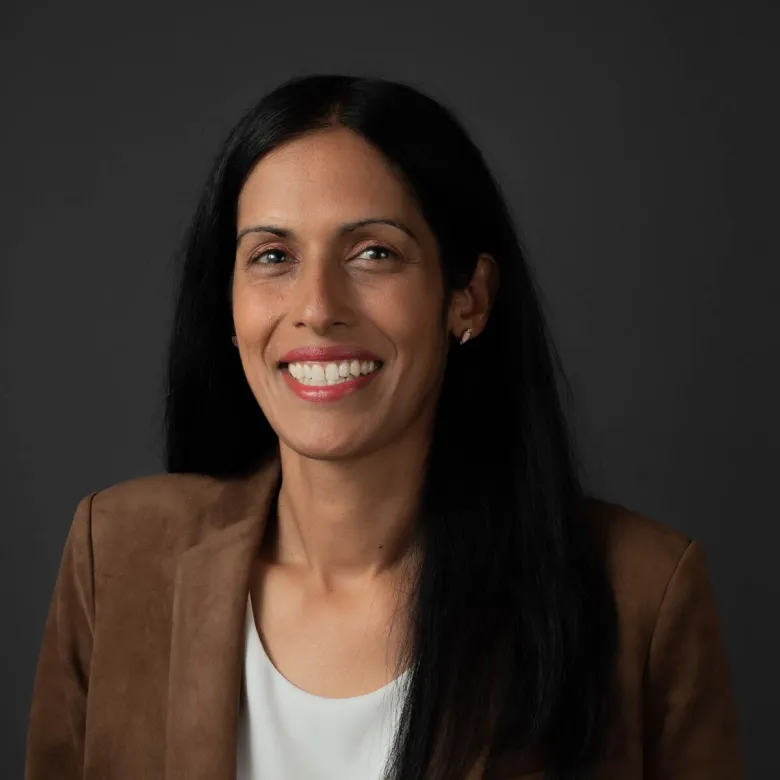 Councilmember Rashi Kesarwani. Credit: Ximena Natera, Berkeleyside/CatchLight Local
Wydro added the majority of the team’s work was phone-based and that Berkeley police’s dispatch data included mental health incidents that did not require the Mobile Crisis Team.
At the June meeting in which the City Council approved the budget, officials did not dispute that the cuts made to close the deficit — which included laying off 20 employees, and closing more than 100 vacant positions — would hurt. (Wydro has been reassigned to another position within the city.)
Councilmember Rashi Kesarwani called the overall budget reductions “painful,” but cast them as unavoidable.
“It’s a structural deficit in which expenditures, particularly for position costs, are on track to consistently outpace revenues unless we reduce the size of our organization,” Kesarwani said.
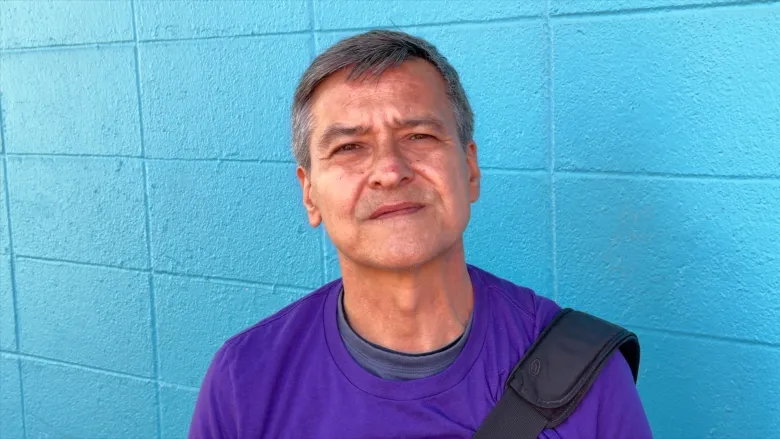 Thomas Gregory. Credit: James Twomey
Thomas Gregory, chapter leader for Service Employees International Union Local 1021, the largest union that represents city workers, argued the money to save the Mobile Crisis Team was already sitting in Berkeley’s reserves. The city’s contingency fund holds more than $57 million, he noted ahead of the vote, and the layoffs are the kind of hardship for which the fund was built.
“Our chapter is not claiming that these layoffs are an emergency, but we are claiming that they are a rainy day, and that’s exactly what the millions of dollars in our rainy day fund are for,” Gregory said.
Can Alameda County absorb Berkeley’s crisis response?
There is no formal plan or agreement for Alameda County to take over the services provided by Berkeley’s Mobile Crisis Team or the Specialized Care Unit, said Nia Patrick, a public information manager for the department, and no extra funding for the county to do so — it will simply cover Berkeley as part of its existing service.
The county’s mobile crisis program — an operation known as the Crisis Assessment and Transport Team, or CATT — began responding in Berkeley in 2025 to help the city manage its planned service reductions, Patrick said in an email. But she said there was “no plan for further expansion in Berkeley.”
Ten CATT teams cover Alameda County, Patrick said, and are required to respond within an hour in cities and two hours in rural areas. Asked whether shifting Berkeley’s emergencies onto the county would leave the city without adequate coverage, she said the county was “unable to offer an opinion relative to the City of Berkeley’s services nor any operational impacts because of their change in service delivery.”
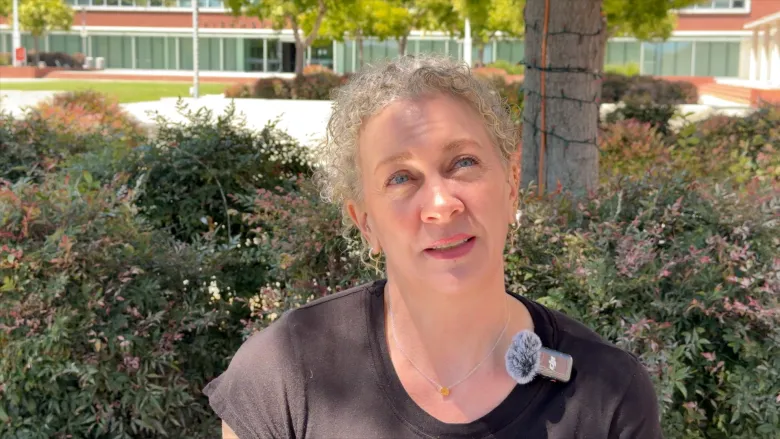 Jennifer Wydro. Credit: James Twomey for Berkeleyside
Wydro said the plan to shift the responsibility of responding to mental health emergencies in Berkeley to Alameda County would effectively leave the city without any coverage, as the county team is already spread too thin. But Berkeley officials who wanted to cut costs, she contends, were satisfied that the county’s team could cover the city “on paper,” she said.
“They considered that good enough, and did not really have interest in the reality of that coverage,” Wydro said.
Leaving the police department to solely deal with mental health emergencies will see an increase in hospitalizations as the only “tool” available to officers, she added.
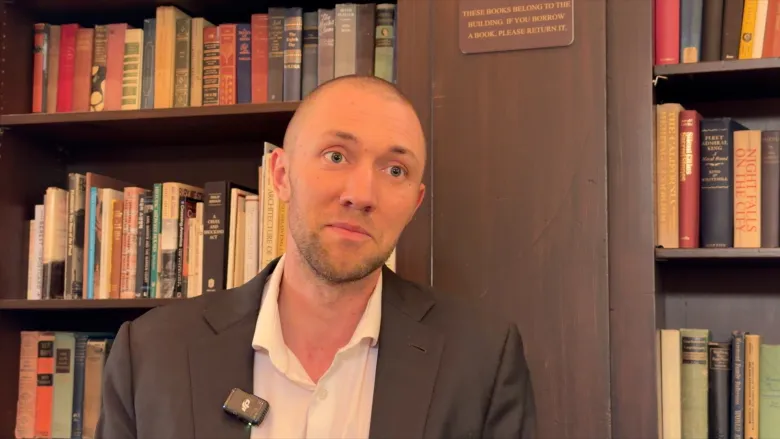 Robbie Powelson. Credit: James Twomey for Berkeleyside
The city spent just over $770,000 on the Mobile Crisis Team in 2022, city records show. But Robbie Powelson, an affiliate of UC Berkeley’s Criminal Law and Justice Center who focuses on homeless advocacy, said the cost of police officers solely responding to mental health emergencies could cost the city more than the cuts had saved.
The Mobile Crisis Team is “a major way to prevent really unproductive interactions with law enforcement that result in arrest or injury and serious consequences,” Powelson said.
“I think it is going to be more incarceration, more citations and arrests,” he added. “It is going to be a huge waste of taxpayer dollars, because every time you arrest somebody and prosecute them, it turns into a huge cost and nobody gets housed, nobody gets help.”
Paul Kealoha Blake, former chair of Berkeley’s Mental Health Commission, said that while Berkeley police officers are better than most at handling mental health crises, everyone needs more education about acute mental health issues. And Blake lamented the closure of the Berkeley Wellness Center, noting that “preventive action is far better than crisis action.”
Between 2017 and 2023, law enforcement encounters in California resulted in roughly 150 deaths and 435 serious injuries per year, with mental health conditions reported in more than 40% of fatal incidents annually — a figure that climbed to nearly 60 percent in 2022, according to a Public Policy Institute of California report.
The potential to eliminate those encounters was what drove Berkeley — and many other cities — to explore non-police responses in 2020 in response to the murder of George Floyd by an officer and other cases of violence.
 Alameda County-based mental health care provider Bonita House ran Berkeley’s Specialized Care Unit before its closure. Credit: Supriya Yelimeli/Berkeleyside
The Specialized Care Unit was a pilot program born from Berkeley’s Reimagining Public Safety initiative in 2020, with the goal of having teams of counselors, medics and specialists respond to mental health emergencies. Unlike the Mobile Crisis Team, which often had firefighter paramedics or police accompanying them, the SCU teams were designed to be free from any law enforcement involvement and include counselors and specialists — a civilian response for people wary of police intervention.
But there was not enough federal or state funding available to keep the unit going after the pilot period, and the nonprofit that operated it could not hire enough staff to keep it running, city officials said last year upon deciding to close it.
Winter homeless shelter served ‘highly vulnerable’ people
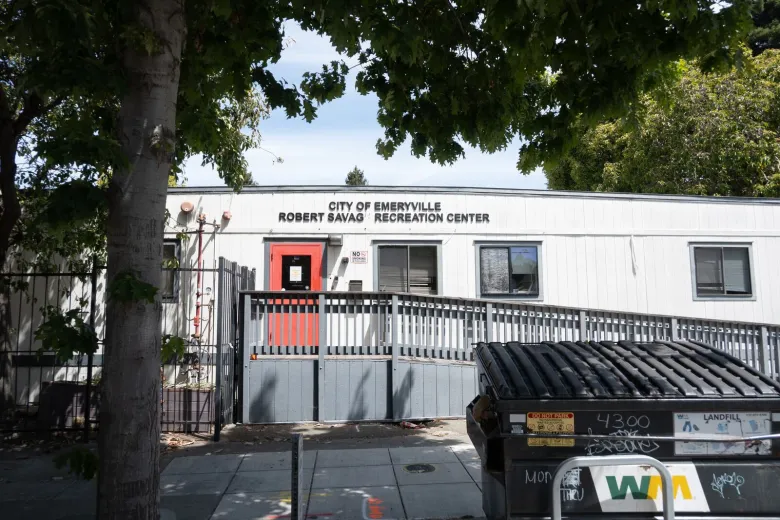 The Berkeley Winter Shelter was moved to a site in Emeryville this winter, but it did not appear the site would again be available this season. Credit: Hope Muñoz/Berkeleyside
Berkeley’s new budget will also eliminate a winter homeless shelter, ending a program it operated typically between December and April. The shelter provided 25 beds to people city budget manager Maricar Dupaya described as “highly vulnerable unsheltered individuals, often seniors.”
The Berkeley Winter Shelter has been run by the nonprofit Dorothy Day House and, until the most recent season, opened each winter in the city’s Old City Hall. Budget documents from city staff recommend eliminating it “due to the lack of a feasible location” after repairs at the Old City Hall building forced a temporary move to a site in Emeryville last winter. Through a city spokesperson, city staff told Berkeleyside that the city of Emeryville indicated the site would not be available to the city this season. Cutting the program saves the city $358,750.
The city’s separate Inclement Weather Shelter — a 40-bed program that opens on cold or rainy nights, also run by Dorothy Day House — is not affected, according to a budget memo from City Manager Paul Buddenhagen.
An email from Berkeley spokesperson Matthai Chakko that provided information from city workers noted that this year’s Point-in-Time Count of homeless individuals showed a 13% reduction in overall homelessness across Alameda County.
“Given that reduction, countywide shelter capacity pressures may be somewhat lower than in prior years, though actual bed availability will still vary by program, eligibility criteria, referral process, and timing,” Chakko noted.
The email also said that the city had applied for a grant recently to expand shelter capacity.
Still, losing 25 beds is a big impact, said Blake, the former Mental Health Commission chair.
“I sort of understand it, but on the other hand, we don’t really have a replacement at this point,” Blake said of the shelter closure, nodding at the budget crisis. “That’s a lot of people — where are they going to go?”
And as with mental health care, he said, there is not enough education or sense of urgency around preventive care for vulnerable people.
“We describe the conditions we feel people shouldn’t be living under,” Blake said. “But ultimately we allow them to live under those conditions.”
Powelson said the cuts fit a broader retreat from investing in shelters and behavioral health solutions since the U.S. Supreme Court’s 2024 decision in Johnson v. Grants Pass, which overturned earlier court protections that had limited how cities could punish people for sleeping outside, and since the height of the pandemic, when cities were investing in housing homeless people in motels and hotels.
“Governments are taking a more carceral approach — that pushes people into bridges and ditches where they’re not safe,” Powelson said. “It’s exposing them to well documented harms.”
“*” indicates required fields