
The best junior golfers in the world arrive in San Diego this week with travel bags, swing coaches, parents, expectations and resumes.
Some will leave with trophies.
Others may leave with something even more valuable.
A college future.
The Uswing Mojing Junior World Golf Championships begin Tuesday at seven San Diego-area courses, bringing more than 1,130 players from 55 countries and 40 states to one of junior golf’s most important annual gatherings.
Play begins at 6:30 a.m. Tuesday, with competitors spread across five age divisions at Torrey Pines North and South, Arrowood Golf Course, Country Club of Rancho Bernardo, El Camino Country Club, The Heights Golf Club, Singing Hills Golf Club (Oak Glen) and Mission Bay Golf Course.
For college coaches, Junior World is a recruiting database brought to life. A week when players who would otherwise require flights to Australia, Thailand, Japan, Mexico, Europe or South America instead appear in one city, on difficult courses, against international competition.
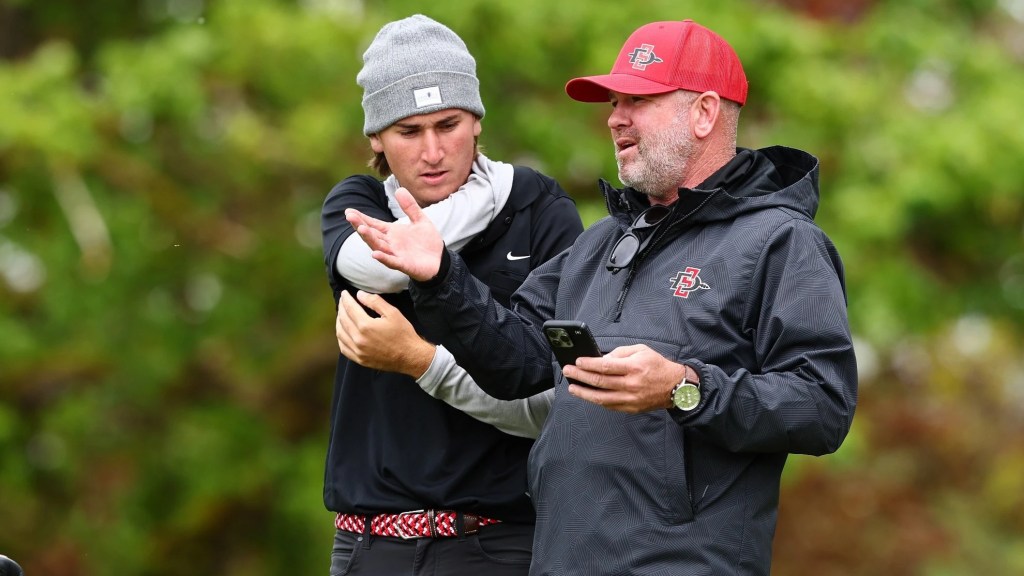
Ryan Donovan has turned San Diego State into one of the West’s steadiest programs, a perennial NCAA regional team with seven NCAA Championship appearances under his watch.
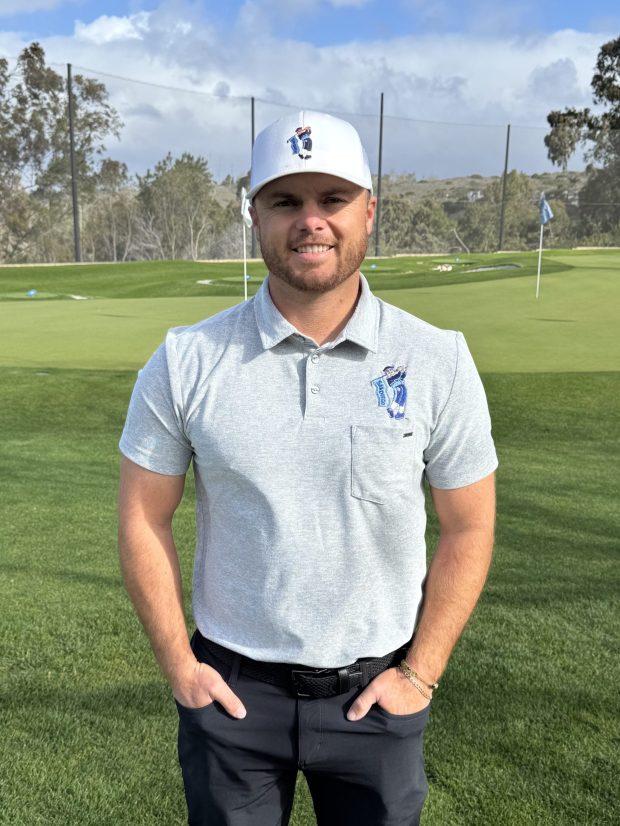 Evan Emerick is entering his second season as USD’s men’s golf coach. (Jay Posner)
Across town, USD has surged under Evan Emerick. The Toreros have made consecutive NCAA Championship appearances and finished 15th nationally this spring, their best finish in 15 years.
Both programs operate in a city that becomes, for three days every July, one of the most efficient scouting stops in amateur golf.
“This is a huge benefit for our San Diego schools, but also for teams across the country,” Donovan said. “There will be 100, 150 coaches out here from all over. We’re getting so many kids from all over the world, and it’s such a benefit because it is a worldwide game now.”
International players often arrive with national coaches or academy coaches who may not know the mechanics of recruiting. The Junior Worlds allow college coaches to build relationships with those gatekeepers, too.
“They’ll say, ‘I’m coming to San Diego. Here’s my resume. Here are my tee times,’” Donovan said. “Sometimes, we’ll even get guys to come on campus after the tournament ends.”
Emerick has a unique perspective. He grew up in San Diego and estimated he played in Junior Worlds eight or nine times. Before he was recruiting at the event, he was one of the kids trying to measure himself against the field.
Now he returns as a coach looking for players who can help USD keep pushing upward. Some names are already on the list. Others appear without warning.
“This is what’s great about it,” Emerick said. “Sometimes you might not know a name, and you’ll check the leaderboard after round one and say, ‘Let’s go check this kid out.’ Then you go watch them the next day, and you like it. You have the kids on your list, but some just pop out of nowhere.”
Oregon coach Casey Martin played the Junior Worlds at Torrey Pines as a young golfer from Oregon, long before he became a Stanford standout, PGA Tour player and national championship coach. He finished second. The result changed his recruitment.
“Even though I wasn’t an international, it’s not like a lot of coaches would come to Oregon to watch where I was from,” Martin said. “When I went there, it was one of my first national or international events. I finished second, and I got recruited by a ton of schools after that.”
That memory has stayed with him.
So has the tournament.
Martin said he has come to Junior World almost every year in more than two decades as a college coach.
The reasons are practical.
The timing is right, and the field is different. The setting is useful, and San Diego in July is not a hard sell.
“I see all these coaches from the Southeast, and it’s like, ‘What are you doing out here?’” Martin said. “It’s like, well, it’s 500 degrees in Texas and Georgia, so San Diego is pretty nice this time of year.”
Martin said the Junior Worlds function differently than many domestic junior events because it gives coaches players they do not see every week. It helps create reference points.
A coach may not be recruiting a player from Thailand or Australia, but watching that player helps calibrate the field.
If another prospect has repeatedly beaten him, that result now has context. If a player’s scoring record looked impressive on paper, Torrey Pines can validate it or expose it.
“You would have to take a trip to Thailand and Australia, and it would break the budget and wear you out,” Martin said. “But here, you get to see kids who aren’t typically on your radar. It makes evaluations easier. It helps connect the dots.”
That is why the venue is a big part of the evaluation.
Torrey Pines has hosted U.S. Opens, and hosts a PGA Tour event every year.
“The golf course is definitely a separator,” Martin said. “A lot of junior golf events are set up fairly easy, and it’s harder to identify the best talent. But at Torrey, it’s pretty easy because the course is really difficult.”
Emerick said Torrey Pines may be one of the best recruiting venues in junior golf for the same reason.
“If you can shoot good scores there,” he said, “you can play good golf anywhere.”
Donovan has watched junior tournaments where short tees and friendly pins distort the field, where a player shoots in the 60s and a coach has to mentally adjust for what that number would mean on a college setup.
Torrey reduces the guesswork.
“It exposes you on all fronts because it’s just hard,” Donovan said. “No matter what the setup is like, it helps us evaluate the kids we’re looking for and the level they need for the next level.”
Donovan still remembers one of his earliest trips to Junior Worlds as a coach. He was walking Torrey Pines, trying to learn how to recruit, when he stopped to watch a player for five or six holes. Other coaches wondered why he bothered. The player, they told him, was going pro.
It was Jason Day, the 2015 PGA Championship winner and future No. 1-ranked player in the world.
“It sounded different when he hit the ball,” Donovan said. “I was like, this guy’s really good. I learned quickly that some of these guys aren’t even going to college.”