
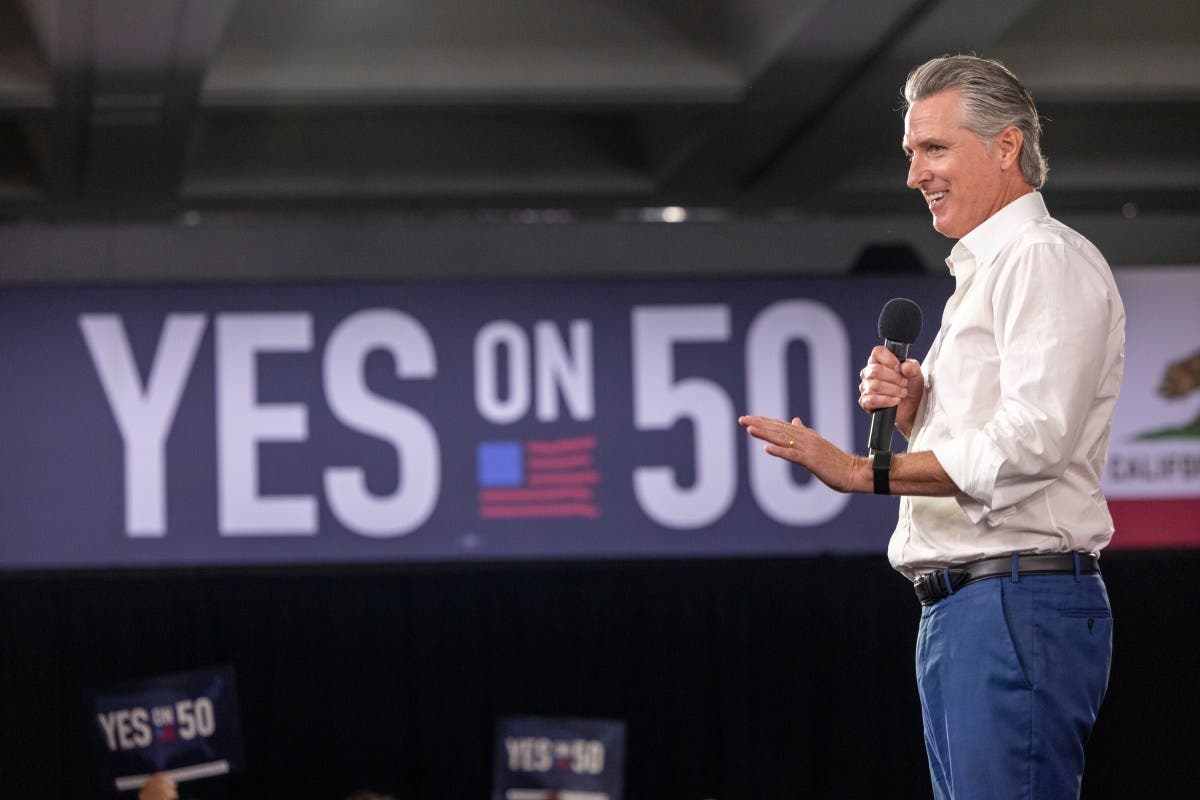
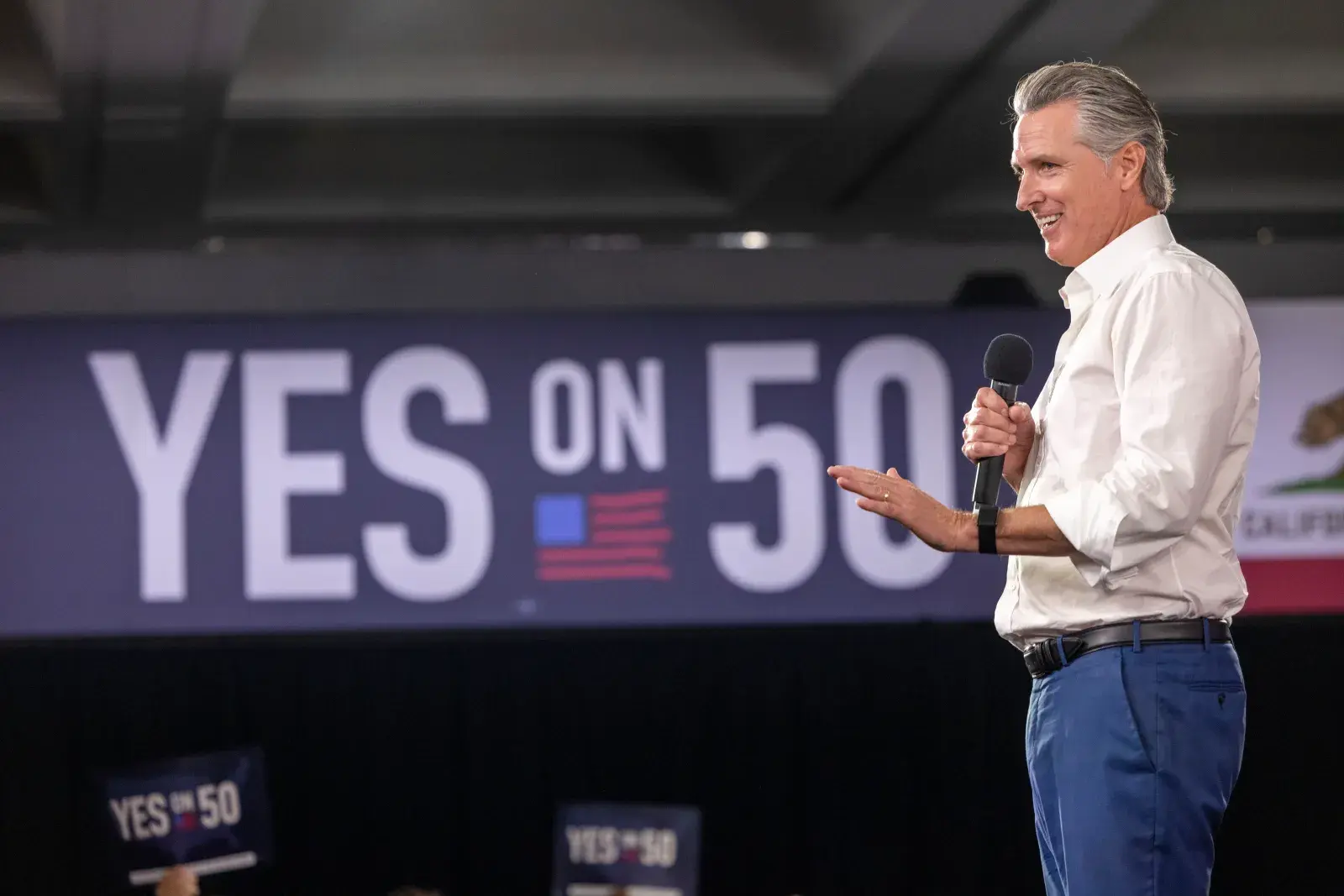
A plan to redraw California’s congressional districts, known as Proposition 50, has passed in Tuesday’s election, in a blow to President Donald Trump.
The measure was spearheaded by Democratic California Governor Gavin Newsom, who threw the weight of his political operation behind it in a major test of his mettle ahead of a potential 2028 presidential campaign. Former President Barack Obama urged voters to pass it as well.
Speaking after the result was called, Newsom said the passage delivered a powerful message to Trump, who was “historically the most unpopular president in modern history.”
Why It Matters
The ballot measure will see redistricting in an effort to help the Democratic Party in next year’s midterm elections, as Republican-led states have sought to bolster their party’s chances of holding on to the House of Representatives.
 What Is Proposition 50?
The proposed redistricting targets five Republican representatives and would create more Democratic seats in California, thus neutralizing a Republican-favoring redistricting plan advancing in Texas.
Under the existing map, Republicans dominate much of inland California while Democrats control the coast and major cities. The proposed map shifts several inland and southern districts toward Democrats, consolidating Republican voters into fewer, larger districts.
The changes would only be temporary, lasting through the 2026, 2028 and 2030 election cycles, before the 2030 U.S. Census is used to draw a new map for the coming decade.
The plan, passed by the State Assembly (57-20) and State Senate (30-8) along party lines in August, is designed to give Democrats a stronger advantage in several key congressional races.
According to political analysts Kyle Kondik and J. Miles Coleman, the new boundaries could help Democrats gain up to five additional seats, targeting Republican Representatives Doug LaMalfa (CA-1), Kevin Kiley (CA-3) and Ken Calvert (CA-41), with two others, David Valadao (CA-22) and Darrell Issa (CA-48), seen as toss-ups.
What People Are Saying
Newsom, speaking to reporters Tuesday night: “What a night for the Democratic Party. A party that is in its ascendancy. A party that is on its toes, no longer on its heels. From coast to coast, sea to shining sea. But it was not just a victory tonight for the Democratic Party, it was a victory for the United States of America, for the people of this country, and the principles our Founding Fathers lived and died for.”
Manuel Pastor, director of the Equity Research Institute at the University of Southern California, told Newsweek in October: “On Prop 50, it’s all been said—well, almost all. Abstractly, it’s much better to have independent redistricting focused on communities of concern than to have partisan maps focused on who can win. Newsom’s argument is that we are not living in the abstract; in the real world, Republicans are gleefully drawing boundaries that favor their interests and hoping that Democrats stick to principles. So squabble up—here comes a fight.”
Former Vice President and California U.S. Senator Kamala Harris, speaking to voters recently: “We believe in the power of the vote, and we are prepared, when necessary, to fight fire with fire. California is taking a stand to say: ‘We understand the difference between right and wrong, and we will step up when necessary to make sure the voices of the people are heard.’”
Kiley, California Republican, in an August statement: “California voters are overwhelmingly opposed to Newsom’s plan to sideline our state’s Citizens Redistricting Commission. Yet the Supermajority Legislature chose to ignore this and will now spend $250 million trying to convince voters to reverse themselves and return power to politicians. The political leadership of California has never been more out of touch with the people of California.”
What Happens Next
Districts will be redrawn ahead of the November 2026 midterms.