
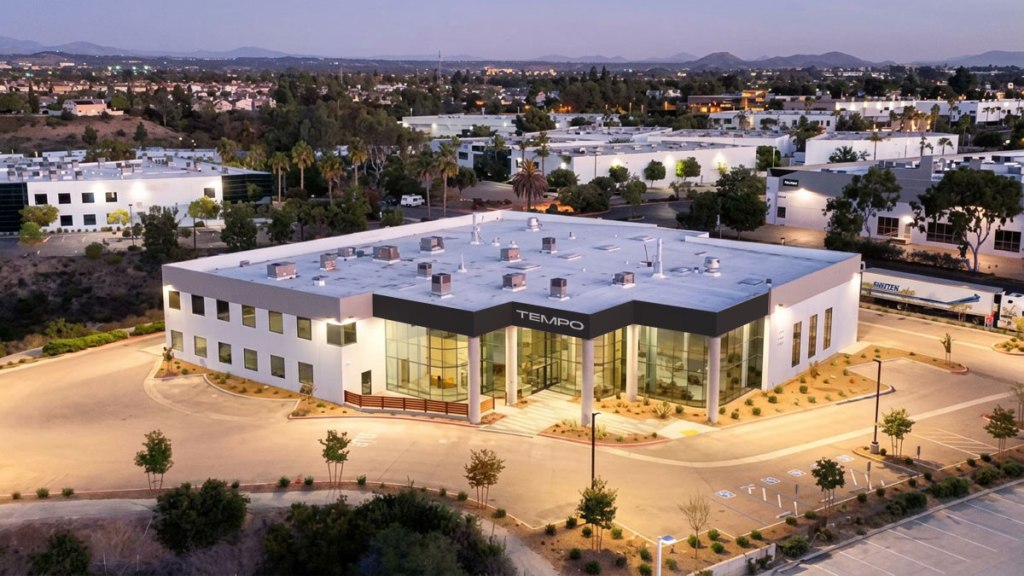
San Diego battery company Tempo is planning to double its workforce, hiring 50 employees in the next 18 months and moving into a 35,000-square-foot facility in Sorrento Mesa.
The company develops thermochemical energy storage technology — essentially large heat batteries for industrial clients.
Today, many industrial facilities are caught in a cost-climate conundrum.
They either burn fossil fuels to heat their furnaces, which significantly adds to their carbon emissions, or they use electricity, which can emit less carbon dioxide but can be costly during periods of high demand and constrained by grid capacity.
Tempo says its battery offers a solution — by chemically storing thermal energy, factories can use renewable heat on demand.
Tempo utilizes magnesium-manganese oxide redox systems, which “are suitable for low-cost high energy density storage,” according to a paper published by a few of Tempo’s founders at the Department of Mechanical Engineering at Michigan State University in 2021.
Historically, industrial batteries have faced scrutiny over safety concerns, particularly the risk of fire.
The largest San Diego battery fire happened a few years ago in Otay Mesa, when the Gateway Energy Storage facility fire burned for almost 17 days.
But according to Tempo, there is no danger of a battery fire or thermal runaway with its technology.
“It’s not physically possible,” said Scott McNally, chief of staff at Tempo.
Its battery uses magnesium, the same main ingredient used in fireworks, McNally explained. The battery “basically stores a lot of energy in a chain of chemical bonds, but if you stop discharging, it just cools down.”
Lithium ion, however, is prone to runaway reactions, in which the battery “basically spirals out of control or starts a fire,” McNally said. “That’s not a risk with this material.”
The only real risks with its battery come from situations of “sabotage,” he said. But if that were the case, “you’d want to go after a chemical reactor, or lithium ion battery, if you were trying to do harm to someone or something.”
Tempo has created internal prototypes and is currently working on deploying its first battery for UC San Diego, expected in January. It also plans to deliver a battery to Dow Chemical in early 2027.
Tempo also said it’s working with global customers across cement, chemicals, metals, food and beverage, and other industries to electrify industrial heat at scale. The company also plans to announce a major customer by the end of the year.
Tempo has raised more than $40 million in venture capital. The company has also received $8.2 million in obligated funding from the U.S. Department of Energy.
The new headquarters at 6680 Cobra Way will serve as the company’s central “innovation engine,” Tempo said. The building, which was built in 1996, will finish renovations in the next six weeks.
To support its growth, Tempo plans to double its workforce over the next 18 months. Today, it employs more than 50 people, most of whom live locally.
Open positions range from electrical engineers to technicians. The highest-paying role offers a salary of up to $125,000, plus benefits and equity. Some technician positions are hourly and also include benefits and equity.
“San Diego is a great place to recruit scientists and engineers. We have active engagements with the local universities and have hired many people,” said Pasquale Romano, CEO of Tempo.