
Heading into the offseason, the Anaheim Ducks were riding high.
They had just returned to the playoffs for the first time in eight years, knocked out the two-time defending Western Conference champions in the first round and gave eventual Western Conference champion Vegas a real run for its money in the second round. With a young core to build around, Ducks fans had a lot to look forward to.
Then last week happened.
In an effort to save money to re-sign said young core, the Ducks hemorrhaged talent and saw their surplus of cap space vanish in an instant when Leo Carlsson signed a cap sheet from Philadelphia worth $18 million per year for five seasons. Now, they’re in a bind, and even if they match the Flyers’ offer, the Ducks’ rebuild won’t be the same.
In a world where seemingly every talented young player is signed to a max-term deal worth pennies compared to their actual worth (see: the Montreal Canadiens and Carolina Hurricanes), it’s incredible that Carlsson, Cutter Gauthier and Pavel Mintyukov, all restricted free agents, made it to July without an extension. The Ducks had plenty of space, sure, but extensions for Carlsson and Gauthier alone could cost $30 million now.
The Ducks did well to get out of Mason McTavish’s deal and pick up a pair of first-round picks in the process. But the Ducks still have a big hole down the middle — can you really be a contender with 34-year-old Mikael Granlund as your second-line center? Anaheim’s already lackluster blue line suffered several losses as well. Jacob Trouba left for rival San Jose, and the Ducks dealt away the UFA rights to Radko Gudas and trade deadline rental John Carlson.
Trouba and Carlson played big minutes for the Ducks last season, and they haven’t really replaced them, either. As it stands, their defensive corps is Jackson LaCombe and five guys. Trouba and Gudas aren’t exactly huge losses — the Ducks were probably right to move on from both, more on Trouba here — but only bringing in Nick Jensen isn’t exactly going to stabilize things. The Ducks allowed the third-most expected goals per 60 minutes at five-on-five last year, and there’s a real chance that, unless Mintyukov or Ian Moore take the next step, they’ll be even worse.
But what’s compounding all of this is the $18 million elephant in the room. That is a whole lot of money, and likely the best outcome is Carlsson coming close to living up to it. However, the Ducks are in a no-win situation where they’ll be significantly handcuffed if they match the offer sheet, and they’ll be right back at square one without him. Top-line centers don’t exactly grow on trees, let alone 21-year-old ones.
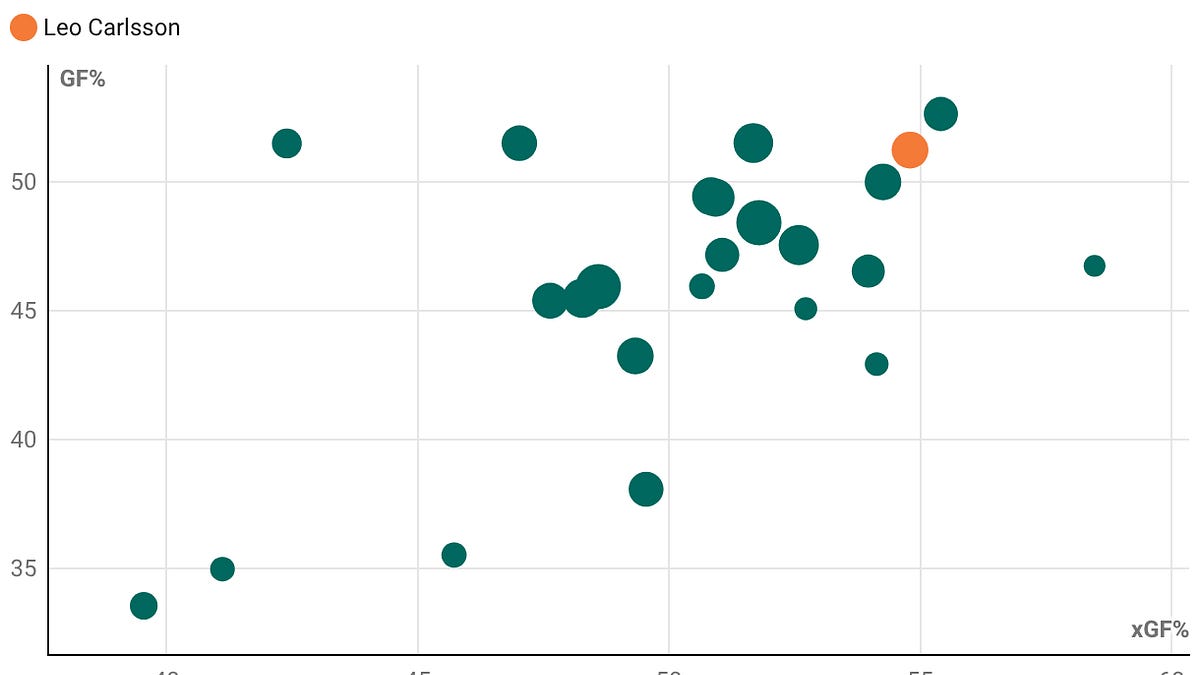
With Carlsson on the ice at five-on-five, the Ducks owned 55.1 percent of the expected goals and had a plus-three goal differential. Without him, the Ducks dropped just below breakeven in expected goals and were a minus-22 in actual goals. Part of that difference in actual goals is because the Ducks’ depth really struggled to finish last year, but it’s hard to see them improve in that area by letting a 21-year-old who nearly scored 30 goals walk.
The disparity was even bigger in the playoffs. Carlsson dominated his minutes in the playoffs to the tune of a 56.7 percent expected goal share and a plus-two goal differential while being a nearly point-per-game player. Meanwhile, the Ducks were outscored by eight goals and had a 43.9 percent expected goal share without him. As it stands, this team isn’t equipped to be competitive without Carlsson.
Carlsson’s produced at a high rate, too. Carlsson’s 2.95 points per 60 minutes at all strengths ranked eighth among U23 forwards last year, per Evolving-Hockey. Carlsson has the potential to be one of the best centers in the league, and the Flyers are obviously betting on that by attempting to pay him that much money.
The Ducks simply have to match the offer sheet. It will be painful, possibly kneecap this rebuild’s ceiling before it can really get going and set up Gauthier and Beckett Sennecke (eligible for a new deal next summer) to ask for even more money than originally planned. But losing Carlsson would set this team back even more. Four presumably late first-round picks aren’t worth a 21-year-old franchise center, and the opportunity cost of finding another top-line center should be enough to sway the Ducks toward matching the offer.
A top-line center is the hardest thing to find in hockey. There’s a reason why the Ducks selected Carlsson with the second overall pick in the 2023 NHL Draft and why the Flyers, a playoff team last year with a gigantic hole at center on their top line, are willing to pay Carlsson $18 million. Carlsson is the type of player that you can pretty much only find at the top of the draft, and it’s incredibly difficult to acquire one via trade, even with four more first-round picks at your disposal.
After finally making the playoffs again, Anaheim cannot afford to take a step back. Carlsson’s new contract might make contending harder, but losing Carlsson means being stuck in no-man’s land. The Carlsson-less Ducks aren’t contenders, but they’re also not going to be bad enough to be in lottery contention. Neither option is great, but one is obviously better than the other.
Even before making their decision on Carlsson, the Ducks are already paying for their inaction. With the Ducks already in a salary cap bind and rumors of another offer sheet circling, Anaheim re-signed Mintyukov to a five-year deal worth $7.2 million per season. Mintyukov, the 10th overall pick in the 2022 NHL Draft, is now being paid like a true top-four defenseman, but he hasn’t played like it yet.
At 22, he still has time to put it all together, but Mintyukov has really struggled so far, especially defensively. Mintyukov was on the ice for the most expected goals against per 60 minutes at five-on-five among Anaheim defenseman last season. While he’s flashed some offensive and puck-moving talent, it hasn’t been enough to offset the defensive shortcomings. He’ll have plenty of opportunity on a thin Anaheim blue line this year, but he’s now getting Brandt Clarke money while not having the same kind of offensive production or play-driving ability that Clarke has shown.
The worst part of this deal? They traded the wrong defenseman.
If the Ducks were looking for a young defenseman to keep around for a while that wouldn’t cost an arm and a leg, they should’ve just kept Olen Zellweger. Zellweger isn’t a former top-10 pick, but he’s shown that he can drive play at a decent rate. Zellweger is undersized and also struggles a bit in his own end, but he brings more offensively and wins his minutes. Most importantly, after getting traded to Buffalo, he re-signed there for three years at $3.1 million per season, a much more reasonable contract.
That’s poor asset management, but that’s been par for the course for the Ducks over the past week. Even in a weak Pacific Division, there’s a decent chance that they’re a worse team than last year just because of how many players they’ve lost and haven’t replaced. As it stands, the Ducks have just over $9 million in cap space if they match Carlsson’s offer sheet and still have Gauthier to sign. They’ll have to trade away another veteran, like Chris Kreider, Alex Killorn or Frank Vatrano, just to stay under the cap. Further complicating matters is that all three players have partial no-trade clauses and that any team acquiring them knows that they’ll have Anaheim over a barrel.
It’s a deep hole for Anaheim to dig itself out of and it’s one that could have been avoided entirely. After several painful rebuilding years, general manager Pat Verbeek has to find a way to keep this team competitive. Otherwise, this rebuild will be doomed before it can even get off the ground.
All stats are from Hockey Stats unless otherwise noted