
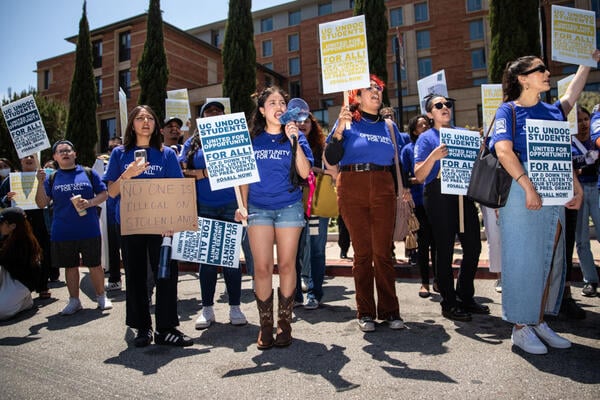
The California Supreme Court chose not to review a lower court’s decision that concluded the University of California system is discriminating against undocumented students by not allowing them to work in on-campus jobs. As a result, the lower court decision stands, the Los Angeles Times reported.
The California Supreme Court’s move not to take up the case is the latest development in a lawsuit filed by a University of California, Los Angeles, alumnus and lecturer last year. The plaintiffs are represented by attorneys from Altshuler Berzon LLP, UCLA’s Center for Immigration Law and Policy, and the National Day Laborer Organizing Network.
Undocumented students, backed by a legal theory developed by scholars at the Center for Immigration Law and Policy, have argued that state entities, such as the public university system, are permitted to hire undocumented individuals. But the UC Board of Regents rejected the idea last year.
A three-judge panel for the Court of Appeal for the First District ruled in August that the UC system’s employment policy “facially discriminates based on immigration status and, in light of applicable state law, the discriminatory policy cannot be justified.” The ruling asked the system to reconsider its hiring policy. But the UC Board of Regents appealed that decision two months ago.
UC spokesperson Rachel Zaentz said in a statement that the California Supreme Court’s decision “creates serious legal risks for the University and all other state employers in California.”
But undocumented students and their advocates are celebrating. Iliana G. Perez, a plaintiff and former UCLA lecturer, said as a formerly undocumented immigrant, she’s seen how employment restrictions can hold immigrant students back.
“The California Supreme Court’s decision not only reaffirms that discriminating against undocumented immigrants from accessing on-campus employment cannot continue to be tolerated, but it also gives the UC the clarity to finally unlock life-changing opportunities for the thousands of immigrant students who contribute to its campuses, and to the state’s economy and workforce,” Perez said in a news release from the Center for Immigration Law and Policy.
