
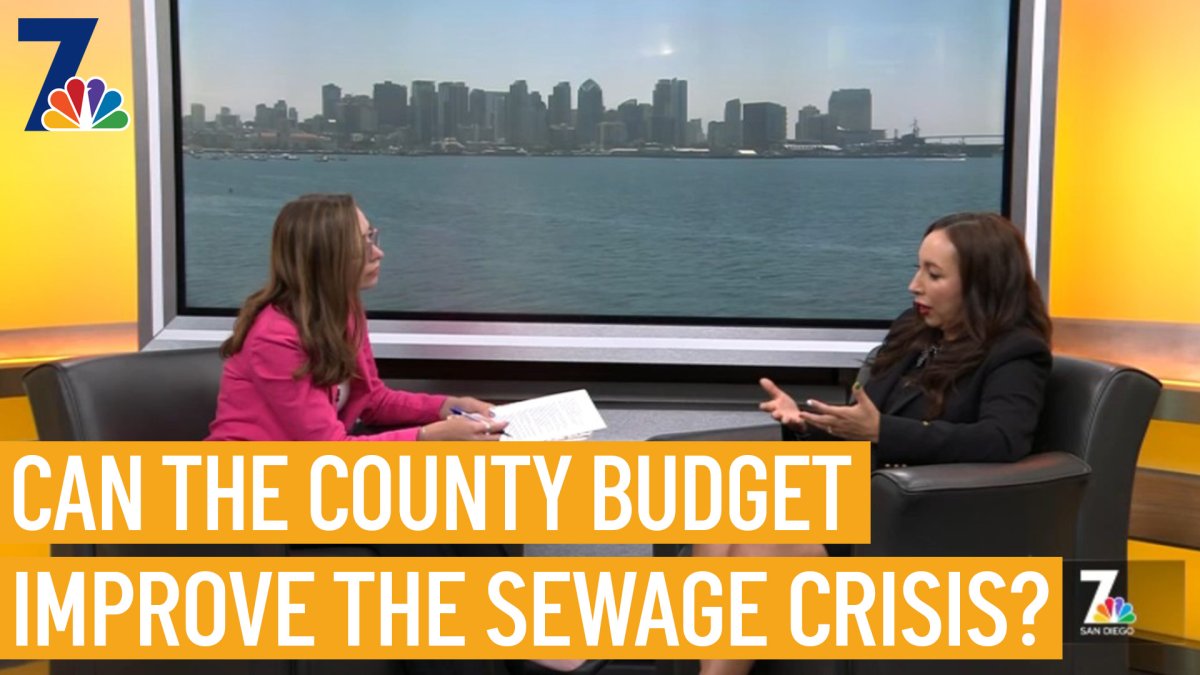
One year after she was elected, County Supervisor Paloma Aguirre is talking about the federal funding cuts, the county budget and the sewage crisis on Politically Speaking with NBC 7’s Joey Safchik.
A transcript of the conversation is below.
Safchik: The county has nailed down its budget. Its very big budget, $9.2 billion. But there are still some big questions about how much money will be coming to San Diego from Sacramento to support vital services like behavioral health treatment. County supervisor Paloma Aguirre joins us for some insight. Thank you so much for being here.
Aguirre: Thank you for having me.
Safchik: What do you see as the biggest challenge facing the county right now?
Aguirre: Well, obviously, top of mind are the federal cuts coming from H.R. 1, which is going to impact the most vulnerable in our communities district, or, I mean, countywide, but especially in my district, where the communities of Nashville City and Pearl beach, Chula Vista, San Ysidro, Spring Valley have not gotten their fair share. And now, with these cuts, people who depend on these safety net programs like Medi-Cal and Cal Fresh are going to be impacted because of the job requirements, because of the cuts to the programs. So we want to make sure at the county that we are offsetting those cuts by increasing staff support to ensure that nobody falls through the cracks or nobody falls off of these programs. And we’re also investing significantly in resources for food, for example, and making sure that we have enough staff to make sure that nobody falls off.
Safchik: I remember six months or a year ago, there was some criticism that the county may be overreacting to some of these cuts. Have you seen them come to fruition now?
Aguirre: No, we have never overreacted. I mean, since I got elected, it’ll be a year this month. You know, thanks to the vice chair and the chair, they’ve been very proactive since before I got elected, you know? So we were not overreacting. There’s been a very serious burden put on counties. A very serious burden put on the state. The state has, you know, I think they just passed their own budget. So, it’s becoming now clear, how much responsibility will fall to us and how much to the state. But at the end of the day, we didn’t wait to take action to ensure that the people’s budget goes to the people.
Safchik: Was it difficult to settle this budget without having some of those answers from the state, without knowing exactly how much it was going to trickle down to San Diego?
Aguirre: Well, it’s always, you know, the– it’s hard to foresee, you know, when the decision is not in your hands. And that’s why I think us being proactive and preparing and doing it responsibly without over exceeding our ability to, our resources that we have. I think that was an important step. And I feel proud about what we were able to achieve, because we’re putting people first and we still have a pretty robust and significant amount of reserves. So we’re doing this in a fiscally responsible way.
Safchik: Historically, the county is pretty flush. But like you’ve alluded to, we know there are some leaner times ahead as a result of these federal funding cuts. Are we prepared?
Aguirre: And I think that’s one of the reasons why the public has foreseen this need rate and has put forward a proposed ballot measure that has been signed by over 100,000 voters in San Diego County to pass a measure to offset those costs. What we’ve been talking about right now is what is at hand. But in the future, this is going to be eventually unsustainable. So there has to be an additional source of revenue.
Safchik: Are people going to suffer?
Aguirre: Well, of course, I mean, never in my lifetime did I think that my generation, your generation, our parents’ generation would be without entitlement programs that generations have paid into. That has never been the case. This is unprecedented. So we don’t have the ability to completely offset the entirety of the decisions and the cuts, frankly, to the poor and working families. You know, that DC is bringing, that Trump is bringing, instead of spending $30 billion in the Iran war, what’s forecasted to be up to $132 billion and in other expenses like Ice raids etc.. So I think that nothing will ever offset the decisions in DC, but we are sure as heck going to ensure that we do whatever we can for the people of San Diego County.
Safchik: The state budget does not send dollars to the counties to help provide health care for people who lost their medical coverage because of those federal cuts. What does the county do to compensate? What kind of burden does that place on the county?
Aguirre: Well, we have different programs. It depends. There’s programs that we have for people who have disabilities or that are veterans. So there’s an array of different programs that could help offset some of that medical coverage that potentially could happen. But that’s why we’re investing 122 new staff positions to ensure that they’re able to help people navigate the new work requirements. And you could. So I think this is a way that the county shows that we have skin in the game, and we want to make sure that nobody suffers.
Safchik: Are you worried at all about bloating the county’s payroll?
Aguirre: Well, in this particular case, like I said before, we are experiencing unprecedented times. Our communities, especially in my district, for too long, have heard. Well, there’s not enough for your community. I’m sorry that, you know, just not enough to upkeep your streets or, you know, other infrastructure services. They’ve accumulated the people’s money, the people’s taxpayer dollars over decades, as we know, that was ballooned and essentially became a hedge fund. We have a fiduciary responsibility to steward in a responsible manner the taxes that people pay and know. So I would say, no, this is unprecedented. This is pretty much a crisis that has been caused by DC. And I hopefully, politically, things change in DC and we can reverse the damage that they’ve done.
Safchik: You just referenced this, but the budget does rely on the county’s pretty robust rainy day fund, right? Why are you confident that’s the right move?
Aguirre: Because according to the government finance officers Association, we need to have a specific amount of reserves. And we have fulfilled that requirement completely. 100%.
Safchik: In the case of an emergency–
Aguirre: We have a significant, robust amount of reserves. The problem is that the amount of reserves was so robust that it prevented that money from going to where it needs to go to the people. So we’re able to offset some of these services and cuts that are happening while still maintaining those healthy reserves.
Safchik: Are there any services or programs that you feel like should have been cut, rather than tapping into the reserves to pay for them?
Aguirre: Well, what I’d like to talk about is the wins that I was able to achieve in my less than a year term in office. So we were able to achieve significant funding to go for affordable housing. IT housing is one of the highest costs in a working family, and we have ensured that we invested $27 million into the New Partnership of Advancement of New America’s Partner Project, which will help build 150 affordable housing units. We’ve put $22 million into the Innovative Housing Trust Fund, which was one of the things that I even mentioned during my swearing in ceremony, wanting to make sure that that money ensures that developers are able to build affordable housing. We know that rents are skyrocketing in San Diego County as gas, as our groceries. We can’t control the price of gas. We can’t control the price of groceries. But we can at least help families. That, especially in my district, are paying more than 50% of their income towards keeping a roof over their head.
Safchik: I think it’s fair to say that most people watching would agree that affordable housing is one of those foundational tenets of what their local government is supposed to do. But do you think there are any programs that are sort of icing on the cake that you should have considered cutting or scrapping, instead of using the reserves to fund?
Aguirre: No. Well, I mean, in the sense that we have funded, for example, something that my predecessors never have funded was actual money towards the sewage crisis. We put $2.5 million towards the pipe extension to eliminate the hotspot that you are familiar with that is not only contaminating our beaches, but also creating an air quality crisis. We’ve put money towards air purifiers, as you know, to expand the program. What we’ve been able to achieve so far, which, even though we accelerated that program, is still not enough. We still hear from our constituents on a daily basis how much they need an air purifier. So we’ve put money into that. And then, you know, I’ve been doing– this unrelated to the budget, but I’ll mention it because we’ve been working very hard to advocate to the state to ensure that we get the Prop 4 funding that has been passed by the voters of California since 2024 to make its way down here, where it’s needed the most.
Safchik: When people hear you say that your predecessors didn’t fund some of those items to tackle the sewage crisis. I mean, do you think that’s surprising?
Aguirre: Look, this crisis for a long time has been about pointing fingers this way and that way. And I was elected with a clear mandate. The people who elected me did not want– and I just want to be very real right now. They didn’t elect me to go to ribbon cuttings. They didn’t elect me to check my email on a daily basis.
Safchik: Kind of a single issue directive..
Aguirre: So they wanted action. And this is something that I promised during my campaign. And it’s something that I’m delivering now in less than one year in office because for too long we heard, well, you know, this is going to be too costly or this is the responsibility of the federal government, or it’s the responsibility of Mexico. And in the meantime, all those years of deferred maintenance, of disinvestment, of passing the buck to a different agency have resulted in what we’re seeing right now, which is the biggest public health and environmental crisis in the entire nation.
Safchik: How satisfied are you with the progress you’ve been able to make over this year, with the levers you’ve been able to pull?
Aguirre: I feel good. I feel, you know, really proud of what we’ve been able to achieve. But is it enough? Absolutely not. Not yet. But we’re at least moving the needle in the right direction. We’re not washing our hands and saying the county can do anything. Sorry, guys. No. Yes we can. When there’s political will, there’s a way. And I’ve always said that. And I think that, you know, the fact that our next governor, whoever that may be, has acknowledged that and has committed to declaring a state of emergency because of this crisis, shows that, you know, powers that be are waking up and realizing how severe this crisis is.
Safchik: It feels like we so often, as you just said, hear about money being thrown at this issue. Are we seeing the result of that or are we seeing the progress?
Aguirre: There is progress. For example, we work so hard to secure this $600 million to expand the plant. And I’ve talked a lot about that. But when that’s completed, according to the Trump administration, in 2027, it’s already falling short of the need. And it’s not even addressing the main culprit of this crisis, which is what’s coming through the river. The flows, what we need to do with the flows, we need to capture them and treat them.
Safchik: So, why has the plant been the focus? Because it’s fixable?
Aguirre: That’s a great question. Because it was pretty much the low hanging fruit. There was an entire Environmental Protection Agency study done that looked at all the different options through the Nepa process, which is the environmental federal law and, the, the treating the river, capturing it and treating it was too expensive. So therefore they put money towards a treatment plant which is treating 100% sewage from residential areas of Tijuana. But what’s freely flowing right now and contaminating our air and beaches is the river itself. So I think with this, ballot that voters are going to have before them in the fall, it speaks also volumes to not just people in district one, but people countywide wanting to help in this and seeing an opportunity for us to take the bull by the horns and not wait for, help at the federal level or from Mexico and getting that, project started.
Safchik: So how do you feel when you hear, oh, it’s too expensive? Should there be a price tag?
Aguirre: No, there should never be a price tag on life. It’s very simple. And what we are seeing are incredibly high levels of chemicals that are being blown into the air that are carcinogenic. You know, if you thought that movie Erin Brockovich was bad, the element that they found in their drinking water is just one of probably a thousand that are going up into the air right now, carried by the river. And that’s not even talking about the pathogens and the ailments that kids, the elderly, and immunocompromised people are suffering on a daily basis.
Safchik: So voters are going to be asked to support this half cent sales tax increase countywide in November, about a quarter of the money collected from that would go towards the sewage crisis. Why should that burden fall on the taxpayers?
Aguirre: And that’s a great question. And like I just said, because we’ve been waiting for the federal government to do their jobs for 20, 40 years, and we’ve been living with this crisis for 20, 40 years. And nothing’s really changed this thus far. We can continue waiting for Mexico for solutions. We’ll be here in 2 or 3 generations, continuing to wait. It’s not enough. But it’s something that we can take action on. The people of the county can take action, and that will produce real results.
Safchik: What would those dollars go towards specifically? And can people rest assured knowing that there would be oversight to ensure that that’s how the money is?
Aguirre: Oh, absolutely. There will be an independent oversight committee comprised of, you know, citizens. And there also will be, you know, there is a plan. There is a plan to spend the money. It could go to infrastructure to capture and treat the river, which is a main source of pollution that we’re seeing.
Safchik: So do you feel like all of this work on the plant, some of the victory laps we’ve seen about this progress is political theater? Is it distracting us from the main–
Aguirre: No, no. It’s like saying, you know, and I hate to use this analogy, but it’s like, you know, if you have cancer, we’re talking about cancer early, or, if you have cancer and you’re, you’re getting, chemo, chemo will take months to produce an effect. And then you also have radiation, which is a faster solution, right? You’re attacking it from both ends. It could be equivalent to saying, oh, well, we’re not seeing the results from chemo. So you know, nothing’s happening. No, it definitely will lead us towards seeing improvements. But it’s not the silver bullet solution. And that’s something that I have said since day one. That’s why it’s so important.
Safchik: Is there a silver bullet?
Aguirre: Well, the main culprit of this crisis is what’s flowing through the river. There’s literally, right now, 35 million gallons of untreated chemical poison. And gases and pathogens flowing through our communities in South Bay, out into the ocean. There is now, preliminary empirical evidence that this is making its way all the way to La Jolla in the form of aerosol. So, it’s bad, but unless we capture and treat that which is possible, we won’t begin to see relief.
Safchik: We’ve been having some variation of this conversation on this show for two and a half years now. I’m sure you did with my predecessors as well. Do you ever feel like you’re just screaming into the void?
Aguirre: To be honest, there was a time it felt that way. You know, we, as you well know, when I traveled to DC at least three times to beg the administration for a state of emergency declaration, we talked about, asking the governor, the state administration as well. There’s a time my predecessor declared the air safe, so. Yeah, but look, at the end of the day, what keeps me motivated, what keeps my team motivated, is that, real people’s lives, livelihoods, well-being are at stake. And we can’t wait for others to come save us. We have to save ourselves. And the county has enough resources to at least get that ball rolling so that we can garner the attention that’s needed. And like I said earlier, we at least have the commitment from the next governor of the state of California that this will be elevated to a state of emergency.
Safchik: Do you have faith that this is going to be solved during your tenure in this office or during your lifetimes?
Aguirre: That’s my goal. That’s my goal because nobody should be living like this ever. Nobody. There is no other community in this great nation that is experiencing what we’re experiencing. And I’m just looking at the backdrop right of our set here. It’s this beautiful water of San Diego, known for world renowned San Diego beaches and nationwide. Nobody knows that we have this biggest environmental and public health crisis affecting everyday people.
Safchik: I do need to ask. A minute ago you said the county at least has the resources to get the ball rolling. Why is the sales tax increase necessary then?
Aguirre: Well, we’ve put significant money already towards, you know, the temporary pipe extension to the air purifiers. We have unlocked reserves to invest in a couple of studies. We’re bringing on a pollution crisis, chief. But what we’re talking about, as far as the infrastructure needed to capture and treat the flows in the river is significant, right? It’s something in the ballpark of 500 to $900 million. So it’s a way that the county could potentially just start moving that vehicle in the right direction. As we continue to advocate for federal funding, as we continue to advocate for state funding, they need to put skin in the game.
Safchik: Very quickly: should supervisors be eligible for a third term?
Aguirre: That’s going to be up to the voters.
Safchik: Do you think so?
Aguirre: We’ll I would defer to the voters.
Safchik: Was this budget process transparent enough?
Aguirre: Oh, yes. There was a lot of work done around this budget process. There were multiple community held hearings and meetings and, you know, opportunities for people to provide feedback. I mean, a perfect example of how this budget was revised, taking into consideration the input from the public, even though we had already well, the CEO had already published your proposed budget, was the funding that was allocated for the Youth Development Department analysis. What that would do is look at, if we are able to begin a department that encourages youth development and focuses on youth. Another one is the Mas Fresco Plus program, which serves people who are in need of food. And, these two programs were very clearly expressed by advocates that they wanted to see included. And that was $500,000 for the month preschool plus program. So, you know, we heard we listen, is it exactly what everybody wanted? Perhaps not. Like I said earlier, I feel proud of the wins we were able to secure. But the fight continues. We’re not going to stop fighting until the people have what they need and deserve.
Safchik: I’m gonna push you a little harder. Why do you think the voters should even decide whether supervisors should have a third term? Why shouldn’t it just stay the way it is? And are you worried at all that that could lead to career county supervisors?
Aguirre: Well, the argument that I heard, from I mean, when we were considering this, I had a binder this thick of letters submitted from, I don’t know, over 100 organizations and the entire meeting, it was just a parade of people from all walks of life. Firefighters, construction workers, nurses, health care providers, nonprofit organizations talking about what they wanted to see, the terms match the state, the state’s, which are 12 years. Because they, what they vocalized was that there was a bit of a disadvantage with counties having only the two terms. So there was that rationale. There was obviously, it’s not just about the terms. There was an array of different, proposed solutions that they’d like to see to increase transparency. They would like to see the Board of Supervisors have a stronger say on, you know, key positions in the county. They wanted to see the public defender potentially be elected. They wanted to see more transparency. So there’s the proposed independent oversight auditor. And, so there’s a lot of things that they brought to the table. For me, it was a matter of the public has spoken what they want. Let the voters decide.
Safchik: But you’re truly agnostic on it?
Aguirre: Yeah, yeah.
Safchik: This month marks a year since you were elected to this office. I want to know what the steepest learning curve has been and what your proudest accomplishment is.
Aguirre: Look, it’s it’s, you know, I came from a small city, right? City of Imperial Beach had a budget of approximately $29 million a year. We went from that to a $9.15 billion agency. So, of course, there’s a learning curve. But, you know, I think I made some smart decisions in the team and the people that I hired that have the institutional knowledge to help us, guide and in the direction that we need to go. The direction is very clear. Like I said earlier, the priorities that the people of district one elected me to fight for are sewage, crisis housing affordability, and, fighting the Trump administration. That was very clear to me. It was not just on H.R. 1, but even things that may be outside of or arguably could be, outside of our scope, like immigration issues. But obviously just everyday affordability. So I feel proud of the team that I have. I think it’s a rockstar team that helps us navigate the steep learning curve. But we’ve been able to deliver real wins, like I said, with, you know, innovative housing trust fund money that we put in the budget, everything we’ve done with the sewage crisis, we did a lot within even our first 100 days. People will be able to breathe better. People will begin to see some relief as soon as we remove the hot spot. And that’s something I’m very proud of.
Safchik: Thank you so much for a very comprehensive discussion. Always appreciate having you here.
Aguirre: Thank you for having me.