
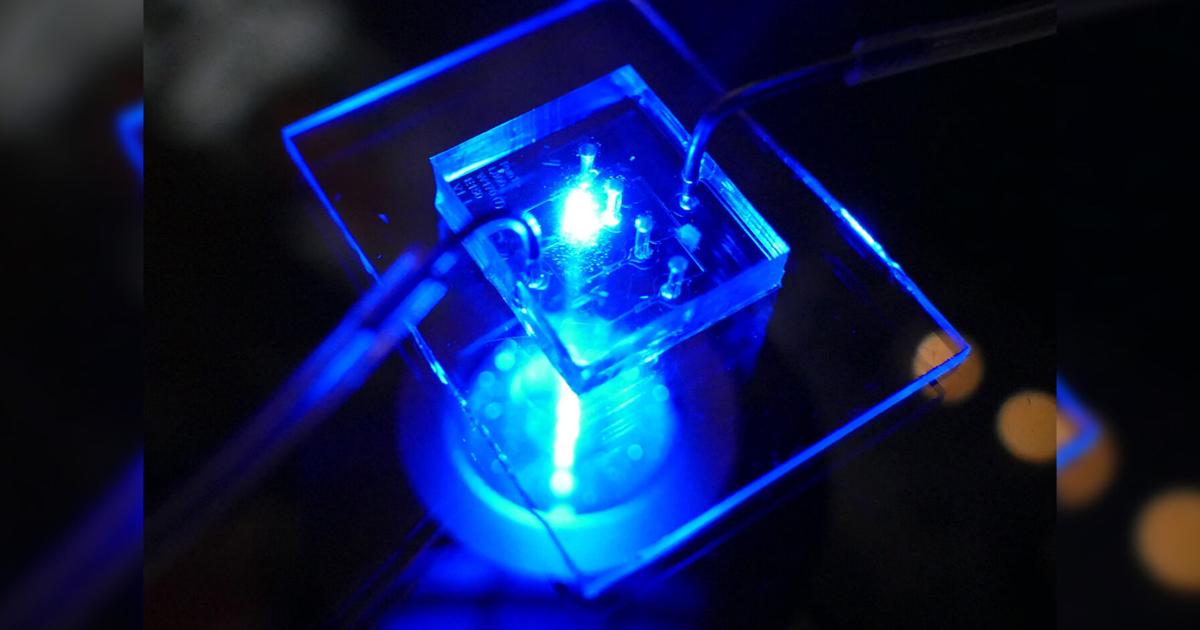
A UC Berkeley-led research team discovered a new method of administering treatment for heart diseases, with the aid of a chip that mimics human heart function, according to a recent study.
The study concentrated on the delivery of lipid nanoparticle-mRNA complexes. Lipid nanoparticles, or LNPs, are often used in vaccines. LNPs can also carry mRNA into damaged tissues for repair.
However, according to the study brief, LNP-mRNA formulations for cardiac delivery were “lacking.”
Kevin E. Healy, UC Berkeley professor and co-principal investigator on the study, said one of the primary challenges was the “delivery of (gene) editing into dense tissue.”
Another hurdle is getting a particle, such as mRNA, to escape the cell’s endosome after diffusion. Healy said the team moved through this “major bottleneck” by using the heart-on-a-chip technology to conduct faster, more cost-efficient tests on different versions of the complex.
“The chip allows us to screen multiple types of formulations in a more … high throughput and a more accurate analysis than traditional methodologies,” Healy said.
The study also found that packages using acid-degradable polyethylene glycol lipids were able to move mRNA into the micromuscle most effectively, avoiding both of the above challenges, and produced similarly positive results in mice.
According to Healy, this treatment is specifically targeted at dying tissue in post-heart attack patients. The goal is to administer treatment before congestive heart failure.
“This methodology could dramatically accelerate the optimization of new LNPs because it will minimize the need for doing animal experiments,” said collaborator and UC Berkeley bioengineering professor Niren Murthy in an email.
UC Berkeley researchers began studying the heart-on-a-chip technology 15 years ago. Healy said the lipid nanoparticle-mRNA study began three or four years ago, supported by a California Institute of Regenerative Medicine grant.
The next steps would be an “injury model” on the heart-on-a-chip, which would then move into animal testing and clinical trials. Healy said if all goes according to plan, the process could take three to five years.
Additionally, although the study concentrates on cardiovascular applications, Healy said the packaging and delivery systems could potentially be applied to other tissues and treatments in the future.
“The lipid nanoparticles are packaging, and so the delivery of anything inside the package is going to be pretty much figured out,” Healy said. “You could then decide what cargo you want to deliver for specific treatment. So it’s not only for the heart, it could be for the liver, it could be for the kidney, it could be for the muscle, really could be for any tissue.”