
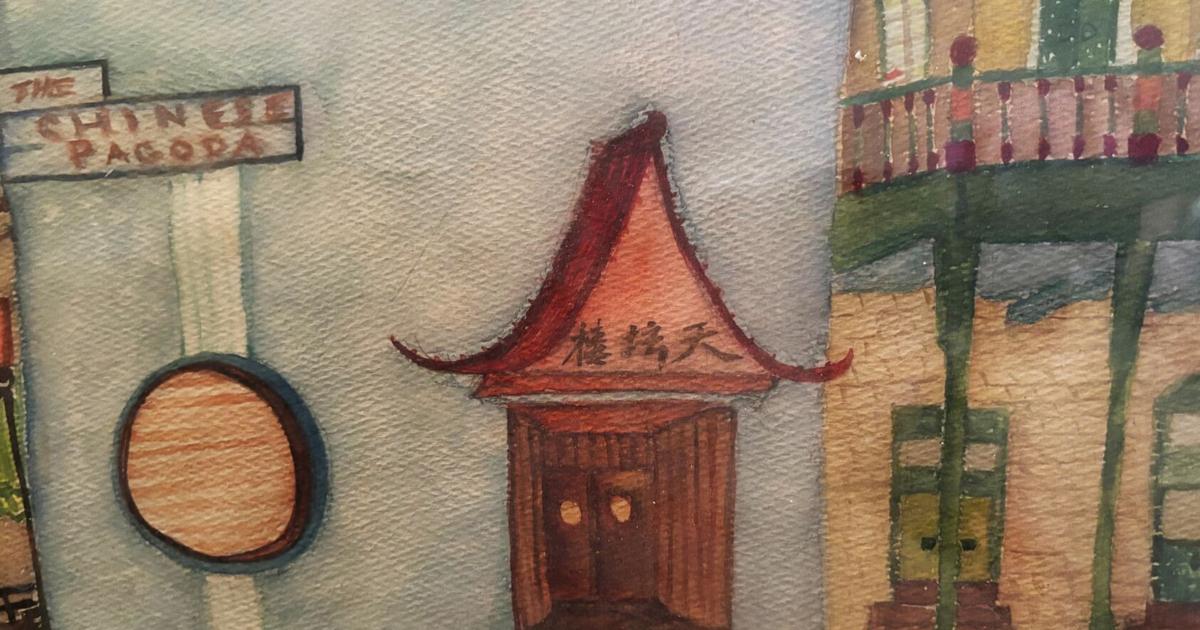
The other day, Steve and I were looking at one of Auntie Harriet’s paintings that hangs in our home. It is a watercolor of my family’s Chinese Pagoda restaurant. I’ve seen it for years. Decades, really. It has always been there, quietly occupying its place on the wall, like a family member who doesn’t have much to say until suddenly she or he does.
Auntie Harriet was the matriarch of our family and one of the most curious people I have ever known. She approached life as if it were an endless classroom. If there was something new to learn, she wanted to learn it.
Fluent in Cantonese and English, languages fascinated her. Over the years she studied Japanese, German, French, and Spanish. She took art classes. She worked with clay. She painted. She read. She explored. Long after many people would have decided they already knew enough, Auntie Harriet remained a student. I often think that curiosity was one of her greatest gifts.
The watercolor hanging in our house was likely painted sometime in the mid 1950s when she was taking lessons from local artist Ralph Powell. The scene captures a version of China Alley that no longer exists.
I can see the old Chu Yee Tong and Sun Lung Jan building standing beside the Chinese Pagoda before my family remodeled the block and created what became the Imperial Dynasty restaurant. Those neighboring buildings appear yellow in her painting, which caught my attention because I have seen evidence that they were painted that color before the stucco and brick facades of the remodel covered them.
But that wasn’t what I was wondering about, it was the Chinese Pagoda itself. Auntie Harriet painted it blue. Not peach. Not tan. Not the familiar stucco color that generations of Hanford residents remember.
I stared at the painting. Had the building really been blue? How had I never wondered about this before? The photographs from that era are mostly black and white, offering no clues. The people who would have known are gone. There is no one left to casually ask across a kitchen table.
Was Auntie Harriet faithfully recording what she saw? Or was she exercising an artist’s privilege and painting the building the color she wished it had been? I honestly don’t know.
Perhaps that uncertainty is what makes the painting so fascinating to me now. Those of us involved in historic preservation spend a great deal of time searching for facts. We look for photographs, newspaper articles, building permits, oral histories, and maps. We try to reconstruct the past as accurately as possible. But every so often we encounter something that doesn’t provide an answer. Instead, it gives us a question. Auntie Harriet’s watercolor poses one of those questions.
It reminds me that history is not only found in official records. Sometimes it survives in a painting tucked away on a wall. Sometimes it hides inside a memory. Sometimes it arrives decades later disguised as a shade of blue. Whether or not the Chinese Pagoda was actually blue may remain a mystery.
What I know for certain is that every time I look at that painting now, I see more than a building. I see Auntie Harriet herself, a woman who never stopped learning, never stopped observing, and never stopped looking at the world with curiosity.
Perhaps that is her final lesson to me. No matter how familiar a place may seem, there is always something left to discover. Even in your own family’s story. Sometimes that discovery begins with a simple question.
Was the Chinese Pagoda really blue?
In honor of Auntie Harriet’s lifelong willingness to try something new I’m sharing a recipe that I discovered several summers ago when I was trying out fresh ways to use all of our garden’s zucchini. This zucchini butter spaghetti from Smitten Kitchen transforms a humble summer vegetable into something unexpectedly wonderful.
Arianne Wing is the author of three books, “Disturbing the Dust” the most recent, and co-operator of the L.T. Sue Tea Room and Emporium, benefiting the restoration and preservation of China Alley. She may be reached at ariannewing@gmail.com