
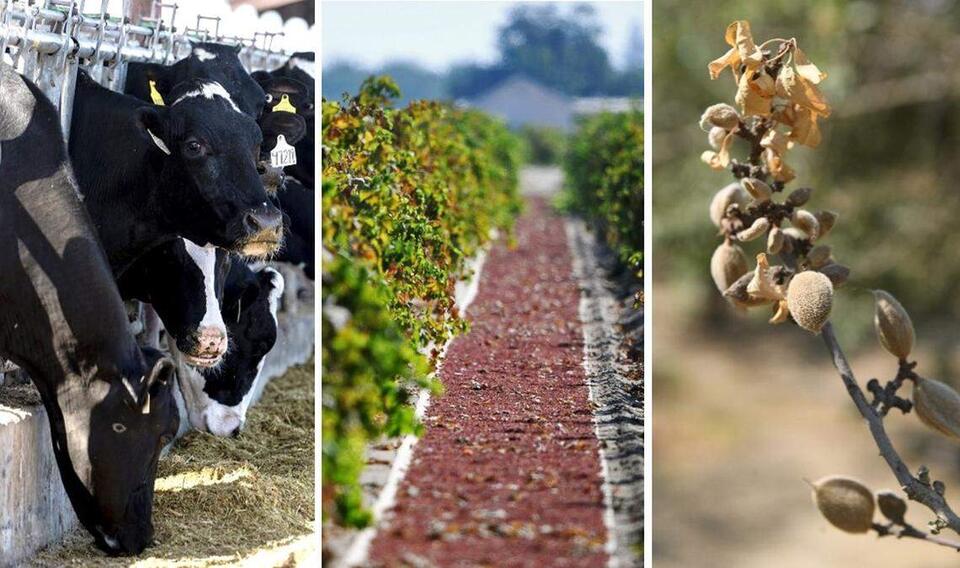
Rebounding crop prices and an adequate water supply helped pushed Fresno County’s agriculture industry into the number one spot in California with a record-setting production value of $9 billion in 2024.
The county’s total production value rose 5.7% from 2023, putting it ahead of Tulare County at a total value of $8.3 billion and Kern County at $7.9 billion .
Fresno County’s Agricultural Commissioner Melissa Cregan delivered the news to the Board of Supervisors Tuesday as part of her annual presentation of the crop and livestock report. This year’s report also recognized the industry’s farmworkers.
“Without them, we would not be able to achieve the level of agriculture production that we have here in Fresno County that feeds the world,” she said.
In a supplemental economic report, Cregan noted that the county’s agricultural contribution to the local economy was $21.6 billion and it generated 108,034 agriculture-related jobs.
Cregan attributed Fresno County’s showing to several factors including a rise in the prices of almonds, milk and beef. She added that one of the county’s strengths is the diversity of what is grown in the region.
“There are approximately 200 different commodities, 82 of which have a gross value in excess of $1 million, and Fresno County continues to supply the highest quality food and fiber nationwide and abroad,” she said.
Fresno County’s farmers export 96 unique commodities to more than 91 countries with the top five export destinations being Mexico, Republic of Korea, Canada, Taiwan and Japan.
Supervisor Buddy Mendes, a longtime farmer, joked that the rise in almond prices wasn’t as spectacular as the numbers indicate. Almonds was the county’s top crop with a gross value at $1.4 billion.
“I’ll make this a little simpler … the price went from really s—– to just kind of s—–,” Mendes said.
Supervisor Brian Pacheco, the only other farmer on the board, said that as a dairy operator he had one of the best years in recent memory.
Supervisor Garry Bredefeld asked Cregan if the growing number of solar farms in the county is hurting agriculture by taking up usable farmland.
Cregan said solar farms aren’t the problem — it’s the availability of water.
“If we had all the water we needed, I would probably be against adding solar farms,” she said. “But we know that is not the case. I think a lot of our family farmers are actually able to stay in business because this is another source of revenue that they are able to bring in on land that they don’t have the water to farm.”
Ryan Jacobsen, executive director of the Fresno County Farm Bureau, thanked Cregan and her staff for compiling the report and highlighting the accomplishments of the region’s farmers and workers.
“Every farm, no matter how large or small, plays a vital role in supporting our community, our nation and our world,” Jacobsen said. “As you know, California grows more than a third of the nation’s vegetables and three quarters of the fruits and nuts, and a significant portion of those are grown right here in Fresno County.”