
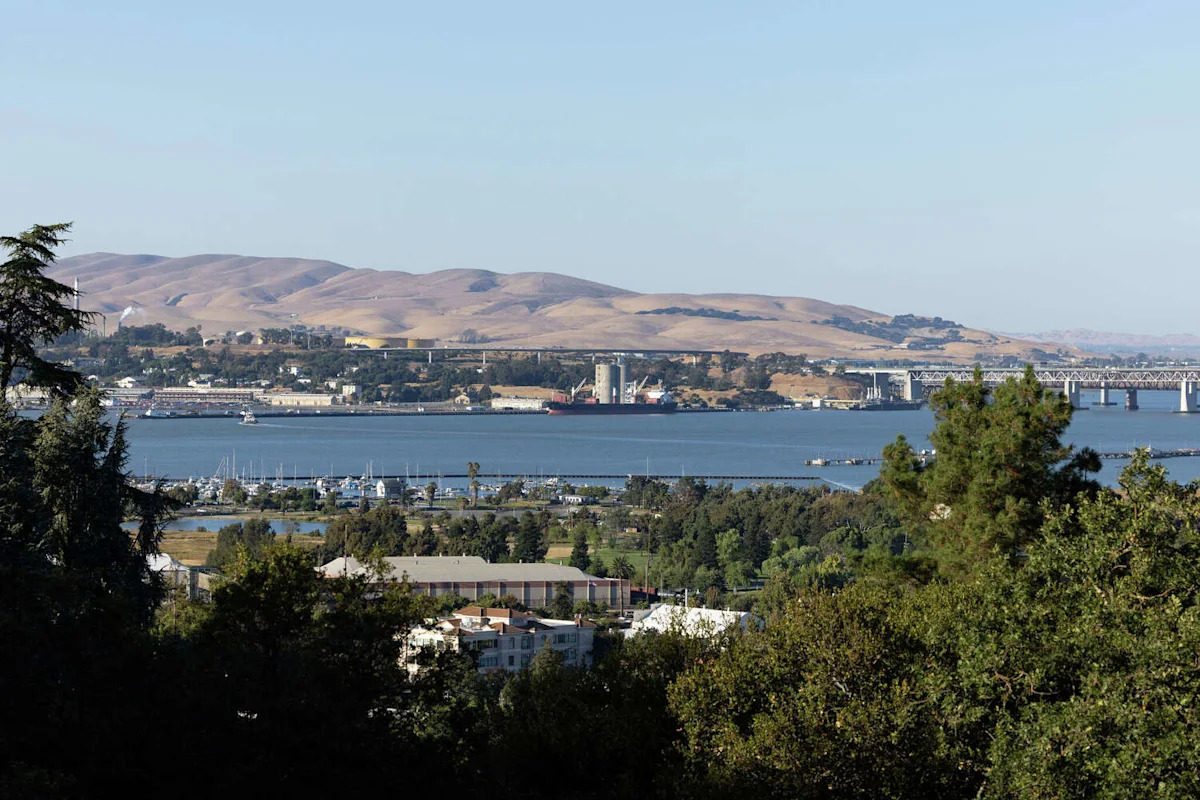
An undersea cable that provides 40% of San Francisco’s electricity is offline for most of the summer.
Since 2010, the Trans Bay Cable has delivered energy across the bay from Pittsburg into San Francisco – the result of efforts to improve electricity reliability in San Francisco after the entire city lost power in a 1998 outage.
But in recent years, underwater erosion has exposed parts of the buried 53-mile-long cable on the bay floor, leaving it susceptible to damage, according to the company. In some places, the cable had dropped as much as 15 feet from its original burial depth, a consultant for the company said at a public permitting meeting. Repairing it involves installing new protective sleeves and 9- to 12-inch-thick concrete coverings on top of the cable to rebury it.
The cable was de-energized on July 6 and will remain off until Aug. 28 for work, according to a spokesperson for NextEra Energy Transmission, the cable’s parent company.
A spokesperson for the California Independent System Operator, the state’s grid operator, said the maintenance is not expected to affect San Francisco customers, though the spokesperson declined to say how the power would be rerouted, citing security concerns. While California’s statewide energy demand soars in the summer due to air conditioning use, demand in San Francisco stays relatively stable throughout the year, according to data from the California Energy Commission.
San Francisco hasn’t had a power plant within city limits since 2010, so it gets its electricity largely from elsewhere. Pacific Gas and Electric Co. owns several underground transmission lines running from the Peninsula to San Francisco, and the San Francisco Public Utilities Commission operates 160 miles of transmission lines to bring clean energy from Hetch Hetchy all the way to the city. Solar panels within the city also generate electricity (when the fog allows).
The Trans Bay Cable came about specifically to address concerns that San Francisco could not keep up with its growing energy demands.
In December 1998, a mistake during maintenance at a PG&E substation in San Mateo triggered cascading failures that eventually knocked out power to the entire city and some nearby Peninsula communities for several hours.
That blackout sparked outrage and caused the grid operator to recommend San Francisco, PG&E and state energy regulators study how San Francisco could increase the reliability of its electrical system.
Finding the space to build a new power plant in the city was unlikely, the study concluded. But importing more energy through new transmission lines was far more feasible. One of the lines would travel up the Peninsula from San Mateo to Brisbane, and another would run underwater through the Carquinez Strait and San Pablo Bay and across to San Francisco.
Without it, a 2005 report concluded, San Francisco and the Peninsula would not have been able to reliably meet projected electricity demand past 2018.
Though owned and operated as its own transmission-only utility, the Trans Bay Cable connects a PG&E transmission line in Pittsburg to the Potrero substation on San Francisco’s eastern shore. It’s capable of delivering 400 megawatts of power – roughly enough for 300,000 households. But storms and even ship traffic overhead can shift the sands on which the cable rests.
A spokesperson for NextEra said the maintenance on the cable would “ensure continued reliable electric service to San Francisco and the surrounding area.”
The San Francisco Public Utilities Commission’s operations will not be impacted by the outage, according to a spokesperson. PG&E has also not seen any impact to customers or to the grid since the outage started, spokesperson Matt Nauman said.
Subscribe
There’s more to San Francisco with the Chronicle. Subscribe today for just 25¢.
This article originally published at Undersea cable that provides 40% of San Francisco’s electricity is offline.