
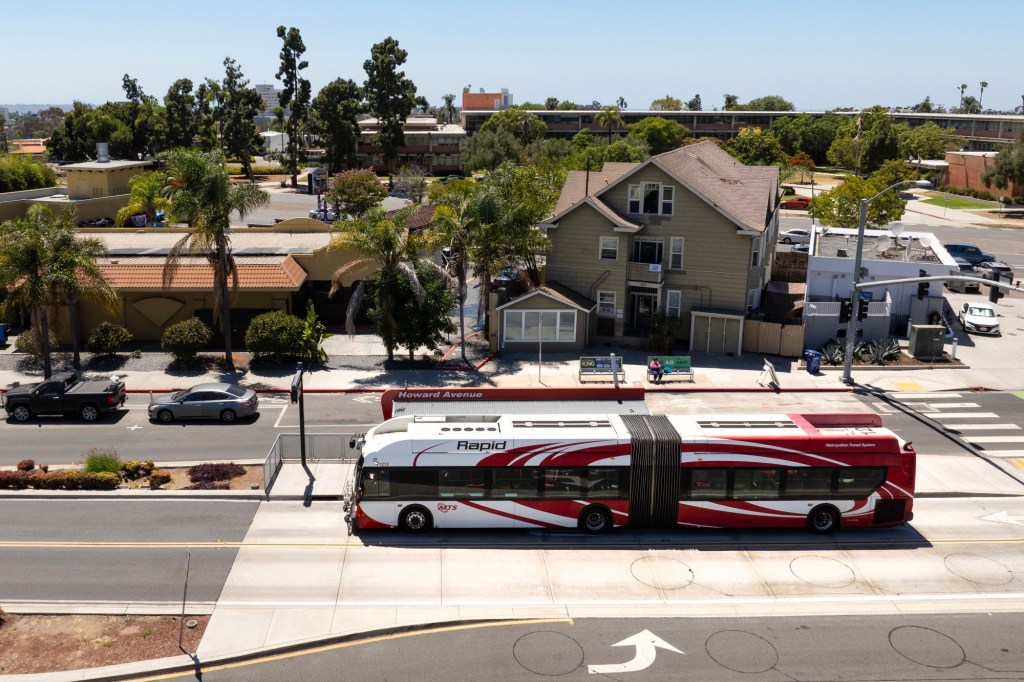
San Diego loves to talk about climate action, equity and building a city where you don’t need a car to live. But if you want to see the gap between our promises and reality, ride Metropolitan Transit System’s Rapid 215.
The 215 is San Diego’s third highest-ridership bus line and the closest thing we have to true rapid transit. It’s a lifeline for the communities of Mid-City, San Diego State University and downtown, running along El Cajon Boulevard through dense, historically underserved communities. It connects people to jobs, school, health care and opportunity. For thousands of riders every day, this isn’t a “nice-to-have.”
And right now, it’s failing many of the people who depend on it most.
The Rapid 215 was supposed to be fast, frequent and reliable. It was envisioned as a corridor that would make transit feel like a real option in a city built around cars. But in practice, the route is still too slow and unpredictable because the most important “rapid” features are incomplete, inconsistent or missing entirely.
What was once envisioned as an approximately 30-minute end-to-end ride now routinely takes over 50 minutes during peak travel times. That difference makes a massive impact on residents’ lives. It’s the difference between making it to class on time or walking in late.
As transit rider Camry Wilkins, a Navy veteran and University of San Diego student who relies on the 215, put it: “The Rapid 215 remains my primary way of getting around San Diego, yet week after week it falls short of its rapid designation. Buses are stuck in traffic, signal priority provides little benefit, and slow boarding turns routine trips into long, unreliable journeys that make it harder for everyday residents to depend on transit.”
The most frustrating part is that this isn’t a mystery because we already know what fixes it.
San Diego leaders should commit publicly to a 30-minute end-to-end peak travel time for the 215, with clear performance targets and accountability. To get there, we need three practical upgrades that many transit agencies across the country already use to make buses faster and more reliable.
— Continuous bus-only lanes: The 215 cannot be rapid if it gets trapped in mixed traffic. San Diego must close every bus-lane gap and restripe the corridor to National Association of City Transportation Officials standards so the 215 runs in continuous, red-painted, 24/7, bus-only lanes. Furthermore, to ensure the buses don’t lose minutes every day to cars treating transit lanes like free parking, the rules for those lanes must be enforced using cameras allowed by state law.
— All-door boarding: This was promised when the route was being planned, and it’s one of the simplest ways to reduce dwell time at stops. UCLA’s Institute for Transportation Studies found that all-door boarding reduced dwell time at stops by an average of 16%, resulting in an end-to-end travel time savings of about 5 minutes on Route 720 in Los Angeles.
— Transit signal priority at every intersection: Not partial. Not inconsistent. Not “sometimes.” Transit signal priority needs to be expanded to all intersections that don’t have it and made always active and truly preemptive, so buses don’t sit through full signal cycles while riders watch the minutes slip away. Studies show it can cut overall travel times by around 15% and reduce intersection delays by up to 50%, often eliminating 10 to 15 signal stops on longer routes.
These improvements are not radical. They’ve been proven around the world. And they are exactly the kind of low-cost, high-impact investments that advance San Diego’s climate goals, equity commitments and Vision Zero priorities all at once.
It is unacceptable and inequitable that a so-called “Rapid” bus sits through red light after red light while long lines of single-occupancy vehicles are given priority to turn. Yet this is reality for riders on the Rapid 215.
If San Diego is serious about building a city where you don’t need a car to survive, then finishing the Rapid 215 is one of the clearest, most immediate ways to prove it.
The 215 doesn’t need more studies. It needs the promise kept.
Gupta is a high school student and safe streets advocate involved in local transportation and climate advocacy in San Diego.