
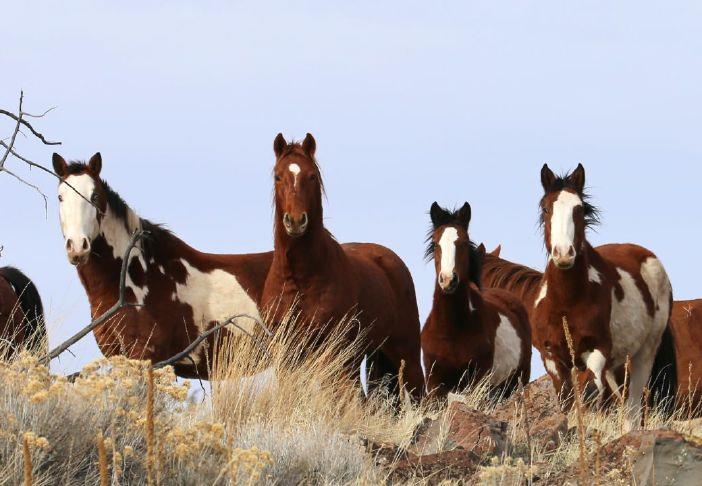
Judge blocks N. California wild horse round-ups
Published 8:30 am Monday, July 13, 2026
A federal judge has blocked the U.S. Bureau of Land Management from gathering and removing about 850 wild horses from public lands in Northern California and adjacent parts of Nevada.
U.S. District Judge William Shubb in Sacramento has agreed with horse advocates that BLM likely violated administrative law in approving the round-ups, which were scheduled to occur in September.
The horses are freely roaming on 196,181 acres of public and private lands along the California-Nevada border.
Last year, two nonprofit organizations — Carter Reservoir Mustangs and Wild Horse Education — were joined by several individual horse supporters in challenging the BLM’s proposal.
“BLM did not establish the necessity for removal of wild horses as the evidence provided to the public does not indicate range conditions are being threatened by wild horses nor does it indicate that removal of wild horses will further BLM’s obligation to maintain a thriving natural ecological balance,” according to the lawsuit.
Now, the judge has ruled that the plaintiffs are likely to prevail in their claims that BLM planned to remove wild horses based on “incorrect assumptions” about the growth rates of their populations in three herd management areas.
Email newsletter signup

The agency estimated wild horse populations on the “unsupported” assumption that herds are increasing by about 20% a year , but its own “environmental assessment” acknowledged that the actual growth rate was significantly lower or negative over the past 15 years, the judge said.
Federal courts cannot “automatically defer” to federal agencies in evaluating whether their plans comply with the Administrative Procedure Act, particularly if those conclusions run counter to the evidence, according to the ruling.
“Because BLM has failed to consider the actual growth rates of the horse populations at issue, the court must conclude that BLM has acted arbitrarily and capriciously in violation of the APA,” the judge said.
The judge has further determined the round-ups would irreparably harm the plaintiffs, who argued the removals would jeopardize the herds by “bottlenecking” their genetic diversity, among other alleged harms.
According to BLM, halting the round-ups could result in “large numbers of excess wild horses” by fall at a time when water is “extremely limited,” which could cause “dehydration and declining body condition” as well as injuries from fighting as they compete for water.
While the BLM claimed that overpopulations could also lead to “extensive trampling” and other resource damage, the judge said that “post-hoc rationalizations” don’t supersede the public interest.
These factors weigh in favor of a preliminary injunction against the horse removals, but the quicker the BLM complies with administrative law, “the sooner it will be able to execute its planned gather,” the judge said.