
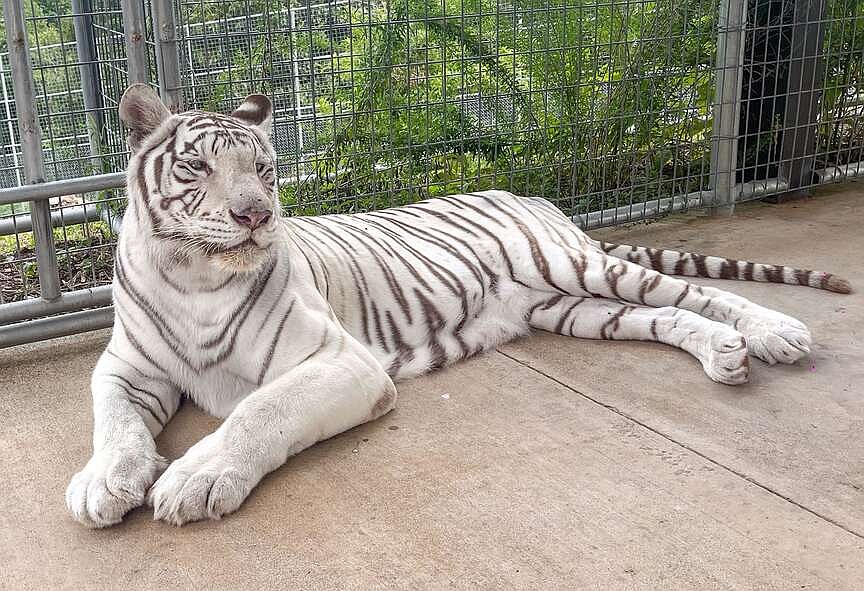
EUREKA SPRINGS — A ninth big cat related to a California restricted-species case has been relocated to Turpentine Creek Wildlife Refuge near Eureka Springs, according to the refuge and its partners.
White tiger Zuri was brought to the refuge on July 8 and is now settling into her habitat, where she’ll receive veterinary care, individualized attention and lifelong sanctuary, according to a news release from Turpentine Creek spokesperson Cheryl King. The tiger’s relocation was performed in partnership with the Oakland Zoo.
People for the Ethical Treatment of Animals was involved in the effort to remove the tiger and others from a roadside zoo, according to a news release from that organization.
Zuri suffers from “significant visual impairment caused by inbreeding,” the PETA release states.
According to a separate release from the Oakland Zoo, white tigers result from a rare genetic mutation called leucism. Breeding these tigers involves pairing two individuals with recessive genes to produce white-coated offspring. However, in these breeding programs, the animals are commonly related, leading to inbreeding that can cause myriad health issues, including blindness, the zoo reported.
The tiger and three others were bred by various seedy dealers, including Mario Tabraue, who was seen in the Tiger King docuseries on Netflix, according to PETA.
“They were acquired by the innocuously named Barry R. Kirshner Wildlife Foundation, a former Oroville, California, facility that held the distinct dishonor of being named ‘The Worst Roadside Zoo in America’ by PETA,” the PETA release states.
There the animals were housed in tiny, chain-link cages and started suffering from a variety of health conditions, according to PETA.
The group then filed complaints with the U.S. Department of Agriculture, California Division of Occupational Safety and Health, and California Department of Fish and Wildlife.
“Kirshner racked up citations and fines, and PETA’s complaints prompted a criminal investigation and state-led shutdown in 2025,” the release states.
Five of Kirshner’s tigers were transferred to a private owner in Rio Vista, Calif., but that person later contacted the Oakland Zoo to surrender them, according to PETA.
Eight others related to the case were brought to the refuge in 2025, according to Turpentine Creek officials. While those animals arrived at the refuge last year, Zuri remained in temporary care until permanent placement could be arranged, the Turpentine Creek release states.
“Every rescue reminds us that protecting captive wildlife is truly a team effort,” Turpentine Creek Wildlife Refuge Founder and President Tanya Smith said. “Accredited sanctuaries and zoos each bring unique strengths to these rescues, and together we’re able to accomplish far more than any one organization could alone. We’re grateful to Oakland Zoo for their partnership and honored that Zuri’s journey has led her to Turpentine Creek.”
Over the coming weeks, Turpentine Creek’s veterinary and animal care teams will allow Zuri time to acclimate before conducting a comprehensive veterinary examination, the release states. Animal care staff are aware she has vision impairment and some muscle atrophy. Following her evaluation, the team will develop an individualized medical and husbandry plan to support her long-term health, mobility, and well-being.
“For Zuri, the rescue didn’t end when the transport trailer arrived,” Smith added. “That’s where her new life begins. After years of uncertainty, she finally has what every rescued animal deserves — a safe, permanent home where she can simply be a tiger.”
The Oakland Zoo announced the placement of four other tigers related to the case last week.
“Projects like this remind us that animal welfare is profoundly personal, and one of the most meaningful things we can do is change the life of one individual,” Oakland Zoo Zoological Manager Amy Phelps said. “These tigers have been given a future with greater stability, greater opportunity, and greater peace. That didn’t happen by chance. It happened because each of you chose to give our skills, compassion, and commitment to something larger than Oakland Zoo.”
The zoo reported it has received more than 250 requests from wildlife agencies, advocacy groups and animal rescue organizations for assistance with rescue operations since 2021. These efforts aim to support victims of the wildlife pet trade, roadside zoos and other forms of trafficking.
“The current tiger cases are not an isolated effort; they are part of a sustained, mission-driven response to wildlife exploitation and trafficking,” Oakland Zoo Director of Animal Welfare and Research Darren Minier said. “Through direct rescue operations, partnerships with accredited zoos and sanctuaries, engagement in wildlife policy, and public education, Oakland Zoo continues to advocate for higher standards of care and stronger protections for captive wildlife.”