
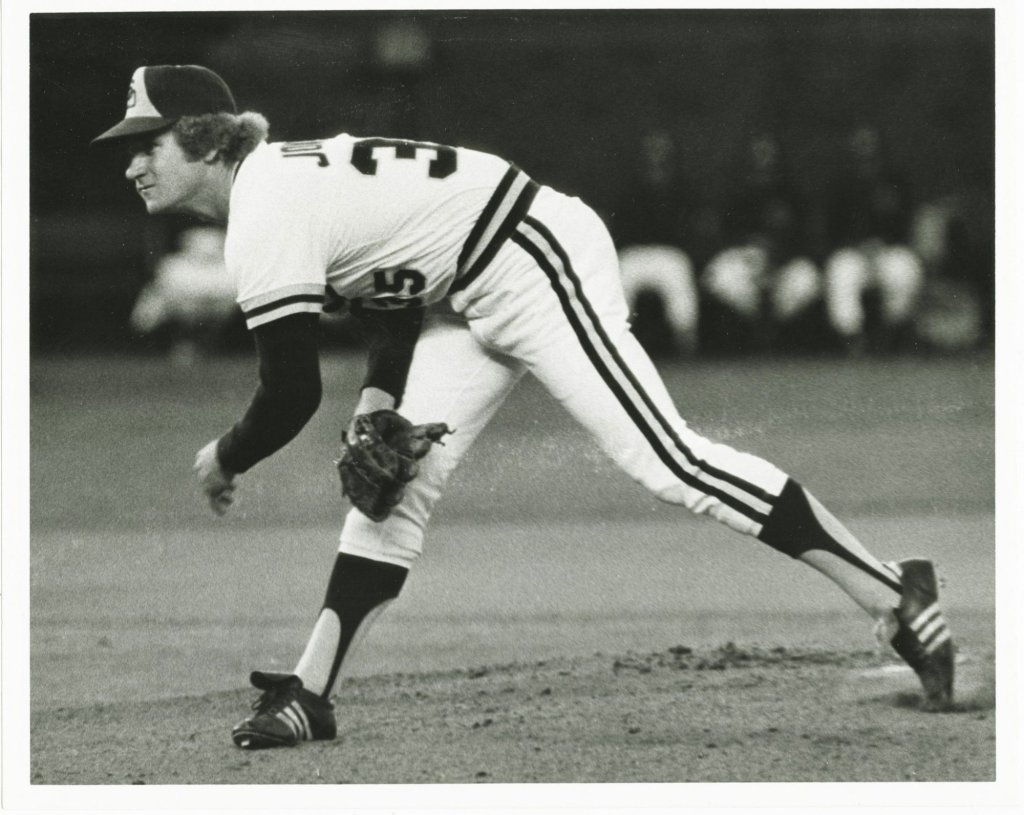
Philadelphia hosting Tuesday’s All-Star Game is appropriate as the nation celebrates its 250th birthday.
After all, the city hosted the original all-stars in 1776, when those attending the Continental Congress adopted the Declaration of Independence.
As big as this year’s observance has been, nothing compares to the bicentennial celebration in 1976.
That year, Philadelphia hosted the All-Star Game — as well as the NBA and NHL All-Star games and NCAA men’s basketball championship.
There were an estimated 30,000 residents in Philadelphia in 1776, making it the most populous city in the colonies back in the day. More than twice that many people filled Veterans Stadium for the 1976 All-Star Game, where they watched a little left-hander from the Padres put the franchise on the national map for the first time.
Randy Jones started and got the win for the National League in its 7-1 win over the American League. Jones had picked up a save in the 1975 All-Star Game and remains the only pitcher in history with a win and a save in back-to-back All-Star Games.
Each major league team is guaranteed a player on the All-Star team, which is pretty much why the Padres received a representative during their first seven years of existence.
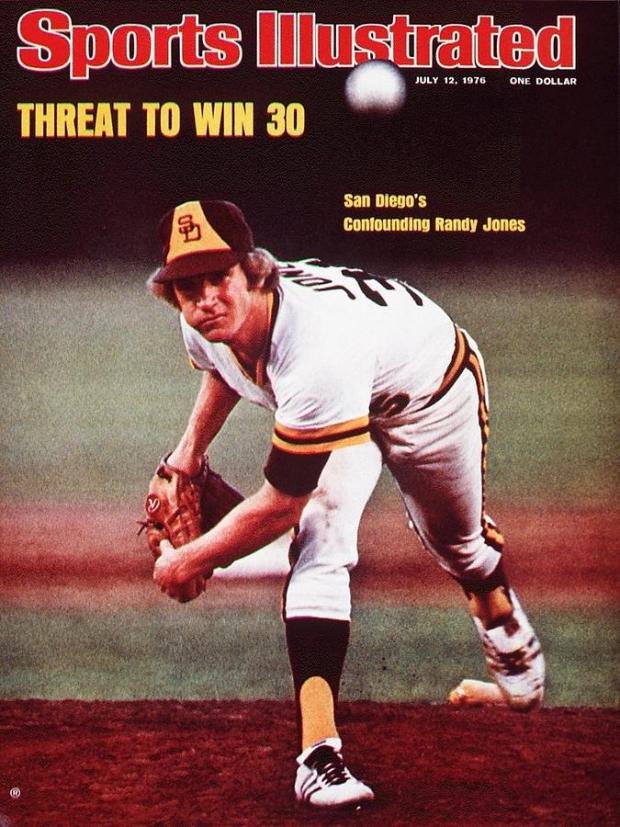 Randy Jones made the cover of Sports Illustrated in 1976. (Sports Illustrated)
‘Threat to win 30’
Jones was the first Padres player to start an All-Star Game, and he earned it with a first half that landed him on the cover of Sports Illustrated (another Padres first) the day before the midsummer classic. Jones was pictured following through on a pitch to the plate, beneath the headline “Threat to Win 30.” The subhead read: “San Diego’s confounding Randy Jones.”
That, he was.
Jones couldn’t break the proverbial pane of glass with his fastball
Jones more than made up for it with an assortment of effective breaking pitches, most notably a sinkerball that hitters beat into the ground for outs.
After becoming the Padres’ first 20-game winner in 1975 and finishing second to the Mets’ Tom Seaver in voting for the NL Cy Young Award, Jones was even better in 1976.
He arrived at the break with a 16-3 record, something no pitcher has done before or since, along with a 2.53 ERA. Jones tossed 15 complete games in his 21 starts. His work included a stretch of 68 innings without allowing a walk, tying a 63-year-old NL record set by Christy Mathewson.
Jones earned his 16th victory five days before the All-Star Game with a 6-3 win over the Cubs at Wrigley Field.
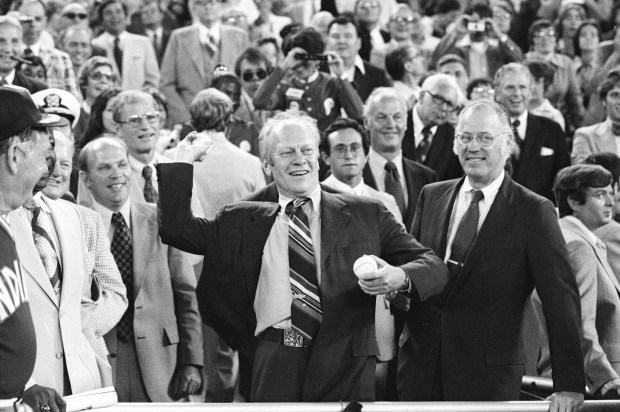 In this July 13, 1976, file photo, President Gerald Ford throws the ceremonial first pitch to start the Baseball All-Star game in Philadelphia. At right is Baseball Commissioner Bowie Kuhn. (AP Photo)
All-Star starter
“I would like to start the All-Star Game,” Jones told reporters afterwards. “I think I’ve earned that honor, but I’ll try not to be disappointed if I don’t.”
Starting the curly-haired left-hander was a no-brainer for Reds manager Sparky Anderson, who guided the NL squad.
Opposing Jones was Detroit Tigers phenom Mark “The Bird” Fidrych, a colorful rookie known for talking to the baseball and doing his own grooming on the mound. Fidrych was not called up to the majors until mid-May, but used an eight-game winning streak to reach the break with a 9-2 record and 1.78 ERA.
A Veterans Stadium crowd of 63,974 watched ambidextrous President Gerald Ford throw out the first pitch — twice. He threw a ball right-handed to NL catcher Johnny Bench of the Reds, then threw one left-handed to AL catcher Thurman Munson of the Yankees.
Ford met Jones before the game while visiting the NL clubhouse. The president showed some knowledge of the left-hander, referencing the pitcher tying Mathewson’s record.
“Sixty-eight innings without a walk — that was something,” Ford said.
Jones smiled and said, “It kind of snuck up on me.”
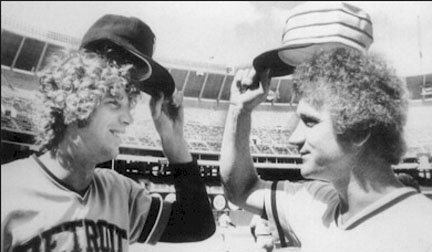 The Tigers’ Mark Fidrych and the Padres’ Randy Jones were the starting pitchers for the 1976 All-Star Game.(Associated Press)
Mowing them down
Detroit’s Ron LeFlore led off the game with a single, but Jones coaxed Rod Carew to hit a double-play ground ball. Jones then walked Kansas City’s George Brett on four pitches.
“A couple of the pitches were close,” Jones said. “They could have gone either way. But the walk helped settle me down. After that, it was all over. I smoothed out my delivery. It was my usual game.”
Jones got out of the first inning on a groundout by Munson.
In the second inning, Jones gave up a two-out single to Detroit’s Rusty Staub before ending the inning when Baltimore’s Bobby Grich grounded out.
Jones pitched a 1-2-3 third inning, sandwiching LeFlore’s strikeout around groundouts by Kansas City’s Hal McRae and Carew.
Seven of the nine outs Jones got were recorded on groundouts. He needed only 37 pitches to get through the three innings.
“I just pitched my normal game,” Jones said. “I got ’em out and they didn’t score any runs.”
Jones had been staked to a 2-0 lead in the first inning, with the Dodgers’ Steve Garvey and Cincinnati’s George Foster driving in runs off Fidrych.
It was 4-0 by the time Seaver replaced Jones in the fourth, the NL doubling its lead in the bottom of the third on Foster’s two-run homer off the Yankees’ Catfish Hunter.
Fred Lynn hit a solo homer off Seaver in the fourth, but that was the only run for the AL. A three-run eighth capped the scoring for the NL, which was in a stretch of dominance that included 23 wins in 26 games.
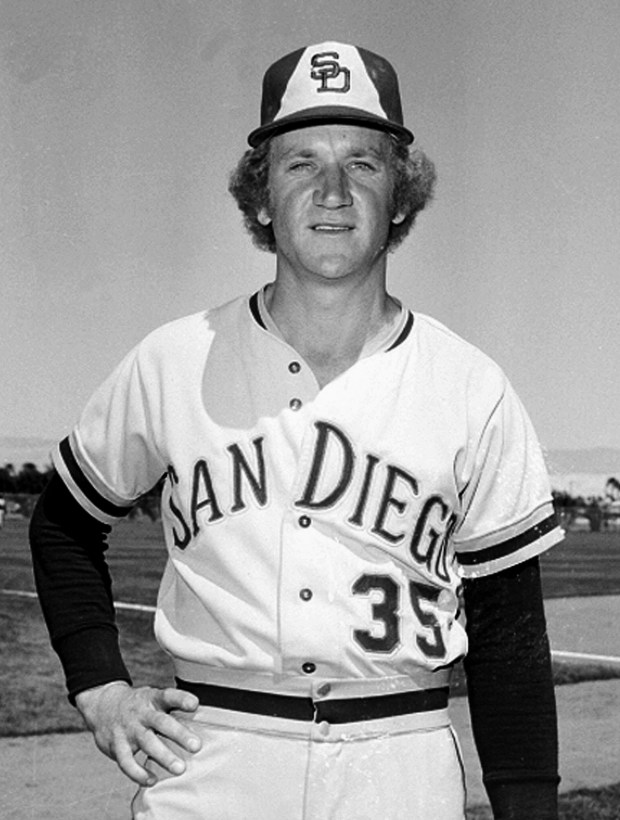 FILE – San Diego Padres pitcher Randy Jones poses for a photo on March 1976. (AP Photo/WF, File)
NL Cy Young winner
Jones was not as successful in the second half of the season, winning only six of 17 decisions to finish with a 22-14 record and a 2.74 ERA. Lack of run support was much of the problem: the Padres scored two runs or fewer in seven of Jones’ second-half losses.
He was still a heavy favorite for the 1976 NL Cy Young Award after leading the league in wins (22), starts (40), complete games (25) and innings pitched (315 1/3).
Jones received 15 of 24 first-place votes to outdistance the Mets’ Jerry Koosman and become the Padres’ first Cy Young winner.
“It’s like a boyhood dream come true,” Jones said after the announcement. “It shows I am for real. When you achieve your boyhood dream, it’s an incredible thrill.”
Years later, Jones said, “My proudest thing was in the ’70s putting the franchise on the map.”