
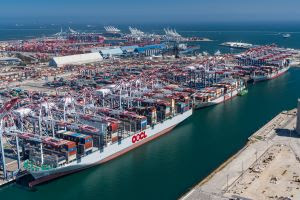
Cargo at the Port of Long Beach is surging, officials said on Tuesday, July 14 — and it’s a trend that could continue through the rest of this year.
The port reported a 10.6% cargo increase in June compared to the same month in 2025, making it the third busiest June in the port’s history, even amid the ongoing uncertainty around tariffs, inflation and global trade.
The Port of Los Angeles, which also indicated it will have strong showings for June, will release its latest numbers on Wednesday, July 15.
Among the drivers, said Port of Long Beach Noel Hacegaba, is a potentially lasting shift in the pattern for holiday-seasonal goods, which typically surged during the summer months. Now, he said in his monthly virtual news conference, amid long-lasting uncertainty in global trade shifts, trade patterns have taken on a more consistent routine as a precaution for what may lie ahead.
In June, he said, the port moved nearly 800,000 cargo units for the second month in a row.
The Trump administration, Hacegaba said, “has created a new normal,” though questions remain over the temporary 10% tariffs that are set to automatically be repealed on July 24, with no word yet on whether there will be another tariff imposed by the administration.
It’s all given rise to the supply chain anticipating a “worst-case scenario,” he said. The ongoing response has been to continue shipping products early to make sure retail shelves are full as the fall and winter holidays approach.
Hacegaba said he also anticipates this could be part of a longer, overall shift that is here to stay for some time.
What has long been regarded as “peak season” for holiday goods arriving at U.S. ports — generally through the mid- to late-summer and even early fall months — appears to be morphing into a much longer ongoing period, Hacegaba said.
In July, the National Retail Federation also reported that an import cargo surge was expected to continue throughout the month at U.S. ports as retailers stock up ahead of expected August tariff increases.
Overall, Hacegaba said, businesses are “preparing for volatility, not certainty.”
“Peak season is no longer a season,” he said. “It’s a year-long strategy” that could make the former rules about a peak season obsolete.
“The holiday season has already started,” he added, with cargo front-loading ongoing and retailers stocking shelves now for the fall and winter seasons to come.
But seasonal goods are also already leveling off a bit, Hacegaba said, with year-round demand becoming steadier for supplies for data centers and other tech items ticking upward.
“We’ve noticed that trend,” he said, “and we are assessing those goods entering the U.S. market sooner.”
The overall trend, Hacegaba added, seems to be for yearlong seasonal cargo occurring in “different spurts.”
The front-loading of goods that has been seen in the past two years, Hacegaba said, is resulting in a “series of waves of cargo” that arrive and is being done by shippers to mitigate risk.
“I think this is something we’ll continue to see in the future,” Hacegaba said, “and it’s a strategy that the Port of Long Beach is prepared for. We’re prepared not just for ‘peak season’ but for year-round cargo surges.
“(In) the second half of the year, we’ll continue to see robust (cargo) growth,” he added. “Conventional wisdom a few years ago suggested that when cargo arrives early it slows in the end of the year.”
Rising fuel costs, tariff uncertainty and geopolitical concerns, Hacegaba said, all contributed to expectations for the earlier peak shipping season as companies tried to stay ahead of potential cost increases and avoid delays later in the year.
In June, dockworkers and terminal operators handled 779,331 twenty-foot equivalent units.
Imports accounted for 387,025 TEUs, up 11%, or 348,681, compared to June 2025, while exports were 87,627, down 1.3%.
Overall, based on the May port stats, the Port of Long Beach had processed 4,050,247 TEUs through the first five months of 2026. That was up 0.2% compared to the same period last year, putting the port on pace with its record year in 2025, officials said.