
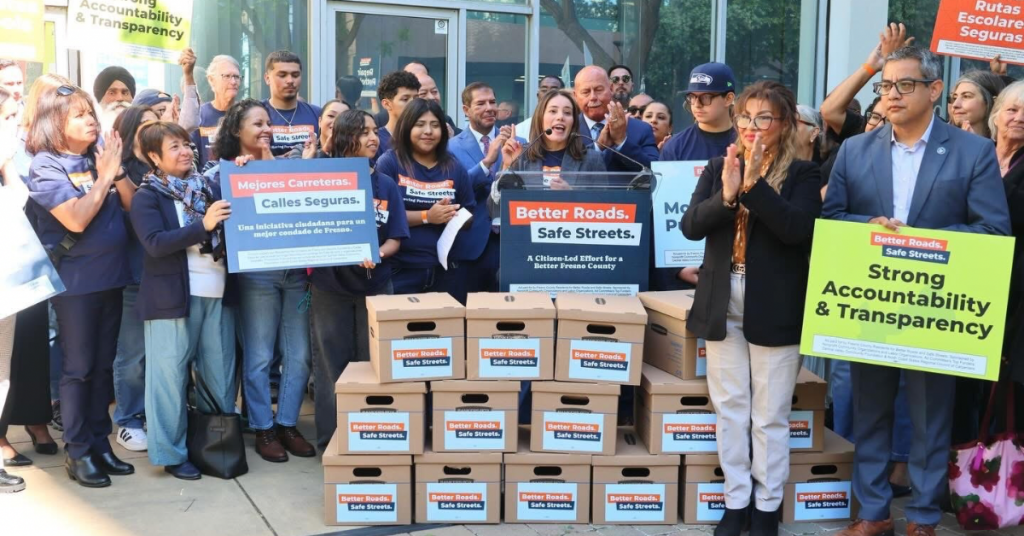
Fresno County voters will likely not have the opportunity to decide on a replacement for Measure C that was submitted by social justice activists.
The Fresno County Board of Supervisors ordered county staff to conduct a study on the Better Roads, Safe Streets initiative on Tuesday, which will prevent it from appearing on the November ballot unless the board speeds up the process.
The backstory: After the Fresno Council of Governments-led Measure C renewal process blew up in large part due to the outsized influence of social justice activists, the Central Valley Community Foundation, Leadership Counsel for Justice and Accountability and other groups collected signatures for a replacement plan, called the Better Roads, Safe Streets initiative.
But the plan failed its random sampling test of signatures in May, leading Fresno County Clerk/Registrar of Voters James Kus to order a manual count of all 32,000 signatures that it submitted.
The county validated enough signatures last week, which brought the initiative before the Board of Supervisors on Tuesday to potentially place on the November ballot.
The big picture: The board voted 3-2 after a hearing that lasted over two hours to order a study on the initiative.
Supervisors Garry Bredefeld, Nathan Magsig and Buddy Mendes voted for the study, while Supervisors Luis Chavez and Brian Pacheco wanted to place the tax before the voters in November.
With the study slated to take 30 days, it would not be ready for the board to consider until after the Aug. 7 deadline to place measures on the November ballot, effectively pushing the initiative to 2028.
The only way for the measure to appear on the November ballot at this point would be if the board called for a special meeting ahead of Aug. 7 to take action.
What they’re saying: Much of the hearing focused on the prescription measures that are included in the initiative.
Magsig noted that while the county would have access to transportation through the initiative – if voters would even approve it – the county needs the study in order to protect itself against any potential litigation that could arise due to the language in the measure.
One point of contention for Magsig is the requirement for pavement quality to be at a certain level before the county can use tax funding to widen roads. Another point was that the measure has language regarding when roads can be improved “when feasible.” Magsig said determining which roads are feasible could lead to litigation.
“I don’t know exactly how the county is going to be able to fully expend its portion,” Magsig said, referring to the litany of prescriptive rules placed in the ballot measure.
On the other hand, Chavez and Pacheco noted that around 90 county employees may have to be laid off since Measure C is expiring next year.
“I want to make sure that folks understand what the consequences of not having this ballot initiative would be out there,” Chavez said.