
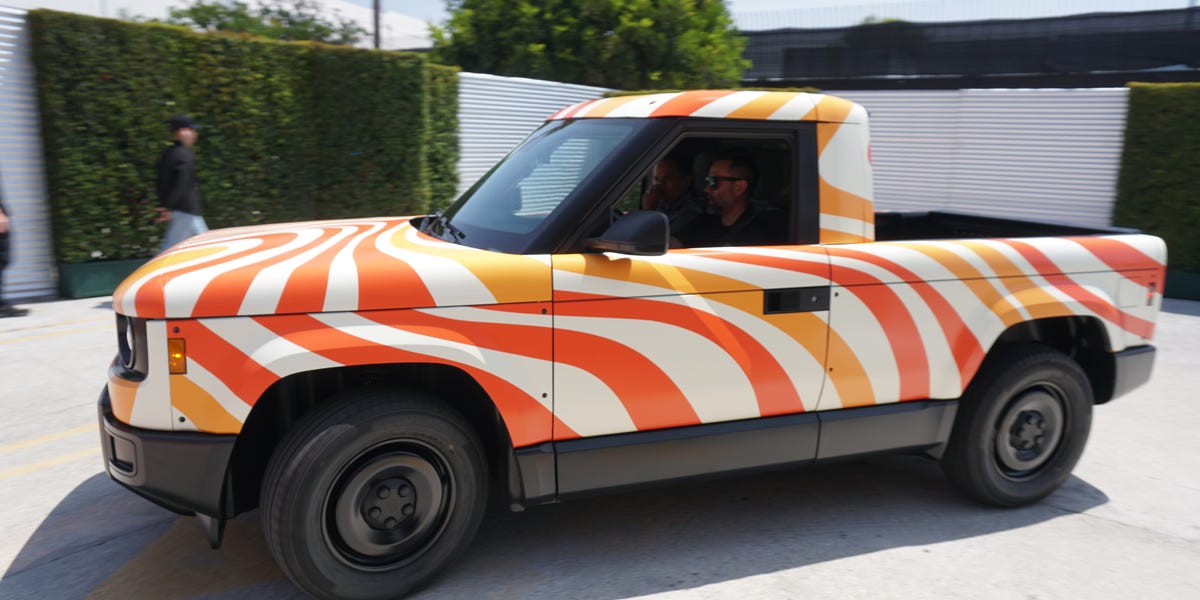
Slate, America’s cheapest EV, cheapest pickup truck, and best at getting its name into the media on a regular basis, finally revealed the number buyers will actually pay to get its electric pickup home: $26,400.
For months it had been circulating a starting price of $24,950, which sounds like a pretty good deal, especially considering that it’s an electric vehicle and the sticker won’t include the now-gone Federal tax credit of $7,500.
But today Slate revealed the destination charge for its truck—$1,450—and since you can’t buy any car, truck, or SUV without paying the destination charge, Slate was essentially announcing the full base price for its EV-pickup. Nonetheless, $26,400 is still a good price.
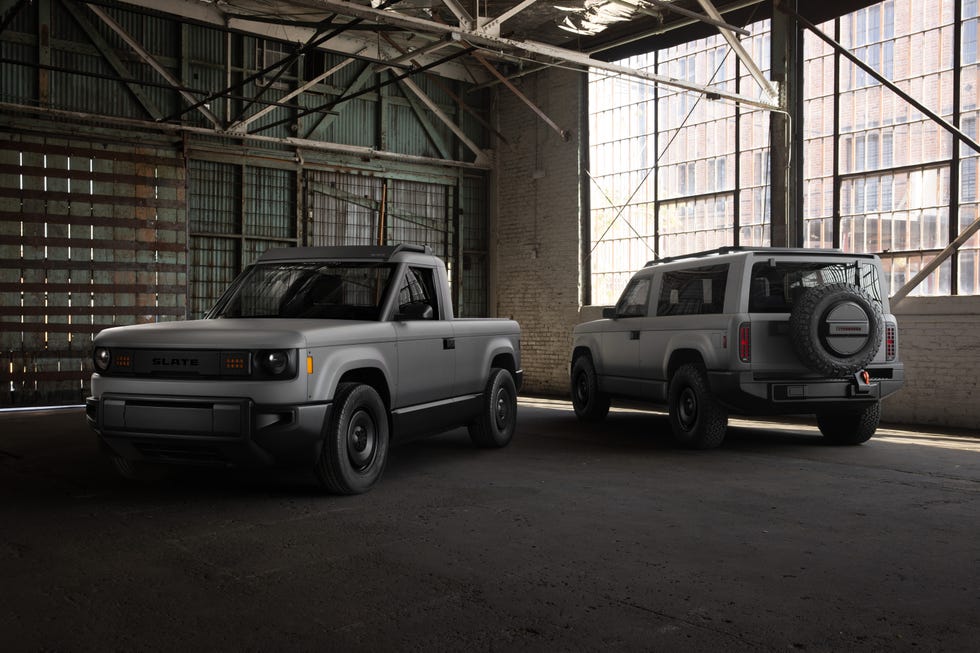 Slate//Autoweek
The Slate pickup and the SUV. No price on the SUV yet.
And in California, where the vast majority of electric cars are sold, you can get $3,500 off. Yes, $3,500. This week, California governor Gavin Newsom signed SB 168, creating the MyFirstEV program. It gives first-time EV buyers a rebate right at the dealership: $3,500 off a new EV and $1,750 off a used one. That makes the entry-level price of a Slate in the state just $22,900. Hard to argue with that.
For comparison’s sake, a Ford Maverick four-door, five-seat pickup with a five-foot bed just like the Slate starts at almost 30k. A Hyundai Santa Cruz is $31,350. A Nissan Frontier is $33,895. And prices go up from there. A Ford Raptor R starts at $114,420.
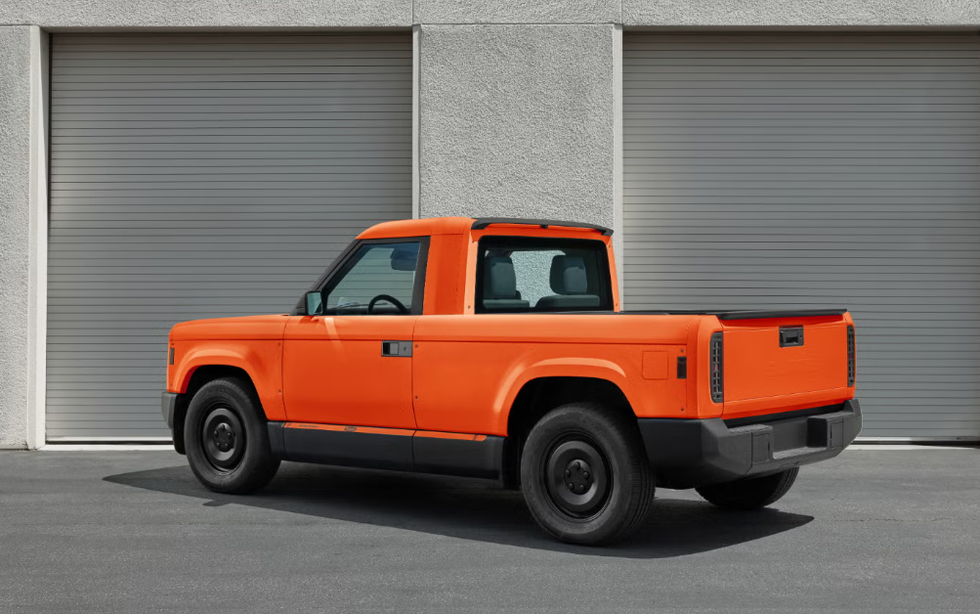 Slate//AutoweekAn official full vinyl wrap kit for the modular Slate Auto electric truck starts at $499.99, according to the build page slate.auto. Because every truck leaves the factory in the exact same unpainted gray composite material, wraps function as the vehicle’s entire color program.
To keep prices down, the so-called Slate Marketplace will offer over 200 accessories, with over 80 percent under $500, Slate said.
Options include roof racks, stereos, zip-off seat covers, and light covers. There will also be over 100 wrap colors at launch, “or any custom color you want,” Slate said. But again, no prices were listed for any of those except the wraps, which are $499.99, not counting professional installation, which is targeted at “$500 or less.”
“Slate gives customers the freedom to buy only what they need today and personalize their vehicle as their needs change tomorrow,” said CEO Peter Faricy, who, along with the pricing and the specs, is also new. “We’re excited to start seeing Slates on roads across America later this year.”
Specifically, Slate said the first deliveries would be in Q4 of this year. The company also claimed there were over 180,000 reservation holders who put down $50 each to keep a place in line. A step up from the $50 “reservation holder” status is now the $300 “preorder.” If you already paid the $50, you only have to add $250 to preorder.
In case you need a Slate update, here are the latest specs:
Range is now listed at 205 miles for a single available LFP battery. Last year there were two batteries with two ranges, 150 and 240 miles. Slate did some math and said the changes amounted to a 37 percent increase.Battery capacity is now listed at 65 kWh. Last year it was a choice of two batteries, 52.7-kWh with a range target of 150 miles; and 84.3 kWh good for 240 miles.Charging is by a NACS port on the left rear corner, making it compatible with the Tesla Supercharger network. It’ll recharge at up to 120 kW there. On a Level 2 home charger, meanwhile, Slate says the 11-kW onboard AC charger will get it to 100 percent in four hours.The tow rating is up from 1,000 to 2,000 lb, which allows you to tow a pair of jet skis.Payload capacity has risen from 1,433 lb to 1,550 lb.The 181-hp electric motor driving the rear wheels will get the 4,048-pound Slate from 0-60 mph in 8.0 seconds. The SUV version weighs 4,335 pounds, but no 0-60 was given.Suspension is MacPherson struts front and De Dion axle in back, same as the Mercedes-Benz electric G-Wagen and the old Mitsubishi iMiEV.
Mark Vaughn grew up in a Ford family and spent many hours holding a trouble light over a straight-six miraculously fed by a single-barrel carburetor while his father cursed the Blue Oval, all its products and everyone who ever worked there. This was his introduction to objective automotive criticism. He started writing for City News Service in Los Angeles, then moved to Europe and became editor of a car magazine called, creatively, Auto. He decided Auto should cover Formula 1, sports prototypes and touring cars—no one stopped him! From there he interviewed with Autoweek at the 1989 Frankfurt motor show and has been with us ever since.