

High cholesterol levels are considered a leading risk factor for heart diseases and strokes across the world. Thus, local institutions are looking to cut it off before it gets out of hand.
In a pair of independent studies, researchers at UC San Diego’s School of Medicine and Sanford Burnham Prebys Discovery Institute evaluated cholesterol from two angles — using a molecular inhibitor to target harmful low-density lipoproteins, or LDL, with a pre-existing treatment and subverting cancerous tumors’ craving for cholesterol.
The mechanism behind cholesterol-clearing
UC San Diego researchers in La Jolla knew going into their latest study that high-cholesterol diets inhibit the ability of the liver — the cholesterol-removing organ — to clear it from the blood. Exactly how that mechanism works was unknown.
The liver breaks cholesterol down through LDL receptors on the surface of liver cells, which means more LDL receptors means more cholesterol cleared from the blood.
The latest study revealed that a certain protein is activated by high cholesterol intake and as a result, makes fewer LDL receptors able to do their job.
“What was interesting is that we found out that high cholesterol in the diet could activate this protein, and then cause the degradation of the receptor that takes cholesterol up into the liver to process it,” explained Alan Saltiel, PhD, professor of medicine at UCSD’s School of Medicine, director of the UCSD/UCLA Diabetes Research Center and the study’s senior author.
Targeting this protein and using a pre-existing molecular inhibitor in mice cells, researchers found in clinical studies that they could both stabilize the LDL receptors and reduce the amount of cholesterol circulating in their bodies.
That molecular inhibitor was originally intended to treat heart failure, but was shelved for what researchers describe as “strategic reasons.” Still, it went through the early stages of drug development and even advanced into a phase 1 clinical trial.
Saltiel says that now they are seriously thinking about resuscitating the once-abandoned drug as a cholesterol-lowering drug, adding that the new pathway they discovered is “completely separate from anything that existing drugs target.”
“Luckily, there’s an experimental drug sitting on the shelf that’s already been shown to be safe in humans,” he explained in a press release from UC San Diego Health. “We hope to test whether this might be effective by conducting a clinical trial — which could potentially bring a new treatment option to patients much sooner than would have been expected.”
The full research team consisted of UC San Diego researchers, in addition to scientists from UC San Francisco, University of Texas Health Science Center at San Antonio and the University of Utah.
The full study is available at nature.com/articles/s41586-026-10697-z.
Cholesterol and cancer cells
A research team made up of scientists at the La Jolla-based Sanford Burnham Prebys and the University of Illinois Chicago, meanwhile, recently explored enzymes that facilitate the movement of cholesterol around cancer cells.
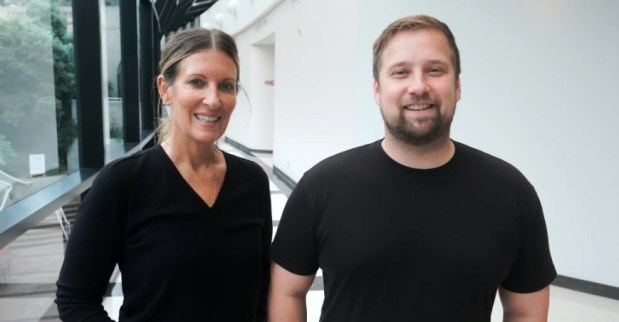 Heading a new Sanford Burnham Prebys Discovery Institute study on cholesterol is senior and corresponding author Brooke Emerling, PhD, director of and associate professor in the Cancer Metabolism and Microenvironment Program at SBP’s NCI-Designated Cancer Center; and lead author Ryan Loughran, PhD, a postdoctoral associate in Emerling’s lab. (Sanford Burnham Prebys)
A recent study found that cancer cells with a mutation in their tumor-suppressing TP53 gene produce extra cholesterol. As a result, a press release stated, “this may make them more vulnerable to starvation if scientists can put a stop to the steady supply of the lipid.”
Brooke Emerling, PhD, director of and associate professor in the Cancer Metabolism and Microenvironment Program at the SBP’s NCI-designated Cancer Center, explained what they knew going in and what they discovered.
“We had known these proteins — these enzymes — were really important for cancers that have this (TP53) mutation,” she explained. “This mutation is one of the most mutant genes in cancers and it’s been very difficult to drug. We’ve discovered when we inhibit or get rid of these enzymes, we can kill or prevent the growth of breast cancer tumors that have these TP53 mutations.”
Ryan Loughran, PhD, a postdoctoral associate in the Emerling lab and lead author of the study, said in a press release that one of their main goals with this study was “to find new treatment possibilities for the large subset of breast cancers harboring TP53 mutations.”
Read the full study at science.org/doi/10.1126/sciadv.aeb8658.